Combating Data Silos: A Unified Analytics Approach for U.S. Enterprises in 2025

A unified analytics approach is crucial for U.S. enterprises in 2025 to dismantle data silos, enabling holistic insights and driving more informed, agile business strategies.
As U.S. enterprises navigate the complexities of 2025, the challenge of combating data silos: a unified analytics approach for U.S. enterprises in 2025 has become paramount. These isolated pockets of information hinder strategic decision-making, operational efficiency, and overall business growth, making a cohesive data strategy indispensable for competitive advantage.
Understanding the Data Silo Phenomenon
Data silos are not merely an IT problem; they represent a fundamental barrier to organizational agility and insight. These isolated data sets, often confined within specific departments or legacy systems, prevent a holistic view of business operations and customer interactions.
In today’s fast-paced digital economy, the inability to access and analyze comprehensive data can lead to missed opportunities, inefficient resource allocation, and a fragmented customer experience. Enterprises in the U.S. are increasingly recognizing that breaking down these silos is not just an option but a strategic imperative for sustained success.
The Genesis of Data Silos
Several factors contribute to the formation of data silos within organizations. Historically, departmental autonomy often led to separate technology investments and data storage practices. Additionally, mergers and acquisitions can introduce disparate systems that are difficult to integrate.
- Departmental Autonomy: Each department invests in solutions tailored to its specific needs, often without considering broader integration.
- Legacy Systems: Outdated technologies may not easily integrate with modern platforms, creating isolated data repositories.
- Mergers and Acquisitions: Combining different organizational structures and IT infrastructures frequently results in data fragmentation.
- Security Concerns: While crucial, overzealous security measures can inadvertently create barriers to data sharing across authorized departments.
Understanding these root causes is the first step toward developing effective strategies for data integration. Without addressing why silos form, any solution will likely be temporary or incomplete. The goal is to foster an environment where data flows freely and securely across the enterprise.
The Strategic Imperative for Unified Analytics
A unified analytics approach transcends mere data integration; it represents a philosophical shift towards treating data as a singular, cohesive asset. This approach enables U.S. enterprises to unlock deeper insights, improve operational efficiency, and drive innovation.
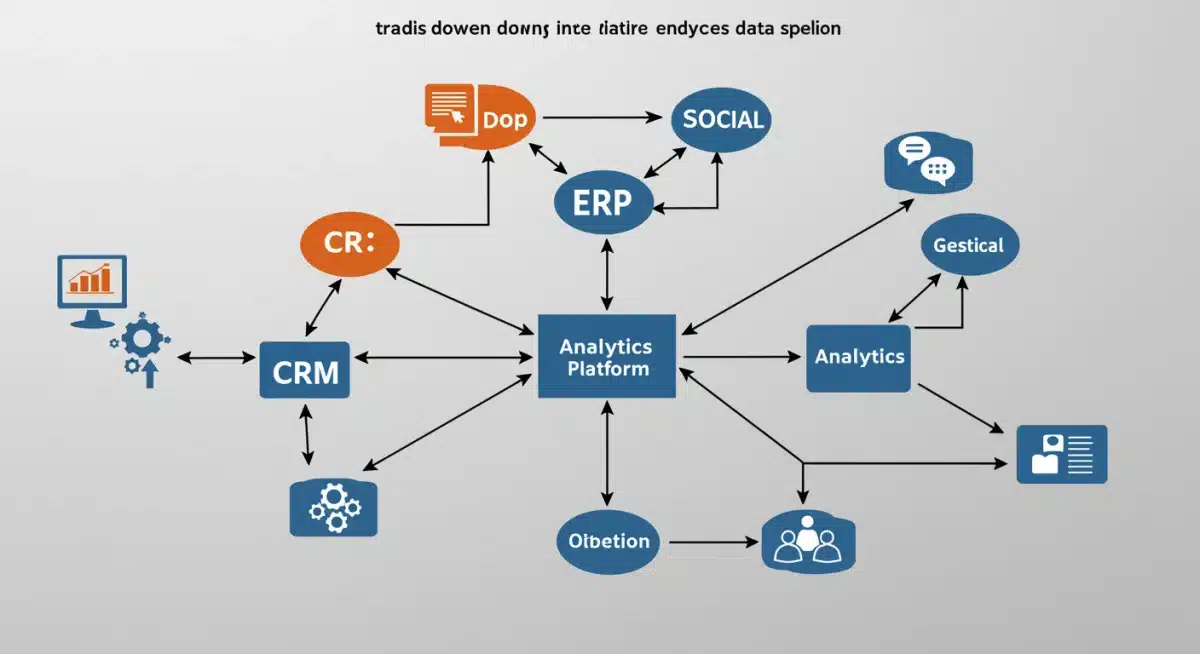
By consolidating data from various sources into a single, accessible platform, organizations can gain a 360-degree view of their business, allowing for more informed and proactive decision-making. This holistic perspective is critical for identifying trends, predicting outcomes, and optimizing performance across all functions.
Benefits of a Unified Analytics Platform
The advantages of implementing a unified analytics platform are manifold, impacting various facets of an enterprise. From enhanced customer understanding to streamlined operations, the ripple effect is profound.
- Enhanced Customer Insights: A complete view of customer interactions across touchpoints leads to personalized experiences and improved retention.
- Improved Operational Efficiency: Identifying bottlenecks and optimizing processes through integrated data analysis.
- Accelerated Innovation: Cross-departmental data sharing fosters new product development and service offerings.
- Better Risk Management: Holistic data allows for more accurate risk assessment and compliance monitoring.
Ultimately, a unified approach empowers enterprises to move beyond reactive problem-solving to proactive strategic planning. It transforms data from a mere record of past events into a powerful tool for shaping future success.
Key Technologies Driving Unified Analytics in 2025
The technological landscape in 2025 offers sophisticated tools and platforms crucial for building a robust unified analytics approach. These technologies are designed to address the complexities of data integration, storage, processing, and analysis at scale.
Cloud-native solutions, advanced AI/ML capabilities, and robust data governance frameworks form the bedrock of successful unified analytics initiatives. Enterprises must carefully evaluate and select technologies that align with their specific needs and strategic objectives.
Cloud-Native Data Platforms
Modern data architectures increasingly leverage cloud-native platforms, offering scalability, flexibility, and cost-effectiveness. These platforms provide the infrastructure necessary to handle vast amounts of data from diverse sources.
The elastic nature of cloud resources means enterprises can scale their analytics capabilities up or down as needed, avoiding significant upfront investments in hardware. Furthermore, cloud providers offer a suite of integrated services that simplify data warehousing, ETL processes, and advanced analytics.
Artificial Intelligence and Machine Learning
AI and machine learning (ML) are becoming indispensable components of unified analytics. These technologies enable automated data processing, pattern recognition, predictive modeling, and prescriptive analytics, extracting deeper insights from integrated data sets.
- Automated Data Cleaning: AI algorithms can identify and correct inconsistencies in data, improving data quality.
- Predictive Analytics: ML models forecast future trends, customer behavior, and potential operational issues.
- Personalization Engines: AI drives highly personalized customer experiences based on integrated data from various touchpoints.
- Anomaly Detection: Machine learning helps identify unusual patterns that might indicate fraud or system failures.
The integration of AI/ML transforms raw data into actionable intelligence, allowing enterprises to automate decision-making processes and gain a significant competitive edge.
Implementing a Unified Analytics Strategy: Best Practices
Successfully adopting a unified analytics approach requires more than just technology; it demands a well-defined strategy, strong leadership, and a commitment to cultural change. U.S. enterprises must navigate various challenges to achieve true data unification.
Establishing clear objectives, fostering collaboration, and investing in data literacy are critical steps. A phased approach, starting with high-impact areas, can help demonstrate value and build momentum for broader adoption.
Establishing a Data Governance Framework
Effective data governance is foundational to any successful unified analytics initiative. It defines the policies, processes, and responsibilities for managing data assets, ensuring data quality, security, and compliance.
- Data Quality Standards: Implement rigorous standards to ensure accuracy, completeness, and consistency of data.
- Access Control and Security: Define who can access what data, ensuring compliance with privacy regulations like CCPA or upcoming federal laws.
- Data Stewardship: Assign clear roles and responsibilities for data ownership and management.
- Regulatory Compliance: Ensure all data practices adhere to industry-specific regulations and legal requirements.
A robust governance framework builds trust in the data, which is essential for its widespread adoption and utilization across the enterprise.
Overcoming Challenges in Data Unification
While the benefits of a unified analytics approach are clear, U.S. enterprises often encounter significant hurdles during implementation. These challenges range from technical complexities to organizational resistance.
Addressing these issues proactively through careful planning, stakeholder engagement, and continuous improvement is crucial for successful data unification. It requires a sustained effort and a willingness to adapt.
Technical and Integration Complexities
Integrating disparate systems and data formats can be technically challenging. Legacy systems, varied data structures, and the sheer volume of data often require specialized expertise and significant resources.
Enterprises need to invest in robust ETL (Extract, Transform, Load) tools, API management platforms, and data virtualization technologies to streamline the integration process. Cloud-native integration services can also play a vital role in simplifying these complexities.
Organizational and Cultural Resistance
Perhaps the most significant challenge is overcoming organizational inertia and resistance to change. Departments accustomed to owning their data may be reluctant to share it, fearing loss of control or perceived competitive disadvantage.
To mitigate this, leadership must champion the unified analytics vision, clearly communicating the benefits to all stakeholders. Training programs, incentives for data sharing, and fostering a data-driven culture are essential for driving adoption and collaboration.
The Future Landscape: Unified Analytics and Competitive Advantage
Looking ahead to 2025 and beyond, a unified analytics approach will not just be a competitive advantage but a fundamental requirement for U.S. enterprises. The ability to leverage integrated data for real-time insights will differentiate market leaders from followers.
As data volumes continue to explode and customer expectations evolve, enterprises that master data unification will be better positioned to innovate, adapt, and thrive in an increasingly complex business environment. This strategic shift will define the next generation of successful organizations.
The continuous evolution of AI, machine learning, and cloud computing will further enhance the capabilities of unified analytics platforms, making them even more powerful and accessible. Businesses that invest in these areas now will reap significant rewards in the coming years.
Emerging Trends in Unified Analytics
Several trends are shaping the future of unified analytics, offering new opportunities for enterprises to enhance their data strategies. These include the rise of Data Mesh architectures, augmented analytics, and ethical AI in data processing.
- Data Mesh Architectures: Decentralized data ownership and domain-oriented data products for greater agility and scalability.
- Augmented Analytics: AI-powered automation of data preparation, insight generation, and explanation, making analytics accessible to a broader audience.
- Ethical AI and Responsible Data Use: Increasing focus on fairness, transparency, and accountability in AI models and data processing to build trust.
- Real-time Analytics: The demand for immediate insights to support instantaneous decision-making, driven by streaming data platforms.
Embracing these emerging trends will be key for U.S. enterprises seeking to maintain a cutting edge in data-driven innovation and decision-making. The future of business is inextricably linked to the intelligent use of unified data.
| Key Aspect | Brief Description |
|---|---|
| Data Silos | Isolated data sets hindering holistic business insights and decision-making. |
| Unified Analytics | Integrating disparate data sources for a comprehensive, single view of enterprise data. |
| Key Technologies | Cloud platforms, AI/ML, and robust data governance frameworks. |
| Strategic Benefits | Enhanced insights, operational efficiency, accelerated innovation, and better risk management. |
Frequently Asked Questions About Unified Analytics
Data silos are isolated collections of data within different departments or systems of an organization. They pose a significant problem because they prevent a comprehensive view of business operations, hindering effective decision-making, increasing inefficiencies, and limiting strategic insights crucial for competitive advantage in the U.S. market.
A unified analytics approach integrates data from all disparate sources into a central, accessible platform. This consolidation allows enterprises to gain a holistic view of their data, fostering cross-departmental collaboration, enabling advanced analytics, and providing a single source of truth for all strategic and operational decisions, effectively dismantling silos.
In 2025, crucial technologies include cloud-native data platforms for scalable infrastructure, artificial intelligence (AI) and machine learning (ML) for advanced insights and automation, and robust data governance frameworks to ensure data quality, security, and compliance. These tools collectively enable efficient data integration and analysis.
The primary benefits include enhanced customer insights through a 360-degree view, improved operational efficiency by optimizing processes, accelerated innovation through better data access, and more effective risk management. This leads to more informed and agile business strategies, driving growth and competitive edge.
Key challenges include technical complexities in integrating diverse legacy systems and data formats, and significant organizational and cultural resistance to data sharing. Overcoming these requires strong leadership buy-in, strategic planning, investment in appropriate tools, and fostering a data-driven culture across the entire enterprise.
Conclusion
The journey towards combating data silos: a unified analytics approach for U.S. enterprises in 2025 is a complex yet critical undertaking. By strategically integrating data, leveraging advanced technologies, and fostering a culture of data collaboration, organizations can unlock unprecedented insights and operational efficiencies. The future of U.S. enterprises hinges on their ability to transform disparate data into a cohesive, actionable asset, driving innovation and securing a lasting competitive advantage in an ever-evolving digital landscape.