Top 5 Paid Ad Platforms for U.S. E-commerce in 2025

The top 5 paid advertising platforms for U.S. e-commerce in 2025 include Google Ads, Meta Ads, Amazon Ads, TikTok Ads, and Pinterest Ads, each offering distinct advantages for maximizing ROI and market penetration.
Navigating the complex landscape of digital advertising can be daunting for e-commerce businesses. In 2025, understanding U.S. e-commerce advertising platforms is more critical than ever to ensure your marketing budget yields maximum returns. This guide offers a data-driven comparison to help you make informed decisions.
The evolving landscape of U.S. e-commerce advertising in 2025
The digital advertising ecosystem is in constant flux, shaped by technological advancements, shifting consumer behaviors, and new privacy regulations. For e-commerce businesses operating in the U.S., 2025 presents both challenges and unparalleled opportunities to connect with target audiences.
Understanding these dynamics is crucial for crafting effective advertising strategies. The platforms that dominated yesterday might not hold the same sway tomorrow, necessitating a proactive and adaptive approach to media buying and campaign optimization.
Key trends shaping the future
- AI-driven optimization: Artificial intelligence is no longer a futuristic concept; it’s an integral part of ad platform algorithms, driving more precise targeting and automated bidding strategies.
- Privacy-centric advertising: With the deprecation of third-party cookies and stricter data protection laws, first-party data strategies and contextual advertising are gaining prominence.
- Video and immersive experiences: Short-form video content and interactive ad formats continue to capture consumer attention, especially on mobile devices.
- Retail media networks: E-commerce giants are increasingly leveraging their vast customer data to offer advertising solutions directly on their platforms, blurring the lines between retailer and ad publisher.
These trends underscore the importance of selecting not just popular platforms, but those that align with your specific product, audience, and growth objectives. A diversified approach, informed by data, is often the most resilient strategy in a volatile market.
In conclusion, the U.S. e-commerce advertising environment in 2025 demands agility and a deep understanding of evolving technological and regulatory frameworks. Businesses must adapt their strategies to leverage AI, prioritize privacy, embrace rich media, and explore new retail media opportunities to maintain a competitive edge.
Google Ads: unparalleled reach and intent-based targeting
Google Ads remains a cornerstone of any robust digital advertising strategy, especially for e-commerce in the U.S. Its vast network encompasses Search, Display, YouTube, and Shopping, offering an expansive reach that few other platforms can rival. The platform’s strength lies in its ability to capture user intent at various stages of the buying funnel.
For e-commerce, Google Shopping campaigns are particularly potent, placing product listings directly in front of users actively searching for specific items. This intent-based targeting often translates to higher conversion rates and a more efficient ad spend.
Financial impact and ROI considerations
While often perceived as competitive in terms of cost-per-click (CPC), Google Ads can deliver exceptional return on investment (ROI) when managed strategically. The key is in meticulous keyword research, effective ad copy, and continuous optimization.
Smart Bidding strategies, powered by machine learning, can help advertisers optimize for conversions, conversion value, or target ROAS (Return On Ad Spend). This automation, coupled with detailed analytics, allows businesses to refine their campaigns for maximum financial impact.
- Search campaigns: Ideal for capturing high-intent users searching for specific products or solutions.
- Shopping campaigns: Visually driven, perfect for showcasing products directly in search results.
- Display campaigns: Effective for brand awareness and remarketing to previous website visitors.
- YouTube Ads: Powerful for video content, reaching a broad audience with engaging visual narratives.
The sheer volume of search queries and online activity on Google properties means that nearly every potential customer in the U.S. can be reached through this platform. Its analytical tools provide deep insights into consumer behavior, allowing for continuous campaign refinement and improved financial outcomes.
Ultimately, Google Ads offers a comprehensive suite of tools for U.S. e-commerce businesses to drive traffic, increase sales, and build brand awareness, making it an indispensable part of their 2025 advertising toolkit. Its focus on intent makes it highly effective for direct response marketing.
Meta Ads (Facebook & Instagram): social commerce and audience engagement
Meta Ads, encompassing both Facebook and Instagram, continues to be a dominant force in U.S. e-commerce advertising, particularly for brands focused on social commerce and community engagement. With billions of active users, Meta platforms offer unparalleled opportunities for demographic and interest-based targeting.
The strength of Meta Ads lies in its ability to create highly personalized ad experiences, leveraging extensive user data to connect businesses with their ideal customers. This is crucial for impulse purchases and building brand loyalty through storytelling.
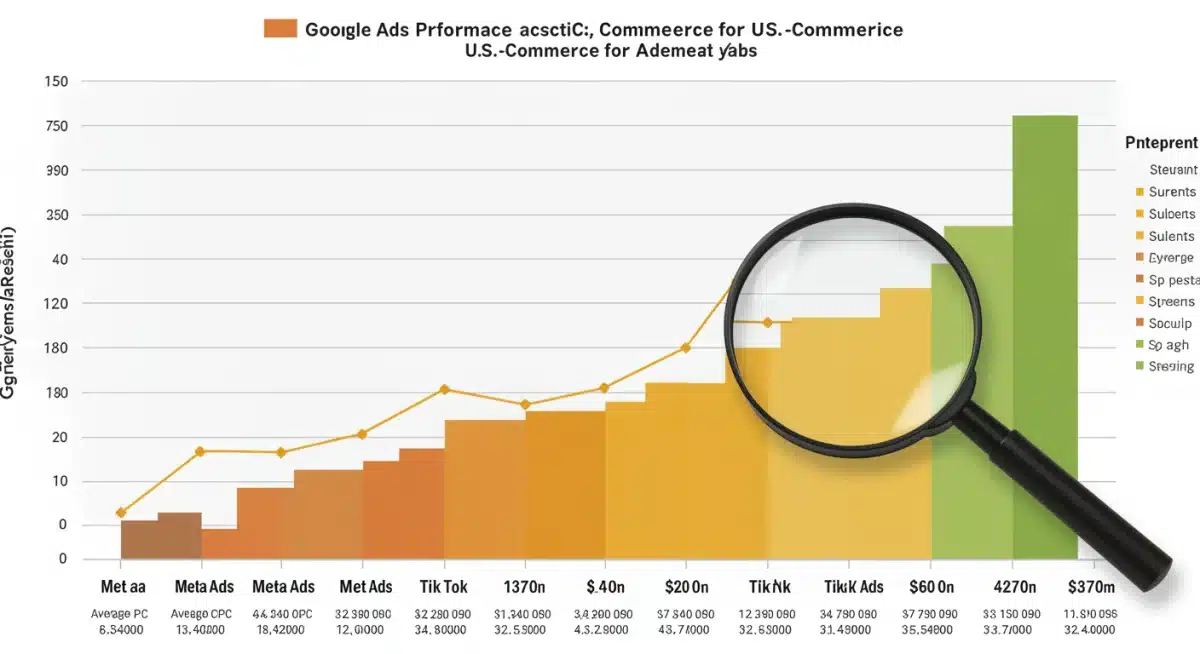
For e-commerce, features like Instagram Shopping, Facebook Marketplace, and dynamic product ads are instrumental. These tools allow businesses to integrate their product catalogs directly into the social experience, streamlining the path to purchase.
Leveraging advanced targeting and creative formats
Meta’s ad platform offers sophisticated targeting options, including custom audiences, lookalike audiences, and detailed demographic and interest targeting. This precision enables advertisers to reach niche markets effectively and scale successful campaigns.
Creative formats are also a significant advantage, with carousel ads, collection ads, and video ads proving highly effective for showcasing products in an engaging manner. The visual nature of Instagram, in particular, makes it ideal for fashion, beauty, and lifestyle brands.
- Demographic targeting: Reach specific age groups, genders, and locations with high accuracy.
- Interest targeting: Connect with users based on their hobbies, passions, and online behaviors.
- Custom audiences: Target existing customers or website visitors for remarketing campaigns.
- Lookalike audiences: Expand reach by finding new users who resemble your best customers.
The financial impact of Meta Ads can be substantial, especially for brands that invest in high-quality creative and leverage the platform’s advanced targeting capabilities. While CPCs can vary, the potential for viral reach and strong community building often justifies the investment.
In summary, Meta Ads remains a vital platform for U.S. e-commerce businesses looking to build brand awareness, drive social commerce, and foster strong customer relationships through highly engaging and targeted advertising campaigns.
Amazon Ads: direct access to high-intent shoppers
Amazon Ads has emerged as an indispensable platform for e-commerce businesses, particularly those selling products directly on Amazon.com. Its unique value proposition lies in its ability to reach consumers at the very end of their purchasing journey, often when they are ready to buy.
Being present on Amazon’s search results pages and product detail pages is crucial for visibility and sales conversion. The platform offers various ad types, including Sponsored Products, Sponsored Brands, and Sponsored Display, catering to different advertising objectives.
Maximizing sales within the Amazon ecosystem
For brands operating within the Amazon ecosystem, advertising on the platform provides direct access to a massive audience of high-intent shoppers. The financial impact can be immediate and significant, as ads lead directly to product pages where purchases are often just a click away.
Optimizing Amazon Ads involves understanding Amazon’s A9 algorithm, which prioritizes relevance, sales velocity, and customer reviews. Successful campaigns integrate strong product listings with targeted advertising efforts.
- Sponsored Products: Promote individual product listings in search results and on product pages.
- Sponsored Brands: Showcase a brand’s portfolio and custom landing pages, boosting brand discovery.
- Sponsored Display: Reach relevant audiences on and off Amazon, based on shopping and browsing signals.
- Video Ads: Engage shoppers with compelling video content on Amazon and across the web.
While the focus is often on direct sales, Amazon Ads also play a critical role in brand building and product discovery within its marketplace. Businesses can leverage metrics like ACoS (Advertising Cost of Sale) and ROAS to measure campaign effectiveness and optimize for profitability.
In conclusion, Amazon Ads offers a powerful avenue for U.S. e-commerce businesses to capture sales from high-intent shoppers directly within the world’s largest online marketplace. Its integrated approach to advertising and sales makes it a unique and highly effective platform.
TikTok Ads: capturing the Gen Z and Millennial market
TikTok has rapidly ascended to become a powerhouse in the digital advertising space, especially for U.S. e-commerce brands aiming to connect with Gen Z and younger Millennial demographics. Its short-form video format and highly engaging content feed offer a unique opportunity for viral marketing and authentic brand discovery.
Unlike traditional platforms, TikTok thrives on creativity and trend participation, encouraging brands to adopt a more native and less overtly commercial approach to advertising. This aligns with the platform’s user base, which values authenticity and entertainment.
Driving discovery through creative content
The financial impact of TikTok Ads can be profound for brands that successfully tap into the platform’s culture. Campaigns often see high engagement rates and significant organic reach when content resonates with users, leading to a lower effective cost per acquisition (CPA).
TikTok offers various ad formats, including In-Feed Ads, TopView Ads, Brand Takeovers, and Branded Hashtag Challenges, allowing businesses to choose the format that best suits their campaign objectives and creative capabilities.
- In-Feed Ads: Appear natively in users’ For You Page, blending seamlessly with organic content.
- TopView Ads: Full-screen video ads that appear immediately upon opening the app, offering maximum visibility.
- Branded Hashtag Challenges: Encourage user-generated content and viral participation around a brand.
- Spark Ads: Boost organic TikTok posts and creators’ content, leveraging existing viral trends.
Success on TikTok often hinges on understanding current trends, collaborating with influencers, and producing highly creative, scroll-stopping video content. The platform’s algorithm is designed to push engaging content, offering significant organic amplification for well-executed ads.
To summarize, TikTok Ads provides a dynamic and highly effective channel for U.S. e-commerce businesses to engage with younger audiences, drive brand discovery through creative video content, and potentially achieve viral reach at a competitive cost.
Pinterest Ads: visual discovery and purchase inspiration
Pinterest stands out as a unique platform for U.S. e-commerce advertising, positioning itself as a visual discovery engine where users actively seek inspiration for purchases. Unlike social media platforms, Pinterest users are typically in a planning mindset, making them highly receptive to product-oriented content.
For businesses in categories like home decor, fashion, beauty, food, and DIY, Pinterest offers a highly engaged audience with strong purchasing intent. The platform’s visual nature makes it ideal for showcasing products in aspirational contexts.
Connecting inspiration to conversion
The financial impact of Pinterest Ads can be significant for brands that align with its visual-first approach. Users often save pins for future reference, extending the lifespan of ad content and potentially driving conversions over time. This ‘evergreen’ nature of pins can lead to a sustained ROI.
Pinterest offers various ad formats, including Standard Pins, Video Pins, Shopping Ads, and Collection Ads, designed to integrate seamlessly into the user experience and guide them from inspiration to purchase.
- Standard Pins: Promote visually appealing images with direct links to product pages.
- Shopping Ads: Feature products directly from your catalog, making them instantly shoppable.
- Collection Ads: Group multiple products into a single ad, allowing users to browse and shop directly.
- Idea Pins: Multi-page video content for storytelling and tutorials, inspiring users with product usage.
Effective Pinterest advertising involves high-quality imagery, compelling ad copy that highlights product benefits, and strategic keyword targeting to appear in relevant searches. The platform’s analytics provide insights into how users interact with pins, enabling continuous optimization.
In conclusion, Pinterest Ads offers a powerful channel for U.S. e-commerce businesses to tap into a highly motivated audience seeking visual inspiration for purchases. Its unique blend of discovery and intent makes it an invaluable platform for driving both brand awareness and direct sales.
The strategic imperative: integrating diverse platforms for optimal results
While each of the top 5 paid advertising platforms—Google Ads, Meta Ads, Amazon Ads, TikTok Ads, and Pinterest Ads—offers distinct advantages, the most successful U.S. e-commerce advertising strategies in 2025 will likely involve a thoughtful integration of several. A diversified approach mitigates risk and allows businesses to reach consumers at different touchpoints in their buying journey.
Consider the customer journey: a user might discover a product on TikTok, research it on Google, compare prices on Amazon, see a retargeting ad on Instagram, and finally make a purchase after seeing an inspirational pin on Pinterest. A holistic strategy ensures your brand is present at each critical stage.
Building a resilient multi-channel strategy
Effective integration goes beyond simply running ads on multiple platforms. It involves harmonizing messaging, creative assets, and targeting strategies to create a cohesive brand experience. Data analytics play a pivotal role in understanding how different platforms contribute to overall conversions and ROI.
Attribution modeling becomes essential to accurately credit each platform’s contribution, moving beyond last-click models to understand the true impact of each touchpoint. This allows for smarter budget allocation and optimization across your entire ad portfolio.
- Unified messaging: Ensure consistent brand voice and value propositions across all platforms.
- Cross-platform retargeting: Leverage data from one platform to retarget users on another, reinforcing brand recall.
- Data centralization: Use a centralized analytics system to track performance and attribute conversions accurately.
- Budget fluidity: Be prepared to shift budgets dynamically based on real-time performance data and emerging trends.
The financial implications of a multi-channel strategy can be highly positive. By leveraging the unique strengths of each platform, businesses can achieve greater reach, more precise targeting, and ultimately, a higher overall return on their advertising investment.
In essence, the future of U.S. e-commerce advertising in 2025 is not about choosing one platform over another, but rather about strategically combining the top contenders to create a powerful, resilient, and highly effective multi-channel marketing machine that drives sustained growth.
| Key Platform | Primary Advantage for U.S. E-commerce |
|---|---|
| Google Ads | Unparalleled reach and high-intent search targeting. |
| Meta Ads | Strong social commerce, vast audience engagement, and detailed demographic targeting. |
| Amazon Ads | Direct access to high-intent shoppers within the Amazon marketplace. |
| TikTok Ads | Captures Gen Z and Millennial markets with creative, viral video content. |
Frequently asked questions about U.S. e-commerce advertising
For new U.S. e-commerce businesses, a combination of Google Shopping Ads for high-intent traffic and Meta Ads for brand building and social discovery often proves most effective. Starting with clear goals and a manageable budget is crucial for initial success and scaling.
ROI is measured by comparing the profit generated from ad campaigns against the cost of those campaigns. Key metrics include Return On Ad Spend (ROAS), Customer Acquisition Cost (CAC), and Lifetime Value (LTV). Accurate tracking and attribution models are essential.
Yes, privacy changes, especially the deprecation of third-party cookies, will significantly impact targeting and measurement. E-commerce businesses must prioritize first-party data strategies, contextual advertising, and privacy-enhancing technologies to maintain effectiveness.
TikTok remains highly viable, particularly for products appealing to Gen Z and Millennials. While strong in fashion, beauty, and lifestyle, its reach is broadening. Success depends on adapting creative strategy to the platform’s unique, authentic, and trend-driven content style.
Retail media networks, like Amazon Ads, are increasingly vital. They offer direct access to high-intent shoppers on platforms where they are already making purchases. Their value lies in leveraging vast first-party consumer data for precise targeting and immediate sales conversion.
Conclusion
The landscape of U.S. e-commerce advertising in 2025 is dynamic and demanding, yet rife with opportunities for businesses ready to adapt. The top five platforms—Google Ads, Meta Ads, Amazon Ads, TikTok Ads, and Pinterest Ads—each offer unique strengths that, when strategically combined, can create a powerful and resilient marketing ecosystem. Success hinges on a data-driven approach, continuous optimization, and a willingness to embrace emerging trends like AI and privacy-centric strategies. By understanding the distinct advantages and financial impacts of each platform, e-commerce businesses can craft comprehensive strategies that not only reach their target audiences effectively but also drive sustainable growth and maximize their return on investment in an increasingly competitive digital marketplace.