Predicting Churn: Data-Driven Retention in the U.S. Market

Predicting churn with data-driven approaches is crucial for U.S. businesses aiming to boost customer retention by 15% by 2025, leveraging advanced analytics to identify at-risk customers and implement proactive strategies.
In today’s highly competitive U.S. market, the ability to anticipate and prevent customer defection is not just an advantage, but a necessity. Predicting churn data through sophisticated analytics offers businesses a powerful mechanism to understand customer behavior and proactively intervene, aiming to retain 15% more customers by 2025.
Understanding the churn challenge in the U.S. market
Customer churn, or the rate at which customers stop doing business with a company, presents a significant challenge for businesses across the United States. High churn rates can severely impact revenue, profitability, and long-term growth. The cost of acquiring a new customer is often significantly higher than retaining an existing one, making churn reduction a top strategic priority.
The U.S. market, characterized by its dynamic nature and fierce competition, demands that companies adopt proactive measures to safeguard their customer base. Without a clear understanding of why customers leave and who is most likely to churn, businesses are left reacting to losses rather than preventing them.
The economic impact of customer attrition
- Revenue loss: Direct loss of subscription fees or repeat purchases.
- Increased acquisition costs: More resources spent on attracting new customers.
- Reduced customer lifetime value: Shorter customer relationships diminish overall value.
- Brand reputation damage: Dissatisfied customers can spread negative word-of-mouth.
Addressing churn effectively requires moving beyond anecdotal evidence and embracing a data-driven mindset. This involves collecting, analyzing, and interpreting vast amounts of customer data to uncover patterns and predict future behavior.
Ultimately, understanding the multifaceted nature of churn in the U.S. market is the first step toward building resilient and customer-centric business models. It sets the stage for implementing advanced analytical techniques that can transform retention efforts.
The power of data analytics in churn prediction
Data analytics stands at the forefront of modern customer retention strategies, offering unparalleled insights into customer behavior. By leveraging historical data, businesses can build predictive models that identify customers at high risk of churning before they actually leave. This proactive approach allows for timely and targeted interventions, significantly improving retention rates.
The sheer volume and variety of customer data available today—from transaction histories and website interactions to customer service logs and social media engagement—provide a rich foundation for sophisticated analysis. When properly harnessed, this data can paint a comprehensive picture of customer loyalty and potential disengagement.
Key data sources for churn prediction
- Transactional data: Purchase history, frequency, value, and recency.
- Behavioral data: Website visits, app usage, feature engagement.
- Demographic data: Age, location, income (where available and consented).
- Customer service interactions: Support tickets, call logs, feedback.
The application of advanced analytical techniques, such as machine learning algorithms, is what truly unlocks the predictive power of this data. These algorithms can process complex datasets to detect subtle patterns and correlations that human analysts might miss, providing a more accurate assessment of churn risk.
Embracing data analytics for churn prediction is no longer a luxury but a strategic imperative. It empowers businesses to move from a reactive stance to a proactive one, fundamentally changing how they approach customer relationships and retention.
Building a robust churn prediction model
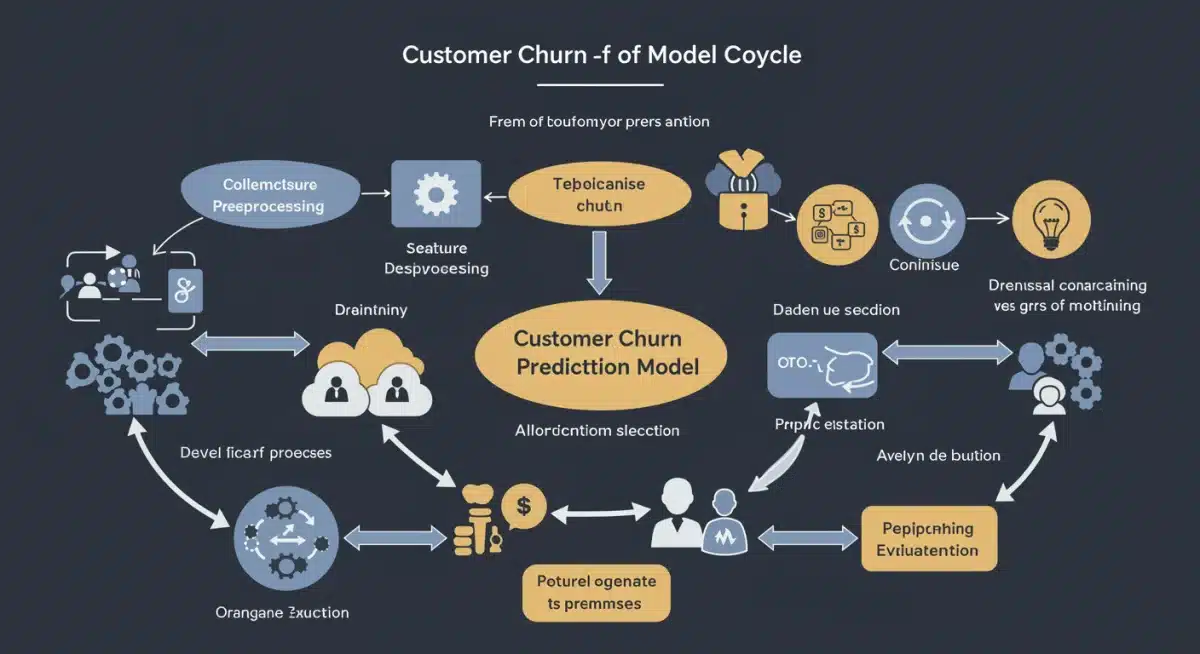
Developing an effective churn prediction model involves several critical steps, from data preparation to model validation. The goal is to create a system that accurately identifies at-risk customers, allowing businesses to allocate resources efficiently and implement targeted retention campaigns. This process is iterative and requires continuous refinement to maintain accuracy and relevance.
The foundation of any successful model lies in high-quality, comprehensive data. Without clean and relevant data, even the most advanced algorithms will yield suboptimal results. Therefore, significant effort must be placed on data collection, cleaning, and feature engineering—the process of transforming raw data into features that best represent the underlying patterns.
Stages of model development
- Data collection and preparation: Gathering relevant data and ensuring its quality.
- Feature engineering: Creating new variables from existing data to improve model performance.
- Model selection: Choosing appropriate algorithms (e.g., logistic regression, random forests, neural networks).
- Model training and validation: Training the model on historical data and evaluating its accuracy.
- Deployment and monitoring: Integrating the model into operational systems and continuously tracking its performance.
Once a model is built and validated, its effectiveness depends on its integration into the business’s operational workflow. This means providing actionable insights to customer-facing teams, enabling them to engage with at-risk customers in a timely and personalized manner.
A robust churn prediction model is a living entity that evolves with customer behavior and market conditions. Regular updates and recalibrations are essential to ensure its continued accuracy and value to the business.
Implementing proactive retention strategies
With a churn prediction model in place, the next crucial step is to translate these insights into actionable retention strategies. Identifying at-risk customers is only half the battle; the real value comes from effectively intervening to prevent them from leaving. Proactive retention strategies are tailored interventions designed to re-engage, incentivize, and satisfy customers before churn occurs.
These strategies must be diverse and personalized, recognizing that different customers churn for different reasons. A one-size-fits-all approach is unlikely to be effective. Instead, businesses should segment their at-risk customers based on their specific churn drivers and tailor interventions accordingly.
Effective proactive retention tactics
- Personalized offers: Discounts or special promotions based on past purchasing behavior.
- Enhanced customer support: Proactive outreach from customer success teams.
- Product improvements: Addressing pain points identified through feedback and usage data.
- Educational content: Demonstrating the full value of the product or service.
- Loyalty programs: Rewarding long-term commitment and engagement.
The timing of these interventions is also critical. Early detection of churn risk allows for earlier and potentially more effective engagement. Waiting until a customer has already decided to leave significantly reduces the chances of successful retention.
Ultimately, proactive retention strategies transform the relationship between a business and its customers, fostering loyalty and demonstrating a commitment to their satisfaction, thereby directly contributing to the goal of retaining 15% more customers.
Measuring success and continuous improvement
The journey of predicting churn and implementing retention strategies does not end with deployment; it requires continuous measurement, evaluation, and improvement. To achieve the ambitious goal of retaining 15% more customers by 2025, businesses must establish clear metrics for success and foster a culture of ongoing optimization.
Key performance indicators (KPIs) must be defined to track the effectiveness of churn prediction models and retention campaigns. These metrics provide tangible evidence of impact and guide future adjustments. Without proper measurement, it’s impossible to determine whether efforts are yielding the desired results.
Key metrics for evaluating churn initiatives
- Churn rate reduction: The primary measure of success.
- Customer lifetime value (CLTV) increase: Indicating more valuable customer relationships.
- Retention campaign ROI: Assessing the financial return on retention investments.
- Model accuracy: How well the prediction model identifies at-risk customers.
- Customer satisfaction (CSAT) scores: Gauging customer sentiment post-intervention.
Beyond quantitative metrics, qualitative feedback from customers and frontline staff is invaluable. This feedback can reveal nuances in customer behavior and preferences that quantitative data alone might not capture, leading to more refined strategies.
Continuous improvement involves regularly reviewing model performance, updating data sources, refining algorithms, and experimenting with new retention tactics. This iterative process ensures that the churn prediction system remains effective and adapts to changing market dynamics and customer expectations.
Future trends in churn prediction for the U.S. market
The landscape of churn prediction is constantly evolving, driven by advancements in artificial intelligence, big data analytics, and a deeper understanding of human psychology. For U.S. businesses aiming to stay ahead, anticipating these future trends is crucial for maintaining a competitive edge and achieving ambitious retention goals.
One prominent trend is the increasing sophistication of AI and machine learning models. We can expect to see more widespread adoption of deep learning techniques, capable of uncovering even more complex patterns in vast, unstructured datasets. These models will offer even greater predictive accuracy and granular insights into individual customer behaviors.
Emerging technologies and methodologies
- Real-time analytics: Predicting churn moments as they happen, enabling immediate intervention.
- Explainable AI (XAI): Understanding why a model predicts churn, not just that it predicts it.
- Behavioral economics integration: Applying psychological insights to design more effective retention tactics.
- Personalized customer journeys: Hyper-customized experiences based on predictive insights.
- Ethical AI and data privacy: Ensuring models are fair, unbiased, and comply with privacy regulations.
The integration of real-time data streams will become paramount, allowing businesses to detect and respond to potential churn signals almost instantaneously. This shift from batch processing to continuous monitoring will enable highly agile and responsive retention efforts.
Furthermore, the focus will increasingly be on not just predicting churn, but also on understanding the underlying reasons and prescribing the most effective interventions. This move towards prescriptive analytics will empower businesses with a comprehensive framework for customer retention, cementing their position in the U.S. market.
| Key Point | Brief Description |
|---|---|
| Churn Challenge | High customer attrition impacts revenue and growth in the competitive U.S. market. |
| Data Analytics Power | Leveraging data and machine learning to proactively identify at-risk customers. |
| Proactive Strategies | Implementing personalized interventions to re-engage customers before they leave. |
| Future Trends | Real-time AI, XAI, and behavioral economics will further enhance prediction capabilities. |
Frequently asked questions about churn prediction
Customer churn refers to the rate at which customers discontinue their relationship with a business. In the competitive U.S. market, high churn signifies lost revenue and increased customer acquisition costs, making its reduction a critical business objective for sustainable growth and profitability.
Data-driven churn prediction allows U.S. businesses to proactively identify customers at risk of leaving. This enables targeted interventions and personalized retention strategies, significantly improving the chances of retaining valuable customers and achieving growth targets, like the 15% retention goal by 2025.
Churn prediction models commonly utilize a variety of data, including transactional history (purchases, frequency), behavioral data (website/app usage), demographic information, and customer service interactions. Combining these datasets provides a holistic view of customer engagement and potential churn indicators.
Proactive retention strategies involve personalized offers, enhanced customer support outreach, targeted product improvements, and loyalty programs. The key is to act swiftly once churn risk is identified, tailoring interventions to address specific customer pain points and re-engage them effectively.
Future trends in churn prediction include the adoption of real-time analytics for instant intervention, Explainable AI (XAI) for deeper insights into model decisions, and the integration of behavioral economics. These advancements will lead to more precise and effective retention efforts, especially in dynamic markets like the U.S.
Conclusion
The journey to retaining 15% more customers in the U.S. market by 2025 through data-driven churn prediction is both challenging and rewarding. By embracing advanced analytics, building robust predictive models, and implementing proactive, personalized retention strategies, businesses can transform their customer relationships. This strategic shift not only mitigates revenue loss but also fosters stronger customer loyalty, driving sustainable growth in an increasingly competitive landscape. The future of customer retention lies in the intelligent application of data, ensuring that every customer interaction is informed, impactful, and designed to cultivate lasting value.