Optimizing Ad Spend: 10% Efficiency Gain for US Campaigns 2025

Achieving a 10% efficiency gain in U.S. ad campaigns by 2025 hinges on adopting sophisticated attribution models that accurately credit touchpoints and optimize budget allocation for maximum return.
In the fiercely competitive landscape of digital advertising, the ability to precisely measure and optimize marketing efforts is paramount. For U.S. campaigns in 2025, the ambition to achieve a 10% efficiency gain in optimizing ad spend is not merely a lofty goal but a strategic imperative that can significantly impact profitability and market share. This article delves into how advanced attribution models are becoming the cornerstone of this efficiency drive, offering marketers unprecedented insights into their customer journeys.
The imperative of ad spend optimization in 2025
The digital advertising ecosystem is constantly evolving, with new platforms, formats, and consumer behaviors emerging at a rapid pace. For businesses operating in the U.S., staying ahead means not just increasing ad budgets but making every dollar work harder. The drive for a 10% efficiency gain is a direct response to rising ad costs and the need for greater accountability in marketing investments.
Achieving this level of optimization requires a fundamental shift from traditional, often simplistic, measurement approaches to more sophisticated methodologies. Understanding which marketing channels truly contribute to conversions, and to what extent, is no longer a luxury but a necessity for sustainable growth. Without this clarity, ad spend can easily be misallocated, leading to diminished returns and missed opportunities.
Rising ad costs and competitive pressures
The cost of digital advertising continues to climb, driven by increased demand and platform algorithms that prioritize higher bids. This escalation means that advertisers must be more strategic than ever, ensuring that their campaigns are not just reaching audiences but converting them effectively. The competitive landscape in the U.S. market further intensifies this pressure, as brands vie for consumer attention across a multitude of channels.
- Increased competition for ad inventory across platforms.
- Higher cost-per-click (CPC) and cost-per-impression (CPM) rates.
- Saturated markets requiring more targeted and efficient campaigns.
- Consumer fatigue with generic advertising, demanding personalized experiences.
The confluence of these factors makes the goal of a 10% efficiency gain not just desirable but essential for maintaining a competitive edge. It forces marketers to scrutinize every aspect of their ad spend, from creative development to audience targeting and, critically, attribution.
Ultimately, the imperative for ad spend optimization in 2025 is about maximizing return on investment (ROI) in an increasingly complex and expensive digital environment. Businesses that fail to adapt their measurement and optimization strategies risk falling behind, making the adoption of advanced attribution models a critical component of future success.
Understanding attribution models: beyond last-click
At the heart of ad spend optimization lies the concept of attribution: assigning credit to marketing touchpoints that lead to a conversion. For years, many U.S. marketers relied heavily on the last-click attribution model, which gives all credit to the final interaction before a sale. While simple, this approach often paints an incomplete and misleading picture of the customer journey.
Modern marketing recognizes that consumers rarely convert after a single interaction. They engage with multiple ads, content pieces, and platforms before making a purchase decision. Advanced attribution models aim to capture this complexity, distributing credit across various touchpoints based on their perceived influence on the conversion path.
Limitations of traditional last-click attribution
The last-click model, while easy to implement and understand, suffers from significant drawbacks that can hinder effective ad spend optimization. By ignoring all preceding interactions, it undervalues awareness-generating activities and mid-funnel engagements that are crucial for nurturing leads.
- Ignores the role of initial touchpoints in building brand awareness.
- Fails to credit channels that introduce the customer to the product.
- Can lead to over-investment in bottom-of-funnel tactics.
- Hinders a holistic view of the customer journey, leading to suboptimal budget allocation.
Moving beyond last-click is essential for marketers seeking a true understanding of their campaign performance. It allows for a more nuanced approach to budget allocation, ensuring that all valuable touchpoints receive appropriate recognition and investment.
By moving beyond the simplistic view of last-click, businesses can gain a more accurate understanding of their marketing impact. This shift is fundamental for any strategy aimed at significantly improving ad spend efficiency, as it provides the data needed to make informed decisions about where to invest marketing dollars for the greatest overall effect.
Exploring advanced attribution models for enhanced insights
To truly achieve a 10% efficiency gain in U.S. ad campaigns, marketers must embrace a range of advanced attribution models that offer deeper insights into the customer journey. These models move beyond single-touch credit, providing a more balanced view of how different channels contribute to conversions. Each model has its strengths and is best suited for different marketing objectives and customer journey complexities.
Understanding these models is crucial for making informed decisions about budget allocation and campaign optimization. They allow marketers to identify undervalued channels and reallocate resources to maximize overall campaign effectiveness.
Linear and time decay models
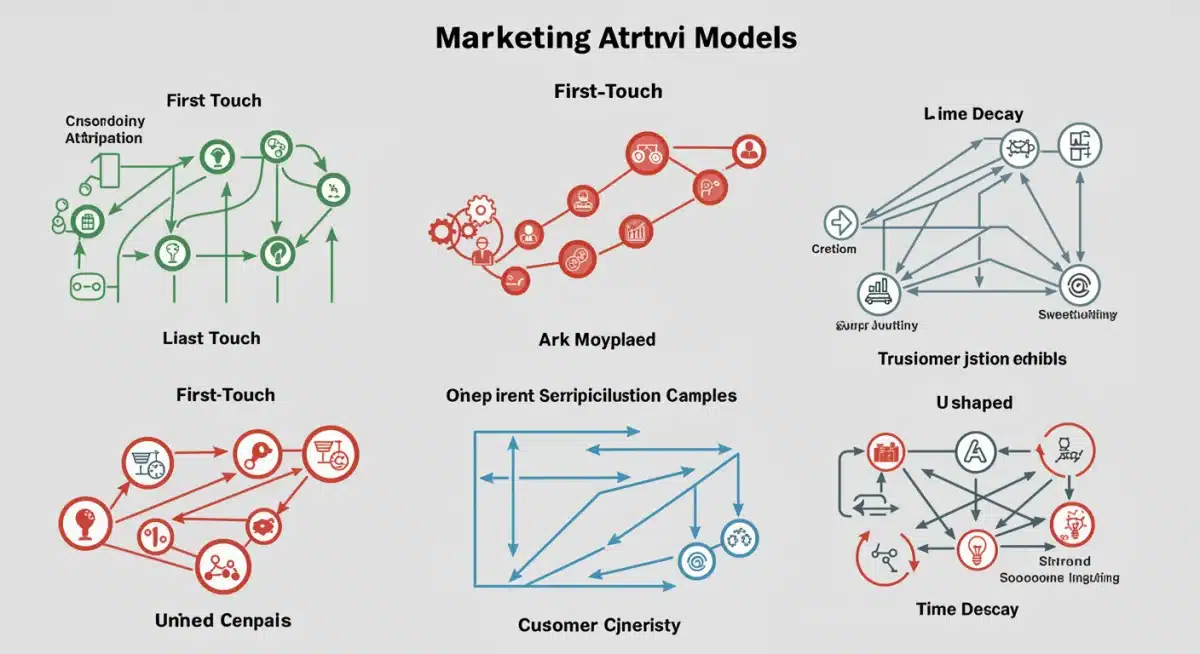
The linear attribution model distributes credit equally across all touchpoints in the conversion path. This model provides a balanced view, acknowledging that every interaction plays a role in the customer’s decision-making process. While it’s a step up from last-click, it doesn’t account for varying levels of influence among touchpoints.
The time decay model, on the other hand, assigns more credit to touchpoints that occur closer to the conversion event. This reflects the idea that recent interactions often have a greater immediate impact on a customer’s decision. It’s particularly useful for campaigns with shorter sales cycles or when the recency of interaction is highly valued.
- Linear Model: Equal credit to all touchpoints, good for understanding overall journey contribution.
- Time Decay Model: More credit to recent interactions, useful for campaigns with short sales cycles.
- Both offer more insight than last-click but may still simplify complex customer behavior.
These models represent a significant improvement over single-touch attribution by providing a more comprehensive understanding of how different marketing efforts contribute to conversions. Their application allows for more strategic budget allocation, supporting the overall goal of efficiency.
Data-driven decision making and budget reallocation
The true power of advanced attribution models lies in their ability to fuel data-driven decision-making and enable intelligent budget reallocation. Once marketers gain a clearer picture of which touchpoints are most effective, they can strategically adjust their ad spend to maximize ROI. This process is iterative, requiring continuous analysis and optimization.
By moving beyond assumptions and relying on concrete data, businesses can make more confident investments, ensuring that every dollar spent contributes meaningfully to their objectives. This precision is what drives the targeted 10% efficiency gain.
Identifying high-impact channels and campaigns
Attribution models reveal the true value of each marketing channel, often uncovering discrepancies between perceived and actual performance. Channels that might appear to have low direct conversion rates under a last-click model could be crucial in the early stages of the customer journey, building awareness and nurturing interest.
Conversely, channels that seem to generate many last-click conversions might be over-credited, overshadowing the foundational work done by other touchpoints. With a multi-touch attribution model, marketers can identify which channels are genuinely driving conversions across the entire funnel.
- Uncover hidden value in awareness and consideration phase channels.
- Prevent over-investment in channels that only capture late-stage conversions.
- Optimize budget allocation to channels with the highest overall impact.
- Refine campaign strategies based on comprehensive performance data.
This granular insight allows for a more balanced and effective distribution of ad spend. Instead of blindly allocating budgets based on incomplete data, marketers can now make strategic decisions that align with the true contribution of each channel and campaign. This leads directly to a more efficient use of resources and improved campaign outcomes.
Challenges and solutions in attribution model implementation
While the benefits of advanced attribution models are clear, their implementation is not without challenges. Data integration, model selection, and organizational buy-in are common hurdles that U.S. marketers face. Overcoming these obstacles is critical for successfully leveraging attribution to achieve a 10% efficiency gain in ad spend.
Addressing these challenges proactively ensures that businesses can fully harness the power of attribution, transforming raw data into actionable insights that drive superior marketing performance. It’s an investment in both technology and strategic thinking.
Data integration and quality
One of the primary challenges in implementing attribution models is the need to consolidate data from various disparate sources. Marketing campaigns often span multiple platforms – social media, search engines, display networks, email, and offline channels – each generating its own set of data. Integrating these diverse datasets into a unified view requires robust data infrastructure and careful data governance to ensure accuracy and consistency.
Poor data quality, including incomplete or inconsistent records, can severely compromise the reliability of attribution models. Marketers must invest in data cleaning, validation, and standardization processes to ensure that the inputs to their attribution models are trustworthy.
- Consolidating data from various marketing platforms and CRM systems.
- Ensuring data accuracy, consistency, and completeness across all touchpoints.
- Developing a robust data infrastructure capable of handling large volumes of information.
- Overcoming privacy concerns and data regulations (e.g., CCPA, GDPR) in data collection.
Effective data integration and maintaining high data quality are foundational to the success of any attribution strategy. Without a solid data foundation, even the most sophisticated models will produce unreliable results, undermining efforts to optimize ad spend.
Future trends: AI, machine learning, and predictive attribution
The future of ad spend optimization, particularly for U.S. campaigns aiming for a 10% efficiency gain by 2025, will be heavily influenced by advancements in artificial intelligence (AI) and machine learning (ML). These technologies are poised to take attribution modeling to the next level, offering predictive capabilities and dynamic optimization that far surpass current methods.
AI and ML can process vast amounts of data, identify complex patterns, and make real-time adjustments, providing marketers with unprecedented accuracy and agility in their campaigns. This evolution promises to make ad spend even more intelligent and responsive.
Algorithmic and custom attribution models
While rules-based attribution models (like linear or time decay) provide valuable insights, they still rely on predefined logic. Algorithmic attribution models, powered by AI and ML, go a step further by dynamically assigning credit based on statistical analysis of historical data and predictive analytics. These models can identify the true incremental impact of each touchpoint, even those with indirect contributions.
Custom attribution models allow businesses to develop bespoke models tailored to their unique customer journeys, business objectives, and industry nuances. This level of customization, often enhanced by AI, ensures that the attribution model perfectly reflects the specific dynamics of a company’s marketing efforts.
- AI-driven models offer more granular and accurate credit distribution.
- Machine learning can predict future conversion likelihood based on touchpoint sequences.
- Custom models provide flexibility to align with specific business goals.
- Real-time optimization capabilities for continuous ad spend adjustments.
The integration of AI and ML into attribution modeling represents a significant leap forward. It enables marketers to move from descriptive analysis (what happened) to predictive analysis (what will happen), allowing for proactive optimization of ad spend and a higher probability of achieving ambitious efficiency targets.
| Key Point | Brief Description |
|---|---|
| 10% Efficiency Goal | Target for U.S. ad campaigns in 2025 through optimized spend. |
| Attribution Models | Tools for assigning credit to marketing touchpoints in the customer journey. |
| Beyond Last-Click | Transition from simple last-click to multi-touch models for better insights. |
| AI/ML Role | Future integration of AI/ML for predictive and dynamic attribution. |
Frequently asked questions about ad spend optimization
Marketing attribution is the process of identifying which marketing touchpoints contributed to a customer’s conversion and assigning value to each. It’s crucial for optimizing ad spend because it allows marketers to understand the true ROI of different channels, enabling smarter budget allocation and improved campaign performance.
By providing a more accurate understanding of the customer journey, attribution models help identify high-performing channels and those that are underperforming. This insight allows marketers to reallocate budgets more effectively, cutting wasteful spending and investing more in impactful strategies, thereby boosting overall campaign efficiency by the targeted 10%.
Last-click attribution oversimplifies the customer journey by giving all credit to the final interaction. It undervalues early-stage awareness and consideration touchpoints, leading to potentially skewed budget decisions. This can result in neglecting channels vital for customer acquisition and nurturing, ultimately hindering overall marketing effectiveness.
AI and machine learning are revolutionizing attribution by enabling dynamic, algorithmic models that can process vast datasets, identify complex patterns, and predict future conversion probabilities. This allows for more precise credit distribution, real-time optimization, and custom models tailored to specific business needs, leading to superior ad spend efficiency.
Key steps include consolidating data from all marketing channels, ensuring data quality and integration, selecting the most appropriate attribution model for your business goals, implementing a robust attribution platform, and continuously analyzing and optimizing your strategies based on the insights gained. Organizational buy-in is also crucial for success.
Conclusion
Achieving a 10% efficiency gain in U.S. ad campaigns by 2025 is an ambitious yet attainable goal, largely dependent on the strategic adoption and sophisticated application of attribution models. By moving beyond traditional, simplistic measurement approaches, marketers can unlock a deeper understanding of the customer journey, enabling more precise budget allocation and enhanced campaign performance. The integration of AI and machine learning promises to further refine these capabilities, pushing the boundaries of what’s possible in ad spend optimization. The future belongs to those who embrace data-driven insights to make every marketing dollar count.