Ad Spend Allocation: Maximize ROI on $10k Monthly Budget in 2025

Strategic ad spend allocation for a $10,000 monthly budget in 2025 demands a data-driven approach, focusing on channel diversification and ongoing optimization to achieve maximum ROI and positive financial impact.
Navigating the complex world of paid advertising requires more than just a budget; it demands a strategic approach to ensure every dollar works as hard as possible. This article delves into effective budget allocation strategies, specifically designed to help businesses distribute a $10,000 monthly ad spend for maximum ROI in 2025, offering practical solutions and highlighting their financial impact.
Understanding your audience and market landscape
Before any ad dollar is spent, a profound understanding of your target audience and the broader market landscape is essential. This foundational step dictates where your advertising efforts will yield the most fruit, preventing wasted spend and ensuring relevance.
Identifying who you are trying to reach involves more than just demographics. It encompasses psychographics, behavioral patterns, and pain points, allowing for highly targeted messaging and channel selection. A deep dive into market trends, competitor strategies, and emerging platforms also provides crucial context.
Audience segmentation and persona development
Effective budget allocation begins with knowing exactly who you’re talking to. Creating detailed buyer personas helps tailor your campaigns.
- Demographic insights: Age, gender, income, location.
- Psychographic data: Interests, values, attitudes, lifestyle.
- Behavioral patterns: Online activities, purchase history, brand interactions.
- Pain points and motivations: What problems do they need solved, and what drives their decisions?
Understanding these facets allows for the creation of ads that resonate deeply, increasing engagement and conversion rates. Without this clarity, your ad spend becomes a shot in the dark, rather than a precision strike.
Competitive analysis and market trends
Analyzing your competitors’ ad strategies can reveal valuable insights and potential gaps in the market. Understanding what they are doing well, and where they might be falling short, informs your own approach.
Furthermore, staying abreast of market trends, such as the rise of new social media platforms or shifts in consumer behavior, ensures your strategies remain agile and relevant. This proactive stance allows for early adoption of effective channels and tactics, giving you a competitive edge.
In conclusion, a thorough understanding of your audience and market landscape forms the bedrock of any successful ad spend allocation strategy. It empowers you to make informed decisions, ensuring your $10,000 monthly budget is directed towards campaigns that genuinely connect with potential customers and stand out in the market.
Diversifying your ad channels for optimal reach
Once you understand your audience, the next critical step is to strategically diversify your ad channels. Relying on a single platform can be risky and limit your reach. A balanced approach across various channels maximizes exposure and minimizes dependency.
Different platforms excel at different stages of the customer journey, from awareness to conversion. A diversified strategy ensures you’re engaging potential customers wherever they are, with messages tailored to that specific environment.
Key digital advertising channels for 2025
The digital landscape is constantly evolving, but certain channels consistently deliver strong results when managed correctly.
- Search Engine Marketing (SEM): Google Ads for immediate visibility and intent-driven traffic.
- Social Media Advertising: Platforms like Facebook, Instagram, LinkedIn, and TikTok for audience targeting and engagement.
- Display Advertising: Google Display Network, programmatic ads for brand awareness and retargeting.
- Video Advertising: YouTube, connected TV (CTV) for immersive storytelling and high engagement.
- Native Advertising: Content-led ads that blend seamlessly with the platform’s editorial content.
Each channel offers unique advantages and caters to different audience segments. The key is to identify which channels align best with your audience’s behavior and your campaign objectives.
Strategic channel allocation for a $10,000 budget
With a $10,000 monthly budget, a prudent approach involves allocating funds across 2-4 primary channels, with flexibility to shift based on performance. For instance, a common distribution might involve a larger portion for SEM due to its high intent, followed by social media for brand building and lead generation, and a smaller segment for display or video for broader awareness.
Consider starting with a slightly more conservative allocation to new channels, scaling up as performance data becomes available. The goal is to create a synergy where different channels complement each other, guiding customers through the sales funnel effectively.
In essence, diversifying your ad channels is not about spreading your budget thinly, but about strategically deploying it where it will have the most impact. This ensures a comprehensive reach and a more resilient advertising strategy against market fluctuations.
Setting clear objectives and KPIs
Effective budget allocation is inextricably linked to clear, measurable objectives and Key Performance Indicators (KPIs). Without these, it’s impossible to gauge the success of your campaigns or make informed decisions about future spending.
Every dollar spent should contribute to a specific goal, whether it’s increasing brand awareness, driving website traffic, generating leads, or boosting sales. Defining these upfront provides the framework for your entire advertising strategy.
Defining SMART advertising goals
Your advertising goals should always be SMART: Specific, Measurable, Achievable, Relevant, and Time-bound. This framework ensures your objectives are clear and actionable.
- Specific: Instead of ‘increase sales,’ aim for ‘increase online sales by 15%.’
- Measurable: Ensure you have the tools to track progress, like conversion tracking or analytics.
- Achievable: Set realistic goals based on historical data and market conditions.
- Relevant: Ensure goals align with your overall business objectives.
- Time-bound: Set a clear deadline for achieving the goal, e.g., ‘within the next quarter.’
These well-defined goals serve as your compass, guiding your budget allocation decisions and ensuring every campaign is purposeful.
Key performance indicators (KPIs) for ROI measurement
Once goals are set, identifying the right KPIs is crucial for tracking performance and measuring ROI. Different objectives will require different KPIs.
- For Brand Awareness: Impressions, reach, brand mentions, video views.
- For Website Traffic: Clicks, click-through rate (CTR), unique visitors.
- For Lead Generation: Cost Per Lead (CPL), lead quality, conversion rate.
- For Sales/Revenue: Return on Ad Spend (ROAS), Customer Acquisition Cost (CAC), average order value (AOV).
Regularly monitoring these KPIs allows you to understand what’s working and what’s not, enabling timely adjustments to your ad spend allocation. This data-driven approach is fundamental to maximizing your $10,000 monthly budget and achieving significant financial impact.
In summary, clear objectives and robust KPIs are the backbone of an effective advertising strategy. They provide the necessary clarity and accountability to ensure your budget is spent wisely and delivers measurable returns.
Implementing a phased budget allocation approach
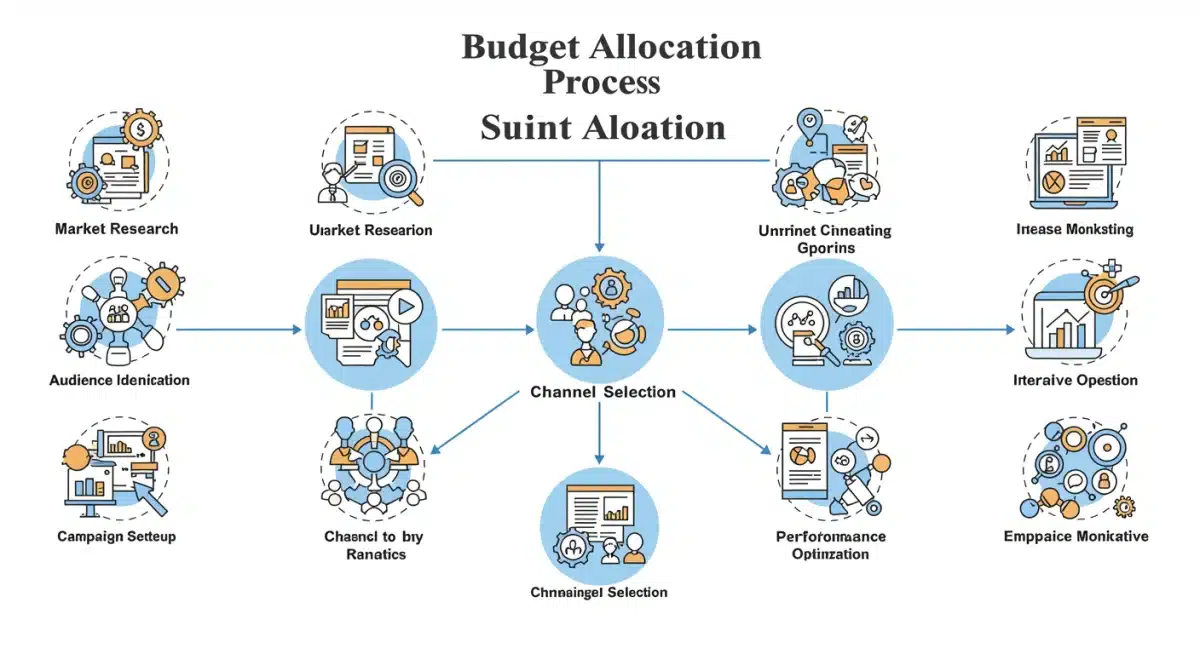
A static budget allocation can quickly become inefficient in a dynamic digital marketing environment. Implementing a phased approach, where budget distribution is reviewed and adjusted periodically, ensures continuous optimization and responsiveness to performance data.
This iterative process allows you to test hypotheses, scale successful campaigns, and reallocate funds from underperforming areas, maximizing the efficiency of your $10,000 monthly ad spend.
Initial allocation and testing phase
Begin with an initial allocation based on your audience insights, market analysis, and defined objectives. This first phase should ideally be smaller, acting as a testing ground.
- Allocate 60-70% to proven channels: Channels that have historically worked well or show high potential based on research.
- Allocate 20-30% to experimental channels: New platforms or ad formats to test their viability.
- Dedicated budget for A/B testing: Test different ad creatives, landing pages, and targeting options.
During this phase, rigorous monitoring of KPIs is paramount. The goal is to gather enough data to make informed decisions for the subsequent phases.
Optimization and scaling phase
After the initial testing period (typically 2-4 weeks), analyze the performance data. Identify which campaigns and channels are delivering the best ROI and which are underperforming.
Reallocate budget from underperforming areas to those showing promise. This might mean increasing spend on a highly effective social media campaign or pulling back from a display network that isn’t converting.
This phase is about scaling what works and refining what doesn’t. Continuous optimization involves ongoing adjustments to bids, targeting, ad copy, and landing pages to squeeze every bit of efficiency from your budget. The flexibility to pivot is a hallmark of successful budget management.
A phased budget allocation approach transforms your $10,000 monthly ad spend from a fixed cost into a dynamic investment. It ensures that your resources are always aligned with the most effective strategies, leading to sustained growth and maximum financial impact.
Leveraging data analytics for continuous optimization
In the realm of paid advertising, data is king. The ability to collect, analyze, and act upon performance data is what truly differentiates successful campaigns from those that merely spend money. Leveraging robust data analytics is crucial for continuous optimization of your ad spend allocation.
This involves more than just glancing at dashboards; it requires a deep dive into the numbers to uncover actionable insights that drive better decision-making and enhance ROI.
Tools and platforms for data analysis
A variety of tools can help you gather and interpret your advertising data effectively.
- Google Analytics 4 (GA4): Essential for website traffic, user behavior, and conversion tracking.
- Platform-specific analytics: Google Ads, Facebook Ads Manager, LinkedIn Campaign Manager provide detailed campaign performance.
- CRM systems: Integrate with your ad platforms to track leads through the sales funnel and understand customer lifetime value (CLTV).
- Attribution modeling tools: Help understand which touchpoints contribute to conversions, especially in multi-channel strategies.
Utilizing these tools allows for a holistic view of your campaigns, moving beyond basic metrics to understand true customer journeys and the impact of each ad dollar.
Interpreting metrics and making informed adjustments
Raw data is only valuable when it’s properly interpreted. Look beyond surface-level metrics to understand the ‘why’ behind the numbers.
- High CTR but low conversions? Investigate landing page experience or ad-to-landing page messaging alignment.
- Low impressions but high conversion rate? Consider increasing budget on that specific, high-performing segment.
- High CAC for a specific channel? Evaluate if the customer lifetime value justifies the cost, or if targeting needs refinement.
Regularly scheduled data reviews (weekly or bi-weekly) are critical for making timely adjustments. This proactive approach prevents prolonged underperformance and ensures your $10,000 monthly ad spend is always directed towards the most efficient paths to ROI. Continuous optimization is not a one-time task but an ongoing commitment to data-driven excellence.
By effectively leveraging data analytics, businesses can transform their ad campaigns into highly efficient machines, ensuring that every allocation decision is backed by evidence and aimed squarely at maximizing financial impact.
Forecasting ROI and financial impact
Understanding the potential return on investment (ROI) and overall financial impact of your ad spend is paramount for strategic planning. It allows you to justify expenditures, set realistic expectations, and demonstrate the value of your marketing efforts to stakeholders.
Forecasting isn’t about predicting the future with 100% accuracy, but rather about making informed projections based on historical data, market trends, and campaign objectives.
Methods for ROI projection
Several methods can be employed to project the ROI of your ad campaigns, even with a $10,000 monthly budget.
- Historical data analysis: Use past campaign performance as a baseline for future projections.
- Benchmarking: Compare your expected performance against industry averages or competitor results.
- Pilot campaigns: Run small-scale tests to gather initial data before a full budget commitment.
- Conservative vs. aggressive projections: Create a range of possible outcomes to prepare for different scenarios.
By combining these methods, you can develop a more robust and reliable forecast, providing a clearer picture of what your ad spend allocation is expected to achieve.
Calculating financial impact and profitability
Beyond simple ROI, it’s crucial to calculate the broader financial impact and profitability of your ad investments. This involves looking at metrics like:
- Customer Lifetime Value (CLTV): Understand the total revenue a customer is expected to generate over their relationship with your business.
- Profit margins: Ensure that the revenue generated from ads translates into healthy profits after accounting for all costs.
- Break-even analysis: Determine how many conversions are needed to cover your ad spend.
- Incremental revenue: Measure the additional revenue generated directly attributable to your advertising efforts.
A comprehensive financial impact analysis helps you understand the true value of your advertising, enabling you to make strategic decisions that contribute to long-term business growth. For a $10,000 monthly budget, demonstrating clear financial returns is key to securing continued investment and scaling your marketing efforts.
Forecasting ROI and meticulously calculating financial impact provides the necessary clarity and confidence to manage your ad budget effectively, transforming spending into a strategic investment with tangible business benefits.
Adapting to market shifts and emerging trends
The digital advertising landscape is in a constant state of flux. New platforms emerge, existing ones evolve, and consumer behavior shifts. To maintain maximum ROI on your $10,000 monthly ad spend, it’s imperative to adapt swiftly to these market shifts and embrace emerging trends.
Stagnation is the enemy of optimization. A proactive approach ensures your budget remains relevant and effective, preventing diminishing returns and opening doors to new opportunities.
Staying informed about industry changes
Cultivating a habit of continuous learning and staying informed is non-negotiable for any digital marketer. This includes:
- Following industry publications and blogs: DigitalMarketChronicle, Search Engine Journal, Adweek.
- Attending webinars and conferences: Gain insights from thought leaders and network with peers.
- Subscribing to platform updates: Google Ads, Meta Business Suite, and other ad platforms frequently introduce new features and policies.
- Engaging with professional communities: Forums and groups where marketers share insights and best practices.
Being aware of these changes allows you to anticipate their impact on your campaigns and adjust your strategies accordingly, ensuring your ad spend allocation remains cutting-edge.
Experimenting with new platforms and ad formats
While a core budget should be allocated to proven channels, always reserve a small portion of your $10,000 monthly ad spend for experimentation. This could involve:
- Testing new social media platforms: If your audience is migrating to a new app, be an early adopter.
- Exploring emerging ad formats: Interactive ads, augmented reality (AR) ads, or shoppable video ads.
- Venturing into influencer marketing: Collaborate with relevant influencers to reach niche audiences.
- Adopting AI-driven tools: Utilize AI for ad creative generation, audience targeting, or bid optimization.
These experiments, even if small, can uncover highly profitable avenues that your competitors might overlook. The ability to pivot and integrate new strategies is a significant competitive advantage, safeguarding and enhancing your financial impact in the long run.
Ultimately, successful budget allocation in 2025 is not just about current performance but also about future readiness. By actively adapting to market shifts and embracing innovation, your $10,000 monthly ad budget will continue to deliver maximum ROI, ensuring sustained growth and a strong financial position.
| Key Strategy | Brief Description |
|---|---|
| Audience & Market Research | Thoroughly understand your target audience and competitive landscape to inform channel selection. |
| Channel Diversification | Spread your $10k budget across multiple platforms (SEM, Social, Display) for broader reach. |
| Data-Driven Optimization | Continuously monitor KPIs, analyze data, and adjust allocations to maximize ROI. |
| Adapt to Market Shifts | Stay updated on trends and experiment with new platforms to stay competitive and effective. |
Frequently asked questions about ad spend allocation
A small business should prioritize channels with high intent, like Search Engine Marketing (SEM), allocating 50-60% there. Dedicate 30-40% to social media for brand building and lead generation, and reserve 10% for testing new channels or ad formats to discover new opportunities.
Key KPIs include Return on Ad Spend (ROAS), Customer Acquisition Cost (CAC), Cost Per Lead (CPL), and conversion rate. These metrics directly reflect the financial performance and efficiency of your ad campaigns, guiding optimization efforts effectively.
It’s advisable to review your ad budget allocation weekly or bi-weekly. The digital landscape changes rapidly, and frequent analysis allows for timely adjustments to capitalize on performing campaigns and reallocate funds from underperforming ones, maximizing efficiency.
Diversification is generally better. While focusing on one channel can yield deep expertise, it also carries higher risk. Spreading your $10,000 across 2-4 channels mitigates risk, expands reach, and allows you to capture different segments of your audience more effectively.
Forecast ROI by analyzing historical data, benchmarking against industry standards, and running small pilot campaigns. Use conservative and aggressive projections to understand potential outcomes and always align forecasts with clear, measurable business objectives and KPIs.
Conclusion
Effectively managing a $10,000 monthly ad spend in 2025 transcends mere expenditure; it’s a strategic investment demanding meticulous planning, continuous optimization, and an unwavering focus on measurable results. By deeply understanding your audience, diversifying across relevant channels, setting clear objectives, and leveraging data analytics, businesses can transform their advertising budget into a powerful engine for growth. The ability to adapt to market shifts and proactively experiment with new trends will be crucial for sustained success, ensuring that every dollar spent contributes significantly to maximizing ROI and achieving substantial financial impact in an increasingly competitive digital landscape.