Marketing Measurement 2025: Integrating Offline & Online Data

By 2025, successful marketing measurement will hinge on seamlessly integrating offline and online data, creating a unified view of customer interactions for unparalleled strategic insights.
The landscape of marketing is continuously evolving, and with it, the methods we use to measure its effectiveness. In an increasingly data-driven world, understanding the complete customer journey is paramount. This article delves into the future of marketing measurement: integrating offline and online data for 2025 success, exploring how businesses can achieve a holistic view of their marketing efforts and drive significant growth.
The evolving landscape of marketing measurement
Marketing measurement has always been about understanding what works and what doesn’t. However, the sheer volume and diversity of data available today present both challenges and immense opportunities. The traditional silos between offline and online marketing data are rapidly crumbling, necessitating a more integrated approach to truly grasp customer behavior and campaign performance.
As we approach 2025, marketers are moving beyond simple last-click attribution models. The focus is shifting towards multi-touch attribution and customer journey mapping, where every interaction, regardless of channel, contributes to the overall picture. This requires a sophisticated blend of technological capabilities and analytical expertise to synthesize disparate data points into actionable insights.
Challenges in data integration
Integrating data from various sources is no small feat. Businesses often grapple with inconsistent data formats, privacy concerns, and the sheer complexity of connecting systems that were never designed to communicate. Overcoming these hurdles is crucial for achieving a unified view.
- Data standardization: Ensuring consistency across different data types.
- Privacy regulations: Navigating GDPR, CCPA, and other compliance requirements.
- Technological compatibility: Bridging legacy systems with modern platforms.
- Organizational silos: Breaking down barriers between departments that own different data sets.
The success of future marketing strategies will heavily depend on how effectively organizations can address these integration challenges, transforming raw data into a cohesive narrative that informs decision-making.
Breaking down data silos: why it matters for 2025
For too long, marketing departments have operated with fragmented data, analyzing online ad performance separately from in-store purchases or direct mail responses. This siloed approach provides an incomplete picture, leading to suboptimal resource allocation and missed opportunities. By 2025, breaking down these data silos will not just be an advantage but a fundamental requirement for competitive marketing.
Integrating offline and online data allows marketers to understand the true impact of their campaigns across all touchpoints. For instance, a customer might see an online ad, then visit a physical store, and finally make a purchase online after receiving an email. Without integrated data, these interactions appear as separate events, obscuring the actual customer journey and the cumulative effect of marketing efforts.
Benefits of a unified customer view
A unified customer view, enabled by comprehensive data integration, offers a multitude of benefits that directly translate into improved marketing performance and business growth.
- Enhanced personalization: Tailoring marketing messages based on a complete understanding of customer preferences and behaviors across all channels.
- Accurate attribution: More precisely crediting each marketing touchpoint for its contribution to conversions, leading to better budget allocation.
- Improved customer experience: Delivering seamless and consistent experiences by recognizing customers no matter how or where they interact with the brand.
- Predictive analytics: Leveraging historical data to forecast future customer behavior and market trends with greater accuracy.
Ultimately, a unified data strategy empowers marketers to move beyond reactive reporting to proactive, insight-driven decision-making, ensuring every marketing dollar is spent effectively.
Technologies enabling seamless integration
Achieving true data integration for marketing measurement in 2025 relies heavily on advanced technological solutions. These tools and platforms are designed to collect, process, and unify vast amounts of data from diverse sources, making it accessible and actionable for marketers.
Customer Data Platforms (CDPs) are at the forefront of this technological revolution. Unlike traditional CRMs or DMPs, CDPs create a persistent, unified customer profile from all available data, both online and offline. This single customer view is then made available to other marketing systems, enabling consistent personalization and more accurate measurement.
Key technologies for data integration
Several technological advancements are crucial for successful marketing measurement integration:
- Customer Data Platforms (CDPs): Centralizing customer data from all sources into a single, comprehensive profile.
- AI and Machine Learning: Automating data processing, identifying patterns, and making predictive recommendations.
- Cloud-based data warehouses: Providing scalable and flexible storage for massive datasets.
- API integrations: Facilitating seamless data exchange between different marketing and business systems.
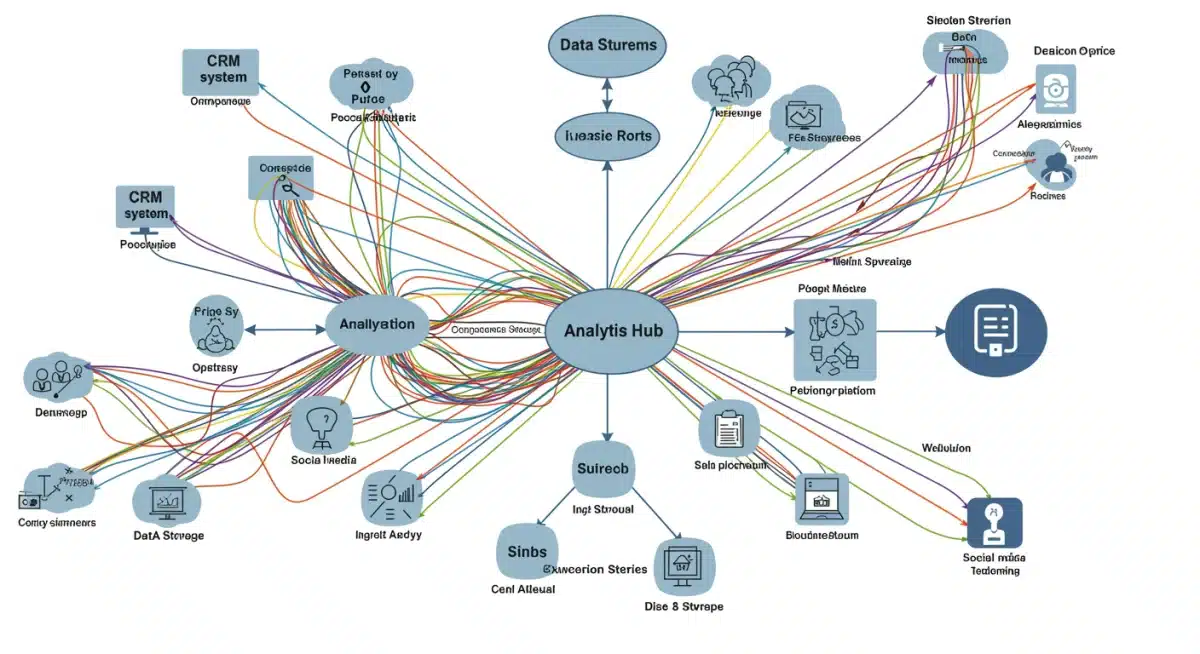
These technologies, when skillfully implemented, form the backbone of a sophisticated marketing measurement system, allowing organizations to move beyond mere data collection to true data utilization.
The role of AI and machine learning in unifying data
Artificial Intelligence (AI) and Machine Learning (ML) are not just buzzwords; they are transformative forces in the realm of marketing measurement. As we look towards 2025, these technologies will play an increasingly critical role in making sense of the overwhelming volume of integrated data, transforming it into intelligent insights that drive superior marketing outcomes.
AI algorithms can analyze complex datasets to identify subtle patterns and correlations that human analysts might miss. This includes connecting seemingly disparate offline behaviors, such as store visits or call center interactions, with online activities like website browsing or social media engagement. Machine learning models can then predict future customer actions, optimize campaign performance in real-time, and even automate personalized content delivery.
Practical applications of AI in marketing measurement
The applications of AI and ML in unifying offline and online data are vast and impactful, offering marketers unprecedented capabilities.
- Predictive customer lifetime value (CLV): Forecasting the long-term value of individual customers by analyzing their integrated behavioral data.
- Dynamic attribution modeling: Adjusting attribution weights in real-time based on AI-driven analysis of customer journey complexities.
- Automated anomaly detection: Quickly identifying unusual patterns in data that might indicate issues or opportunities in marketing performance.
- Personalized content recommendations: Using integrated data to suggest relevant products or content across all customer touchpoints.
By leveraging AI and ML, businesses can move beyond descriptive analytics to truly predictive and prescriptive marketing, ensuring their strategies are always optimized for maximum impact.
Measuring omnichannel success: key metrics for 2025
With offline and online data seamlessly integrated, marketers can finally gain a comprehensive view of their omnichannel performance. This holistic perspective necessitates a shift in how success is measured, moving beyond channel-specific KPIs to metrics that reflect the entire customer journey and overall business impact. By 2025, the focus will be on metrics that reveal the true synergy between various marketing efforts.
Effective omnichannel measurement requires looking at the combined impact of all touchpoints on customer acquisition, retention, and lifetime value. This means understanding how an offline interaction influences an online conversion, or how digital engagement drives in-store foot traffic. The goal is to optimize the entire customer experience, not just individual channel performance.
Essential omnichannel metrics
To accurately gauge omnichannel success, marketers should prioritize a set of integrated metrics that provide a complete picture of customer engagement and conversion.
- Customer lifetime value (CLV): A comprehensive measure of the total revenue a customer is expected to generate over their relationship with a brand, combining offline and online purchases.
- Return on ad spend (ROAS) across channels: Evaluating the revenue generated for every dollar spent on advertising, taking into account all online and offline ad exposures.
- Cross-channel conversion rates: Tracking how customers move between channels to complete a desired action, such as an online ad leading to an in-store purchase.
- Customer journey analytics: Mapping and analyzing the complete path customers take, identifying critical touchpoints and potential friction points.
These metrics enable marketers to make informed decisions about budget allocation, content strategy, and customer experience improvements, all based on a unified view of performance.
Implementing a unified data strategy: practical steps
Transitioning to a unified data strategy for marketing measurement is a journey that requires careful planning and execution. It’s not just about acquiring new technology; it’s about fostering a data-driven culture and establishing robust processes. For businesses aiming for marketing measurement integration success by 2025, a structured approach is essential.
The first step involves a thorough audit of existing data sources, both online and offline, to understand what data is available, its quality, and how it’s currently being used. This foundational understanding will inform the technology stack and the integration roadmap. Collaboration across departments, including IT, sales, and customer service, is also critical to ensure all relevant data streams are identified and incorporated.
Key steps for successful implementation
A phased approach can help organizations effectively implement a unified data strategy, ensuring sustainable progress and tangible results.
- Define clear objectives: What specific questions do you want to answer with integrated data? What business outcomes are you aiming for?
- Invest in the right technology: Select a CDP or similar platform that can effectively unify your data and integrate with your existing systems.
- Establish data governance: Implement policies and procedures for data quality, privacy, and security across all sources.
- Train your team: Ensure marketing, analytics, and other relevant teams are proficient in using the new tools and understanding integrated insights.
- Start small and iterate: Begin with a pilot project to demonstrate value, then expand and refine your strategy based on learnings.
By following these steps, businesses can progressively build a robust and effective unified data strategy that delivers accurate marketing measurement and drives significant competitive advantage.
| Key Point | Brief Description |
|---|---|
| Data Silo Breakdown | Integrating offline and online data is crucial for a complete customer journey view and effective marketing. |
| Unified Customer View | Provides enhanced personalization, accurate attribution, and improved customer experience across all touchpoints. |
| Tech Enablers | CDPs, AI/ML, cloud data warehouses, and APIs are vital for seamless data integration. |
| Omnichannel Metrics | Focus on CLV, cross-channel ROAS, and customer journey analytics for holistic success measurement. |
Frequently asked questions about marketing measurement integration
Integrating offline and online data is crucial for 2025 marketing because it provides a complete, 360-degree view of the customer journey. This holistic perspective enables more accurate attribution, better personalization, and optimized resource allocation, moving beyond siloed insights to truly understand campaign impact and customer behavior across all touchpoints.
Customer Data Platforms (CDPs) are systems that unify customer data from various sources (online, offline, behavioral, transactional) into a single, persistent, and comprehensive customer profile. They help by creating a consistent view of each customer, which can then be used by other marketing and analytics systems for personalization, segmentation, and advanced measurement, breaking down traditional data silos effectively.
AI significantly enhances marketing measurement integration by automating data processing, identifying complex patterns, and making predictive insights from vast, integrated datasets. AI algorithms can connect seemingly unrelated offline and online interactions, optimize attribution models in real-time, and forecast customer behavior, transforming raw data into actionable intelligence for smarter marketing decisions and improved ROI.
For omnichannel success in 2025, marketers should focus on integrated metrics like Customer Lifetime Value (CLV), cross-channel Return on Ad Spend (ROAS), and cross-channel conversion rates. These metrics provide a holistic view of performance, measuring the combined impact of all online and offline marketing efforts on customer acquisition, retention, and overall business growth, rather than isolated channel performance.
The biggest challenges in integrating offline and online marketing data include data standardization (ensuring consistent formats), navigating complex privacy regulations (like GDPR and CCPA), achieving technological compatibility between diverse systems, and overcoming internal organizational silos. Addressing these requires strategic planning, robust data governance, and often significant investment in new technologies and expertise to merge disparate datasets effectively.
Conclusion
The future of marketing measurement in 2025 is unequivocally tied to the successful integration of offline and online data. Businesses that master this integration will gain an unparalleled understanding of their customers, enabling highly personalized experiences, optimized campaigns, and superior return on investment. While challenges exist, the technological advancements in CDPs, AI, and machine learning provide powerful solutions for unifying data and transforming it into actionable insights. By embracing a unified data strategy, marketers can move beyond fragmented views to a holistic, predictive approach that drives sustainable growth and competitive advantage in an increasingly complex digital and physical marketplace.