E-E-A-T Framework: 5 Content Strategies for Google Trust by Mid-2025

Mastering the E-E-A-T framework is crucial for establishing online authority and trust with Google, demanding strategic content creation that showcases real-world experience, deep expertise, clear authoritativeness, and unwavering trustworthiness by mid-2025.
In the ever-evolving landscape of digital marketing, understanding and implementing the E-E-A-T Framework in Action: 5 Content Strategies to Establish Authority and Trust with Google by Mid-2025 is no longer optional; it’s a fundamental requirement for online visibility and credibility. Google’s commitment to delivering high-quality, reliable information to its users means that content creators must actively demonstrate Experience, Expertise, Authoritativeness, and Trustworthiness. This article will delve into actionable strategies to help your content not only rank higher but also resonate genuinely with your audience.
Understanding the E-E-A-T Evolution
Before diving into specific content strategies, it’s vital to grasp the profound shift E-E-A-T represents in Google’s ranking algorithms. Initially, E-A-T focused on Expertise, Authoritativeness, and Trustworthiness. However, Google’s addition of ‘Experience’ underscores the importance of firsthand knowledge and practical application in content creation.
This evolution means that theoretical knowledge alone is no longer sufficient. Content must demonstrate that the creator has direct, personal experience with the topic being discussed. This adds a layer of authenticity that generic, AI-generated content often lacks, making it a critical differentiator in competitive niches.
The Four Pillars of E-E-A-T
- Experience: Does the content creator have firsthand life experience or practical skill in the topic? This could involve using a product, visiting a place, or performing a task.
- Expertise: Does the creator possess specialized knowledge or skill in a particular field? This is often demonstrated through qualifications, professional roles, or a deep understanding of complex subjects.
- Authoritativeness: Is the creator or website recognized as a go-to source for information on the topic by others in the industry? This involves citations, mentions, and a strong professional reputation.
- Trustworthiness: Is the content accurate, transparent, and reliable? This encompasses factual correctness, ethical practices, and a clear, honest presentation of information.
Embracing these pillars transforms your content from mere information into a credible resource. Google’s algorithms are increasingly sophisticated at identifying these signals, rewarding websites that consistently demonstrate strong E-E-A-T across their content portfolio.
The integration of ‘Experience’ emphasizes that true authority stems from doing, not just knowing. For content creators, this means actively engaging with their subject matter, whether through personal experimentation, professional practice, or direct interaction with the topics they cover. This firsthand insight enriches content, making it more relatable and genuinely useful to the audience.
Strategy 1: Showcase Real-World Experience and Perspective
The ‘Experience’ component of E-E-A-T is arguably the most human element, distinguishing genuine insights from purely theoretical discussions. To truly leverage this, your content must reflect authentic interactions and practical understanding of the subject matter.
This strategy involves integrating personal anecdotes, case studies from direct involvement, or demonstrations of skills acquired through practice. It’s about showing, not just telling, your audience that you’ve walked the talk.
Incorporating Personal Anecdotes and Case Studies
One of the most effective ways to showcase experience is through personal stories that illustrate your journey or interaction with a topic. For instance, if you’re writing about digital marketing tools, share your own experiences using them, including challenges and successes. This makes your content relatable and establishes a personal connection with the reader.
- Share your journey: Detail how you learned or applied a skill, highlighting the process and outcomes.
- Use “I” statements: Authentically communicate your perspective and direct involvement.
- Provide specific examples: Instead of generic advice, offer concrete instances where your experience led to a particular result.
- Document your process: For technical topics, show step-by-step how you achieved something, complete with screenshots or video.
Beyond personal anecdotes, well-documented case studies from your professional experience can significantly bolster your E-E-A-T. These studies should outline problems, your solutions, and the measurable results achieved, demonstrating tangible expertise and experience.
By consistently injecting real-world experience into your content, you not only make it more engaging but also provide Google with clear signals that your content is authored by someone who genuinely understands the practical aspects of the topic. This authenticity builds trust and distinguishes your work from less experienced sources.
Strategy 2: Deepen Expertise with Specialized Content Formats
To establish true expertise, content needs to go beyond surface-level information. This means producing comprehensive, well-researched pieces that delve into complex topics, offering unique insights and demonstrating a profound understanding. Specialized content formats are excellent vehicles for this.
Think about long-form guides, whitepapers, research articles, or detailed tutorials that address specific, niche questions within your field. These formats allow for the exploration of nuances and complexities that shorter articles often miss.
Leveraging Expert Interviews and Data-Driven Insights
Conducting interviews with other recognized experts in your field can significantly enhance your content’s expertise. By incorporating quotes, perspectives, and data from these interviews, you not only enrich your content but also associate your brand with other authoritative figures. This cross-pollination of expertise signals to Google that your content is well-vetted and credible.
- Identify key influencers: Seek out individuals with established reputations and specialized knowledge.
- Prepare insightful questions: Focus on eliciting unique perspectives and deep dives into specific topics.
- Attribute sources clearly: Always give credit where it’s due, enhancing transparency and trustworthiness.
- Synthesize findings: Don’t just present quotes; analyze and integrate them into a cohesive narrative that adds value.
Furthermore, demonstrating expertise involves backing your claims with robust data and research. This could involve conducting original studies, analyzing existing datasets, or synthesizing information from peer-reviewed journals. Content supported by empirical evidence is inherently more authoritative and trustworthy.
By investing in specialized content formats and integrating expert opinions and data, you showcase a commitment to thoroughness and accuracy. This not only benefits your audience by providing superior information but also sends strong E-E-A-T signals to search engines, boosting your standing as a go-to expert in your niche.
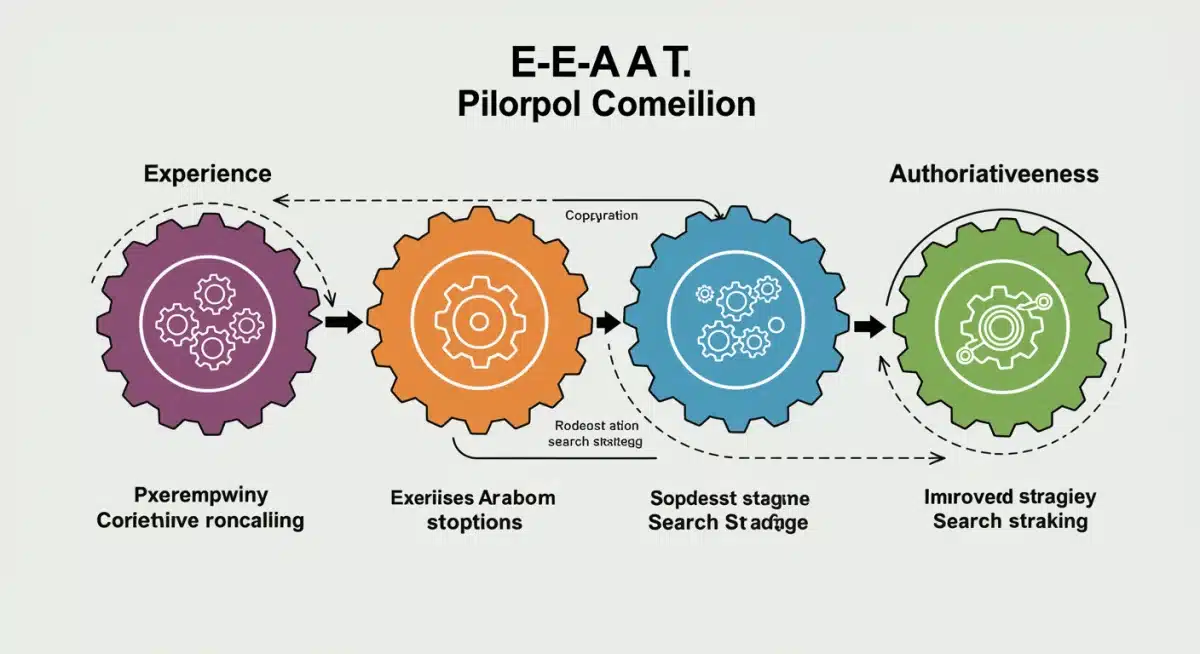
Strategy 3: Build Authoritativeness Through Thought Leadership
Authoritativeness is built over time through consistent contributions to your industry that position you as a thought leader. This involves more than just producing good content; it requires actively shaping conversations, offering unique perspectives, and being recognized by peers and the wider community.
Developing thought leadership means taking a stance, challenging conventional wisdom when appropriate, and providing forward-thinking insights that guide your audience. This kind of content isn’t just informative; it’s transformative.
Engaging in Industry Discussions and Publications
To establish authoritativeness, actively participate in industry dialogues. This can take many forms, from contributing to industry publications and speaking at conferences to engaging in online forums and social media discussions. Each interaction is an opportunity to demonstrate your knowledge and influence.
- Guest posting on reputable sites: Share your insights on high-authority platforms within your niche.
- Speaking engagements: Present at industry events, webinars, or podcasts to share your expertise.
- Active social media presence: Engage with followers, answer questions, and share valuable insights consistently.
- Publishing original research or reports: Contribute new knowledge to your field, establishing yourself as a pioneering voice.
The more you actively contribute to and shape industry conversations, the more recognized you become. Google’s algorithms consider external signals of authority, such as backlinks from reputable sources, mentions in industry news, and positive sentiment across the web. These signals cumulatively build your authoritativeness.
By consistently producing content that pushes the boundaries of current understanding and actively engaging with your professional community, you solidify your position as an authoritative voice. This not only enhances your E-E-A-T but also fosters a loyal audience eager for your next insight.
Strategy 4: Foster Trustworthiness with Transparency and Accuracy
Trustworthiness is the bedrock of E-E-A-T. Without it, even the most experienced and expert content will fail to gain traction. This pillar demands unwavering commitment to accuracy, transparency, and ethical content practices.
In an age of misinformation, being a reliable source is paramount. Your content must be meticulously fact-checked, sources clearly cited, and any potential biases or conflicts of interest openly disclosed.
Implementing Rigorous Fact-Checking and Source Citation
Every piece of information presented in your content should be verifiable. This requires a stringent fact-checking process, ensuring that all data, statistics, and claims are accurate and up-to-date. Misinformation can severely damage your credibility and, by extension, your E-E-A-T.
- Verify all statistics: Cross-reference data with original sources and reputable research institutions.
- Cite academic or industry sources: Link to studies, reports, or expert opinions to support your claims.
- Review for factual errors: Implement a thorough editorial process to catch and correct any inaccuracies before publishing.
- Disclose affiliations: Transparently state any partnerships, sponsorships, or conflicts of interest that might influence your content.
Beyond factual accuracy, transparency about your content creation process and the people behind your website builds trust. An easily accessible “About Us” page, clear author bios with credentials, and contact information all contribute to a trustworthy online presence.
By consistently upholding high standards of accuracy and transparency, you not only protect your reputation but also signal to Google that your website is a reliable source of information. This commitment to trustworthiness is a powerful differentiator and a key component of long-term SEO success.
Strategy 5: Optimize for User Engagement and Experience
While often overlooked in direct E-E-A-T discussions, user engagement and experience play a crucial indirect role. Google’s algorithms are designed to serve users the best possible results, and content that provides a superior user experience is inherently more valuable and therefore more trustworthy and authoritative.
This strategy focuses on making your content not only informative but also enjoyable, accessible, and easy to consume. A positive user experience encourages longer dwell times, lower bounce rates, and more shares, all of which are positive signals to Google.
Enhancing Content Readability and Accessibility
Content that is difficult to read or navigate will deter users, regardless of its underlying quality. Optimizing for readability involves using clear language, appropriate formatting, and visual aids to break up text and convey information effectively.
- Use clear, concise language: Avoid jargon where possible, or explain it thoroughly.
- Employ short paragraphs and sentences: Improve scannability and comprehension.
- Utilize headings and subheadings: Structure your content logically for easy navigation.
- Incorporate multimedia: Use images, videos, and infographics to enhance understanding and engagement.
- Ensure mobile responsiveness: Your content must be accessible and readable on all devices.
Accessibility is another critical aspect of user experience. This includes providing alternative text for images, captions for videos, and ensuring your website adheres to accessibility standards. Making your content accessible to a broader audience demonstrates inclusivity and a commitment to serving all users.
By prioritizing user engagement and experience, you create a positive feedback loop. Satisfied users are more likely to return, share your content, and ultimately contribute to a stronger online presence. These behavioral signals, combined with the direct E-E-A-T signals, reinforce your website’s authority and trustworthiness in the eyes of Google.
| Key E-E-A-T Aspect | Brief Description |
|---|---|
| Experience Showcase | Integrate personal anecdotes and case studies to demonstrate firsthand knowledge and practical skill. |
| Expertise Deepening | Utilize specialized content formats, expert interviews, and data-driven insights for comprehensive coverage. |
| Authoritativeness Building | Engage in industry discussions, guest posting, and thought leadership to gain peer recognition. |
| Trustworthiness Fostering | Implement rigorous fact-checking, clear source citation, and full transparency in content creation. |
Frequently Asked Questions About E-E-A-T
The first ‘E’ in E-E-A-T stands for Experience. Google added this to emphasize the importance of firsthand knowledge and practical engagement with the topic. It signifies that content creators should demonstrate real-world interaction, usage, or skill in the subject they are discussing, rather than just theoretical understanding.
Small businesses can demonstrate E-E-A-T by sharing customer testimonials, detailed case studies of their work, creating comprehensive guides based on their unique expertise, and actively participating in local industry events. Highlighting employee qualifications and experience on their website also builds credibility.
While E-E-A-T is particularly crucial for Your Money or Your Life (YMYL) topics due to their significant impact on users’ well-being, it applies to all content. Google’s quality raters evaluate E-E-A-T signals across various niches to ensure overall content quality and reliability, making it universally important for ranking.
A detailed author bio is vital for E-E-A-T. It helps establish the creator’s expertise and experience by showcasing their qualifications, professional background, and relevant achievements. A credible author bio assures readers and Google that the content is written by someone knowledgeable and trustworthy in the field.
Content should be updated regularly to reflect the latest information, trends, and user needs, which reinforces E-E-A-T. The frequency depends on the industry’s pace of change; highly dynamic fields might require monthly or quarterly reviews, while others can be updated annually. Fresh, accurate content signals ongoing expertise and trustworthiness.
Conclusion
Successfully navigating the digital landscape by mid-2025 demands a proactive and comprehensive approach to content creation, rooted deeply in the E-E-A-T framework. By prioritizing real-world experience, deepening expertise through specialized formats, building authoritativeness as a thought leader, fostering trustworthiness with transparency, and optimizing for an engaging user experience, content creators can significantly enhance their online visibility and credibility. These strategies are not merely about appeasing Google’s algorithms; they are about genuinely serving your audience with high-quality, reliable, and impactful information. Embracing E-E-A-T is an investment in long-term success, ensuring your content stands out as a beacon of trust and authority in a crowded digital world.