Competitive Content Analysis 2025: Steal 20% Organic Traffic

Competitive content analysis for 2025 is a strategic imperative for businesses aiming to dominate their niche, enabling them to identify and exploit SEO weaknesses in competitor strategies to significantly boost their own organic traffic.
In the dynamic landscape of digital marketing, staying ahead means not just understanding your audience, but also scrutinizing your rivals. This article delves into
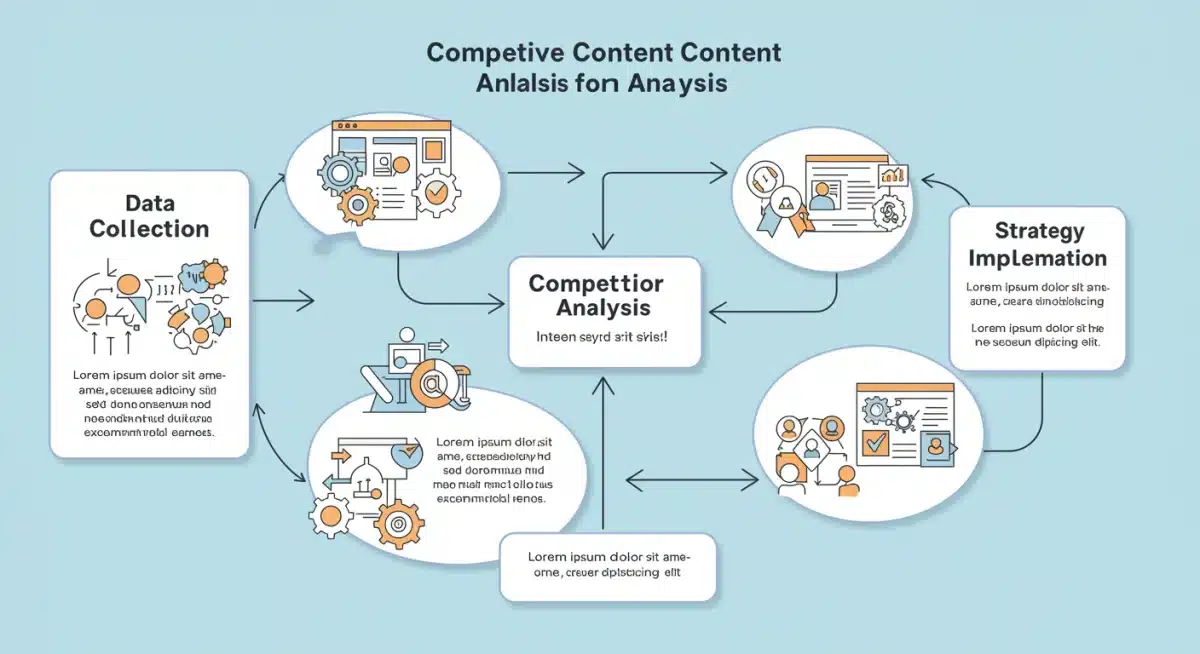
competitive content analysis for 2025: uncovering competitor SEO gaps to steal 20% of their organic traffic – a 4-step process. Are you ready to transform competitor insights into actionable strategies that propel your brand to the top of search engine results?
The Strategic Imperative of Competitive Content Analysis
Understanding what your competitors are doing right, and more importantly, where they fall short, is the cornerstone of a winning SEO strategy. Competitive content analysis isn’t merely about imitation; it’s about intelligent differentiation and strategic exploitation of market opportunities. In 2025, with algorithms becoming more sophisticated and user intent more nuanced, a deep dive into competitor content offers unparalleled advantages.
This strategic approach allows businesses to identify content gaps, discover underserved niches, and refine their own content creation process for maximum impact. By systematically analyzing competitor performance, you can uncover patterns that reveal their strengths and weaknesses, ultimately informing your own content strategy to attract a larger share of organic traffic.
Why Competitor Insights are Your Goldmine
- Identify Untapped Keywords: Discover keywords your competitors rank for that you haven’t yet targeted, or long-tail variations they’ve overlooked.
- Uncover Content Gaps: Find topics or formats that your competitors aren’t addressing, leaving a void you can fill with high-quality content.
- Benchmark Performance: Understand what’s working for others in terms of engagement, backlinks, and search visibility, setting realistic goals for your own efforts.
- Refine Content Strategy: Learn from their successes and failures to create more effective content that resonates with your shared target audience.
Ultimately, the goal is to not just compete, but to outmaneuver. By understanding the competitive landscape, you’re better equipped to make informed decisions that lead to sustainable organic growth and a dominant online presence. This foundational understanding sets the stage for the detailed analysis that follows.
Step 1: Identify Your Top Competitors and Their Digital Footprint
The first crucial step in any effective competitive content analysis is to accurately identify who your true competitors are in the digital realm. This isn’t always as straightforward as identifying direct business rivals. Online, your competitors include any website vying for the same keywords and organic search traffic that you are. Once identified, the next phase involves meticulously mapping out their digital footprint.
This mapping process goes beyond just their website. It includes their presence on social media, their backlink profiles, the types of content they produce, and the platforms they utilize for distribution. A comprehensive understanding of their digital ecosystem provides the necessary context for deeper content analysis.
Tools for Competitor Identification and Footprint Mapping
Leveraging the right tools is paramount for efficiency and accuracy in this initial phase. Several platforms offer robust features for competitor analysis, helping you gather data points that would otherwise be impossible to collect manually.
- Keyword Research Tools: Use tools like Semrush, Ahrefs, or Moz to discover who ranks for your target keywords. Often, you’ll find unexpected competitors.
- Backlink Analysis Tools: These tools reveal who is linking to your competitors’ content, indicating their authority and content popularity.
- Social Listening Tools: Monitor social media conversations to see who your audience engages with and what content resonates within your niche.
- Google Search: Perform incognito searches for your primary keywords to see who consistently appears in the top results.
Once you have a solid list of digital competitors, begin compiling data on their website structure, content types (blogs, videos, infographics, etc.), publication frequency, and overall content quality. This initial data collection forms the bedrock for the subsequent steps, allowing you to move from broad identification to granular analysis with confidence and precision.
Step 2: Dissecting Competitor Content Strategy and Performance
With your competitors identified, the next step involves a deep dive into their actual content strategy and how it performs. This goes beyond just looking at keywords; it’s about understanding the ‘why’ behind their content choices, their target audience, and the effectiveness of their distribution channels. The goal is to reverse-engineer their success and pinpoint their vulnerabilities.
This phase requires a systematic approach to analyzing individual pieces of content, content clusters, and overall content themes. You’ll be looking for patterns in their messaging, their calls to action, and the types of content that consistently generate engagement and high search rankings.
Key Metrics for Content Performance Analysis
Evaluating competitor content performance involves scrutinizing several key metrics that indicate success and areas for improvement. These metrics provide a quantifiable way to assess their content’s impact.
- Organic Visibility: How well does their content rank for target keywords? Are they dominating specific topics?
- Traffic Estimates: Use tools to estimate the organic traffic their top-performing content receives.
- Engagement Metrics: Look for social shares, comments, and time on page (if publicly available or estimable) to gauge audience interaction.
- Backlink Profiles: Analyze the quantity and quality of backlinks pointing to their content, indicating authority and trustworthiness.
- Content Format and Depth: What types of content do they produce (e.g., long-form articles, videos, guides)? How comprehensive are their pieces?
By dissecting these elements, you can start to piece together a clear picture of their strengths and weaknesses. For instance, a competitor might excel in short-form blog posts but neglect long-form guides, presenting an opportunity for you to fill that gap. This detailed dissection is crucial for moving towards the next step of identifying specific SEO vulnerabilities.
Step 3: Uncovering Competitor SEO Gaps and Opportunities
This is where the real magic happens. After meticulously identifying your competitors and dissecting their content, the focus shifts to finding the specific SEO gaps that you can exploit. These gaps represent opportunities to create content that outperforms theirs, captures their audience, and ultimately, steals a significant portion of their organic traffic. This step requires a keen eye for detail and a strategic mindset.
Uncovering these gaps involves cross-referencing your competitor’s content performance with your own target keywords and audience needs. It’s about finding where they are underperforming or completely absent, creating a clear runway for your content to soar.
Strategies for Identifying SEO Gaps
Several strategies can be employed to effectively pinpoint these critical SEO gaps. Combining these approaches will yield the most comprehensive insights.
- Keyword Gap Analysis: Use SEO tools to compare your keyword rankings against competitors. Identify keywords where they rank highly, and you don’t, or where you both rank poorly, indicating an opportunity for superior content.
- Content Topic Gaps: Look for topics relevant to your niche that your competitors haven’t covered in depth or at all. This is prime territory for creating authoritative, comprehensive content.
- Content Format Gaps: If competitors primarily use blog posts, consider creating videos, interactive tools, or detailed guides on the same topic to offer a different, potentially more engaging, user experience.
- Backlink Profile Gaps: Identify content areas where competitors have few backlinks despite ranking well. This suggests their content might be good, but not highly authoritative, opening a door for you to create a more robust, link-worthy piece.
- User Intent Gaps: Analyze if your competitors are truly satisfying user intent for their target keywords. Often, content ranks but doesn’t fully answer the user’s query, leaving room for you to provide a more complete and satisfying answer.
By systematically uncovering these gaps, you’re not just reacting to competitors; you’re proactively carving out your own space in the search results. This intelligence forms the foundation for developing a targeted content strategy that promises significant returns on your efforts.
Step 4: Crafting a Targeted Content Strategy to Seize Organic Traffic
The final step in this four-part process is to translate the insights gained from your competitive analysis into a concrete, actionable content strategy. This isn’t just about filling gaps; it’s about creating superior content that is strategically optimized to outperform competitors and capture a significant portion of their organic traffic. Your strategy should be specific, measurable, achievable, relevant, and time-bound (SMART).
This involves prioritizing content creation based on the identified gaps, optimizing for target keywords, and ensuring your content offers unique value to your audience. The ultimate goal is to establish your brand as the authoritative voice in those areas where competitors are weak or absent.
Implementing Your Traffic-Stealing Content Plan
A well-defined implementation plan is crucial for executing your strategy effectively. This plan should detail the types of content to be created, the keywords to target, and the optimization techniques to employ.
- Prioritize Content Creation: Focus on the highest-impact content gaps first. These are topics with high search volume, low competitor authority, and strong alignment with your business goals.
- Develop Superior Content: Don’t just replicate; elevate. Create content that is more comprehensive, better researched, more engaging, and more visually appealing than anything your competitors have produced.
- Strategic Keyword Integration: Naturally weave target keywords and their semantic variations throughout your content, titles, headings, and meta descriptions.
- Optimize for User Experience: Ensure your content is easy to read, well-structured, and provides a seamless experience across all devices. User signals are critical for SEO.
- Build Authority and Backlinks: Actively promote your superior content to relevant websites and influencers to earn high-quality backlinks, further boosting its search ranking.
- Monitor and Iterate: Continuously track your content’s performance against competitors. SEO is an ongoing process, requiring regular adjustments and optimizations.
By meticulously executing this targeted content strategy, you can systematically erode your competitors’ organic search dominance and redirect a substantial portion of their traffic to your own digital properties. This proactive approach ensures sustained growth and a stronger competitive edge in 2025 and beyond.
Measuring Success and Continuous Optimization
After implementing your targeted content strategy, the work doesn’t stop. Measuring the success of your efforts and continuously optimizing your approach are critical to sustaining growth and maintaining your competitive advantage. The digital landscape is always evolving, and your strategy must evolve with it.
This phase involves tracking key performance indicators (KPIs) related to organic traffic, search rankings, and user engagement. Regular analysis of this data will inform future content decisions and highlight areas where further optimization or new strategic directions are needed. It’s an iterative process of creation, measurement, learning, and adaptation.
Key Metrics for Tracking and Optimization
To effectively measure your success and guide continuous optimization, focus on a core set of metrics that directly reflect your goals of stealing organic traffic and improving SEO performance.
- Organic Traffic Growth: The most direct indicator of success. Track increases in organic sessions and users to your targeted content pages.
- Keyword Rankings: Monitor your position for the keywords you targeted, especially those where competitors previously dominated.
- Conversion Rates: If applicable, track how well your new traffic converts into leads or sales. High traffic is good, but converting traffic is better.
- Backlink Acquisition: Observe the number and quality of new backlinks pointing to your content, as this validates its authority and relevance.
- Engagement Metrics: Analyze bounce rate, time on page, and social shares to understand how well your content resonates with readers.
Regularly review these metrics, ideally on a monthly or quarterly basis, to identify trends and pinpoint areas for improvement. A/B test different content formats, titles, or calls to action to see what performs best. The insights gained from continuous measurement will enable you to refine your strategy, adapt to algorithm changes, and ensure you remain ahead of your competitors in the quest for organic traffic dominance.
Future-Proofing Your Content Strategy for 2025 and Beyond
The digital marketing arena is in a constant state of flux, making it imperative to not only react to current trends but also to anticipate future shifts. Future-proofing your content strategy in 2025 means building resilience against algorithm updates, evolving user behaviors, and emerging technologies. It’s about creating a robust framework that can adapt and thrive irrespective of external changes.
This involves a commitment to quality, a focus on user experience, and an openness to experimenting with new content formats and distribution channels. By staying agile and forward-thinking, you can ensure your competitive content analysis efforts yield long-term benefits.
Anticipating Future SEO Trends
To stay ahead, consider these evolving aspects of SEO and content creation:
- AI-Powered Search: With AI increasingly influencing search results, content that demonstrates E-E-A-T (Experience, Expertise, Authoritativeness, Trustworthiness) will be paramount. Focus on original insights and human-centric content.
- Voice Search Optimization: As voice search grows, optimizing for conversational keywords and natural language queries will become more critical.
- Visual Search: Leverage high-quality images and videos, optimizing them for visual search platforms to capture a broader audience.
- Personalization: Deliver highly personalized content experiences based on user data and preferences, fostering deeper engagement and loyalty.
- Core Web Vitals and Page Experience: Google continues to emphasize user experience. Ensure your website is fast, responsive, and provides an excellent browsing experience.
By integrating these forward-looking considerations into your content strategy, you’re not just competing for today’s organic traffic; you’re building a sustainable foundation for success in the years to come. Competitive content analysis becomes an ongoing cycle of learning, adapting, and innovating, ensuring your brand remains a leader in the digital space.
| Key Aspect | Brief Description |
|---|---|
| Identify Competitors | Pinpoint direct and indirect digital rivals vying for your target keywords and audience. |
| Analyze Content Strategy | Dissect competitor content for keywords, formats, performance metrics, and audience engagement. |
| Uncover SEO Gaps | Find specific content and keyword opportunities where competitors are weak or absent. |
| Implement & Optimize | Craft and execute superior content, then continuously monitor and refine for maximum organic traffic gain. |
Frequently Asked Questions About Competitive Content Analysis
Competitive content analysis is the process of examining competitor content strategies to identify their strengths, weaknesses, and opportunities. In 2025, it’s crucial for SEO because it helps uncover content gaps, discover high-performing keywords, and refine your own strategy to capture a larger share of organic traffic, staying ahead in a competitive digital landscape.
True online competitors are not just direct business rivals but any website ranking for your target keywords. Use SEO tools like Semrush or Ahrefs to see who consistently appears in top search results for your primary keywords. Also, conduct incognito Google searches and monitor social media for who your audience engages with regarding specific topics.
Key metrics include organic visibility (keyword rankings), estimated organic traffic, backlink profiles (quantity and quality of links), content formats and depth, and user engagement signals like social shares and comments. Analyzing these provides insights into what content is performing well and why, helping you identify areas for improvement.
To identify SEO content gaps, perform keyword gap analysis to find keywords competitors rank for that you don’t. Look for topics they haven’t covered in depth or at all, and consider alternative content formats (e.g., video if they only use text). Also, assess if their content truly satisfies user intent; if not, you can create a more comprehensive piece.
‘Stealing 20% of organic traffic’ refers to strategically outranking competitors for a significant portion of shared keywords or dominating underserved niches, thereby diverting a measurable percentage of search users who would otherwise visit competitor sites, to your own. It’s an ambitious yet achievable goal through methodical analysis and superior content creation.
Conclusion
The journey through competitive content analysis for 2025 reveals a clear pathway to not just competing, but dominating the digital landscape. By systematically identifying competitors, dissecting their strategies, uncovering crucial SEO gaps, and implementing a targeted, superior content plan, businesses can realistically aim to divert a substantial portion of organic traffic from their rivals. This isn’t a one-time endeavor but a continuous cycle of analysis, creation, measurement, and adaptation. Embracing this strategic approach will ensure your brand remains resilient, relevant, and highly visible in the ever-evolving world of digital marketing, securing your position as a leader in your industry.