CDP Implementation: A 6-Month Guide for U.S. Marketing Teams

Implementing a Customer Data Platform (CDP) in six months allows U.S. marketing teams to centralize customer data, unify profiles, and drive highly personalized campaigns, leading to significant ROI improvements.
In today’s competitive landscape, understanding your customer is paramount. This comprehensive guide delves into The Rise of Customer Data Platforms (CDPs): A 6-Month Implementation Guide for U.S. Marketing Teams, offering a clear roadmap to harness the power of unified customer data. Discover how a well-executed CDP strategy can transform your marketing efforts, driving deeper engagement and measurable results.
Understanding the CDP Imperative for U.S. Marketing
The modern marketing environment in the U.S. is characterized by fragmented data, siloed systems, and an ever-increasing demand for personalization. Customers expect relevant, timely interactions across all touchpoints. This creates a significant challenge for marketing teams trying to build a cohesive view of their audience.
A Customer Data Platform (CDP) acts as a centralized hub, consolidating customer data from various sources into a single, unified profile. This holistic view empowers marketers to move beyond guesswork, enabling data-driven decisions and highly targeted campaigns that resonate with individual customers. Without a CDP, achieving true personalization at scale becomes an arduous, often impossible, task.
Why CDPs are essential now
The shift towards privacy-centric regulations and the deprecation of third-party cookies underscore the urgency for first-party data strategies. CDPs are foundational to this shift, allowing brands to own and control their customer data, fostering trust and enabling compliant, personalized experiences.
- Data Unification: Consolidates data from CRM, ERP, web analytics, mobile apps, social media, and more.
- Single Customer View: Creates persistent, unified customer profiles, resolving identities across devices and channels.
- Enhanced Personalization: Powers hyper-targeted campaigns and individualized customer journeys.
- Operational Efficiency: Automates data collection, segmentation, and activation, freeing up marketing resources.
In conclusion, the imperative for U.S. marketing teams to adopt a CDP is no longer a luxury but a strategic necessity. It’s about transforming raw data into actionable insights, providing a competitive edge in a saturated market, and building lasting customer relationships.
Phase 1: Foundation and Strategy (Months 1-2)
The initial two months of your CDP implementation journey are critical for laying a solid foundation. This phase involves defining your strategic objectives, assembling the right team, and thoroughly assessing your current data landscape. Rushing this stage can lead to misaligned expectations and costly rework down the line.
Success here hinges on clear communication and cross-functional collaboration. Marketing, IT, and data privacy teams must work in concert to establish a shared vision for how the CDP will serve the organization’s goals. This collaborative approach ensures that the platform selected and implemented will genuinely address existing pain points and unlock new opportunities.
Defining objectives and use cases
Before selecting any technology, it’s crucial to understand what you aim to achieve. What specific marketing challenges will the CDP solve? What are the key performance indicators (KPIs) that will measure success?
- Improved Customer Segmentation: Create more granular and dynamic customer segments.
- Personalized Content Delivery: Deliver tailored messages and offers across channels.
- Enhanced Customer Journey Mapping: Understand and optimize customer paths.
- Attribution Modeling: Gain clearer insights into marketing campaign effectiveness.
Data audit and vendor selection
A comprehensive audit of your existing data sources, quality, and governance policies is essential. Identify where customer data resides, its format, and any current limitations. This audit will inform your requirements for a CDP vendor.
Vendor selection should be a meticulous process, evaluating platforms not just on features, but also on their ability to integrate with your existing tech stack, scalability, and support. Request demos, check references, and consider proof-of-concept projects to ensure the chosen CDP aligns with your long-term vision.
This foundational phase sets the stage for a successful CDP rollout. By carefully planning and establishing clear objectives, U.S. marketing teams can ensure their investment in a CDP yields significant returns, transforming their approach to customer engagement.
Phase 2: Data Integration and Governance (Months 3-4)
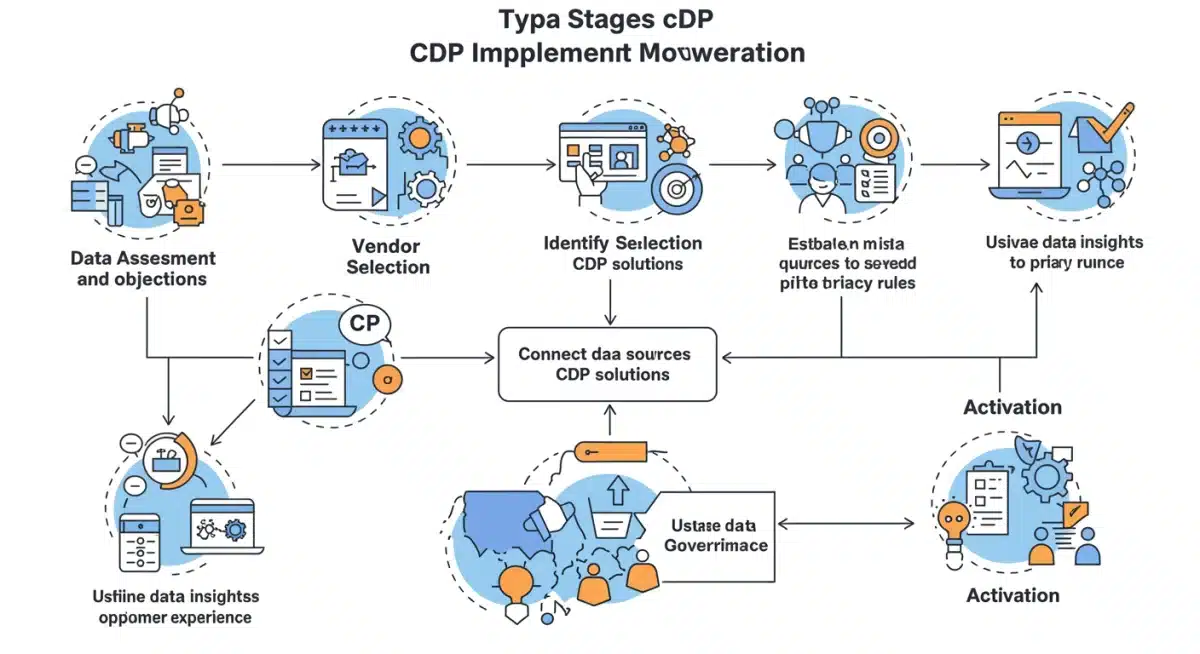
With a strategic foundation in place and a CDP vendor selected, months three and four shift focus to the technical heavy lifting: integrating disparate data sources and establishing robust data governance frameworks. This is where the CDP truly begins to earn its stripes, transforming fragmented information into a unified, actionable asset.
The complexity of data integration can vary significantly depending on the number and type of sources, as well as the cleanliness of existing data. It’s crucial to approach this phase with a clear prioritization of data sources, starting with those that offer the most immediate value for your defined use cases. This phased approach helps manage complexity and delivers early wins.
Connecting the data pipes
Integrating various data sources into the CDP is a multi-step process. This involves establishing APIs, connectors, or batch file transfers from systems like CRM, e-commerce platforms, web analytics, mobile apps, and customer service tools. The goal is to stream or upload data into the CDP, where it can then be processed and unified.
Data mapping is a critical component here, ensuring that fields from different sources are correctly aligned within the CDP’s data model. This consistency is vital for building accurate customer profiles. Technical teams will play a significant role in executing these integrations, often working closely with the CDP vendor’s support team.
Establishing data quality and governance
Simply integrating data isn’t enough; it must be clean, consistent, and compliant. This phase focuses on defining and implementing data quality rules, deduplication processes, and identity resolution strategies. A unified customer profile is only as good as the data that feeds it.
- Data Cleansing: Identify and rectify inaccuracies, inconsistencies, and redundancies.
- Identity Resolution: Match customer identities across various data points to create a single view.
- Privacy Compliance: Ensure all data collection, storage, and usage adhere to regulations like CCPA and GDPR.
- Access Control: Define who has access to what data within the CDP, based on roles and responsibilities.
By the end of this phase, U.S. marketing teams should have a significant portion of their customer data flowing into the CDP, with initial unified customer profiles beginning to take shape. Strong data governance ensures the integrity and usability of this valuable asset.
Phase 3: Activation and Optimization (Months 5-6)
The final two months of the 6-month CDP implementation guide are dedicated to activating the platform’s capabilities and continuously optimizing its performance. This is where U.S. marketing teams begin to realize the tangible benefits of their investment, transforming unified data into personalized customer experiences and measurable marketing outcomes.
Activation involves leveraging the CDP’s segmentation, journey orchestration, and analytics features to execute targeted campaigns. It’s an iterative process, requiring constant testing, learning, and refinement. The goal is not just to launch campaigns, but to establish a feedback loop that continuously improves marketing effectiveness.
Segmenting and activating audiences
With unified customer profiles, marketers can create highly specific audience segments based on a rich array of demographic, behavioral, and transactional data. These segments enable hyper-personalization, ensuring that messages are relevant to the individual’s needs and preferences.
- Dynamic Segmentation: Create segments that update in real-time based on customer behavior.
- Cross-Channel Orchestration: Use CDP data to trigger personalized emails, advertisements, website content, and mobile notifications.
- A/B Testing: Experiment with different messages and offers to optimize campaign performance.
- Real-time Personalization: Deliver personalized experiences based on current customer interactions.
Measuring impact and iterating
The true value of a CDP lies in its ability to drive measurable business results. This phase emphasizes tracking key metrics, analyzing campaign performance, and using these insights to refine strategies and optimize the platform’s usage. It’s a continuous cycle of improvement.
Establish clear KPIs linked to your initial objectives, such as increased conversion rates, improved customer retention, higher average order value, or reduced customer acquisition costs. Regularly review these metrics and adjust your CDP strategies accordingly. Training marketing teams on how to effectively use the CDP’s features is also paramount for long-term success.
By the end of this phase, U.S. marketing teams should be actively using their CDP to drive personalized marketing initiatives, demonstrating a clear return on investment and establishing a foundation for ongoing data-driven growth and innovation.
Overcoming Common CDP Implementation Challenges
Implementing a Customer Data Platform is a significant undertaking, and U.S. marketing teams often encounter various hurdles. Anticipating these challenges and developing proactive strategies to address them can significantly smooth the implementation process and ensure long-term success. It’s not just about the technology, but about people, processes, and data.
One of the most common pitfalls is underestimating the complexity of data integration, especially when dealing with legacy systems or inconsistent data formats. Another challenge often arises from a lack of clear ownership or collaboration between different departments, particularly between marketing and IT.
Data quality and integration complexities
Poor data quality is a pervasive issue that can cripple a CDP’s effectiveness. Inaccurate, incomplete, or duplicate data leads to flawed insights and ineffective personalization. Addressing this requires a dedicated effort in data cleansing and ongoing data maintenance.
- Pre-implementation Data Audit: Thoroughly assess data quality before integration.
- Standardization Protocols: Implement consistent data entry and formatting across all sources.
- Automated Data Cleansing Tools: Utilize CDP features or third-party tools for ongoing data hygiene.
- Phased Integration: Prioritize and integrate data sources incrementally to manage complexity.
Organizational alignment and skill gaps
A CDP impacts multiple departments, and without proper buy-in and collaboration, its potential can be severely limited. Marketing teams need to work closely with IT, sales, and customer service to ensure a unified approach to customer data.
Furthermore, there can be a skill gap within marketing teams regarding data analysis, segmentation, and leveraging advanced CDP features. Investing in training and upskilling is crucial to maximize the platform’s utility. This involves not only technical training but also fostering a data-driven culture within the organization.
By proactively addressing these challenges, U.S. marketing teams can navigate the complexities of CDP implementation more effectively, ensuring the platform delivers on its promise of enhanced customer understanding and personalized engagement.
Measuring ROI and Continuous Improvement
The true measure of a successful CDP implementation lies in its ability to deliver a tangible return on investment (ROI). For U.S. marketing teams, this means not only tracking traditional marketing metrics but also attributing improvements directly to the unified customer data and personalization capabilities enabled by the CDP. This phase is about proving value and fostering a culture of continuous optimization.
Beyond initial ROI, the ongoing success of a CDP depends on a commitment to continuous improvement. The customer landscape, data privacy regulations, and technological capabilities are constantly evolving. Regular reviews, updates, and adaptation are essential to ensure the CDP remains a strategic asset.
Key metrics for CDP success
Measuring ROI requires identifying specific metrics that align with your business objectives. These can range from improvements in customer engagement to direct revenue growth. It’s important to establish baseline metrics before CDP implementation to accurately gauge the impact.
- Customer Lifetime Value (CLTV): Track increases due to better retention and personalized offers.
- Conversion Rates: Monitor improvements in campaign-specific and overall conversion metrics.
- Customer Acquisition Cost (CAC): Analyze reductions through more targeted advertising.
- Marketing Campaign Performance: Evaluate open rates, click-through rates, and engagement for personalized campaigns.
- Customer Satisfaction (CSAT) / Net Promoter Score (NPS): Assess improvements from enhanced customer experiences.
Iterative optimization and future-proofing
A CDP is not a set-it-and-forget-it solution. It requires ongoing attention to data quality, new integrations, and feature utilization. Regularly review your data sources, ensure they are still relevant, and explore new potential integrations as your business evolves.
Furthermore, stay abreast of CDP technological advancements and industry best practices. This includes exploring AI and machine learning capabilities within your CDP for predictive analytics and advanced personalization. Regularly train your team on new features and use cases to maximize the platform’s potential. This iterative approach ensures the CDP continues to drive value and remains future-proof.
Ultimately, a successful CDP implementation for U.S. marketing teams is characterized by demonstrable ROI and a proactive approach to continuous improvement. This commitment ensures the platform remains a powerful tool for understanding, engaging, and retaining customers in an ever-changing digital world.
The Future of CDPs in the U.S. Marketing Landscape
As U.S. marketing teams navigate an increasingly complex digital ecosystem, the role of Customer Data Platforms is set to expand significantly. The demand for deeper customer insights, hyper-personalization, and robust data privacy compliance will continue to drive CDP adoption and evolution. The future isn’t just about collecting data, but intelligently activating it.
Emerging trends suggest CDPs will become even more central to the marketing technology stack, acting as the brain that orchestrates interactions across all customer touchpoints. This evolution will be fueled by advancements in artificial intelligence, machine learning, and the ongoing shift towards first-party data strategies in a privacy-first world.
AI and machine learning integration
The integration of AI and machine learning (ML) capabilities within CDPs is already transforming how U.S. marketing teams leverage customer data. These advanced analytics can identify subtle patterns, predict future behaviors, and automate complex segmentation and personalization tasks.
- Predictive Analytics: Forecast customer churn, purchase intent, and optimal messaging.
- Automated Segmentation: Dynamically group customers based on evolving behaviors.
- Personalized Product Recommendations: Deliver highly relevant suggestions in real-time.
- Journey Orchestration: Automate and optimize multi-step customer journeys across channels.
The first-party data advantage
With the impending deprecation of third-party cookies, first-party data collected and managed by CDPs becomes an invaluable asset. U.S. marketing teams will increasingly rely on their own customer data to understand audiences, build relationships, and drive advertising effectiveness without relying on external identifiers.
This shift emphasizes the importance of trust and transparency in data collection. CDPs provide the infrastructure to manage consent, preferences, and data privacy, ensuring brands can build direct, ethical relationships with their customers. The future of marketing is deeply rooted in owning and effectively utilizing this first-party data foundation.
In essence, CDPs are evolving from mere data aggregators to intelligent engines that power the next generation of personalized marketing. For U.S. marketing teams, embracing this evolution means staying ahead of the curve, delivering exceptional customer experiences, and achieving sustainable growth in a data-driven world.
| Key Implementation Phase | Brief Description |
|---|---|
| Months 1-2: Foundation | Define strategic goals, audit existing data, and select the appropriate CDP vendor. |
| Months 3-4: Integration | Connect data sources, establish data quality rules, and implement governance policies. |
| Months 5-6: Activation | Segment audiences, launch personalized campaigns, and measure initial ROI. |
| Ongoing: Optimization | Continuously refine strategies, integrate new data sources, and adapt to market changes. |
Frequently asked questions about CDP implementation
The primary benefit of a CDP is creating a single, unified view of each customer by consolidating data from various sources. This enables U.S. marketing teams to achieve deeper customer understanding, facilitating hyper-personalized marketing campaigns and more relevant customer experiences across all channels, ultimately driving better engagement and ROI.
While a full-scale CDP implementation can vary, a strategic 6-month roadmap, as outlined in this guide, is a realistic timeline for U.S. marketing teams to achieve initial operational status and start seeing tangible benefits. This includes phases for strategy, data integration, and initial activation, with continuous optimization thereafter.
Key challenges often include ensuring high data quality, integrating disparate legacy systems, and achieving strong organizational alignment between marketing, IT, and other departments. Addressing potential skill gaps within the marketing team and establishing robust data governance are also crucial for success.
A CDP centralizes customer consent and preference data, making it easier for U.S. marketing teams to manage and adhere to privacy regulations like CCPA and upcoming state-specific laws. It provides a structured way to track permissions, ensuring data usage is compliant and builds customer trust in data handling practices.
AI and machine learning will increasingly enhance CDP capabilities by enabling predictive analytics, automated segmentation, and real-time personalization. This allows U.S. marketing teams to anticipate customer needs, optimize campaign performance, and deliver truly dynamic and relevant experiences at scale, moving beyond basic segmentation.
Conclusion
The journey to implement a Customer Data Platform is a transformative one for U.S. marketing teams, offering a powerful solution to the complexities of modern customer engagement. By following a structured 6-month guide, organizations can successfully unify their customer data, unlock unparalleled personalization capabilities, and drive significant marketing ROI. The CDP is not merely a tool; it’s a strategic imperative that empowers marketers to build deeper, more meaningful relationships with their audience, ensuring relevance and sustained growth in an increasingly data-driven world.