Big Data & Hyper-Personalization: 20% CLV Lift by 2025

Achieving a 20% lift in customer lifetime value (CLV) by 2025 hinges on effectively leveraging big data for hyper-personalization, enabling businesses to deliver uniquely tailored customer experiences.
In today’s fiercely competitive digital landscape, the ability to truly understand and anticipate customer needs is no longer a luxury but a necessity. The ambition to achieve a 20% lift in customer lifetime value (CLV) by 2025 through the strategic application of big data for hyper-personalization represents a significant, yet attainable, goal for forward-thinking organizations. This isn’t just about sending targeted emails; it’s about crafting an individual journey for each customer, predicting their next move, and delivering value at every touchpoint.
Understanding big data and hyper-personalization
The concepts of big data and hyper-personalization are often discussed, but their profound impact when combined is frequently underestimated. Big data refers to datasets so large and complex that traditional data processing applications are inadequate to deal with them. These datasets come from various sources, including customer transactions, social media interactions, web browsing history, IoT devices, and more. When analyzed effectively, big data reveals patterns, trends, and associations, especially relating to human behavior and interactions.
Hyper-personalization, on the other hand, takes personalization a significant step further. While traditional personalization might segment customers into broad groups, hyper-personalization focuses on the individual. It uses real-time data, artificial intelligence (AI), and machine learning (ML) to deliver highly relevant content, products, and services tailored to each customer’s specific preferences, behaviors, and context at a given moment. This level of individualization creates a sense of being truly understood and valued, fostering deeper connections and loyalty.
The synergy between big data and hyper-personalization is the engine driving enhanced customer experiences. Without big data, hyper-personalization would lack the depth and breadth of insights required to be truly effective. Conversely, without hyper-personalization, big data remains a treasure trove of untapped potential, unable to translate raw information into actionable, customer-centric strategies. Understanding this foundational relationship is crucial for any business aiming to significantly boost its CLV in the coming years.
In essence, big data provides the raw intelligence, while hyper-personalization is the sophisticated mechanism that transforms that intelligence into bespoke customer interactions. This dynamic duo allows businesses to move beyond generic marketing to a realm where every customer interaction feels uniquely crafted for them, ultimately enhancing satisfaction and driving long-term value.
The direct link between hyper-personalization and CLV growth
The connection between hyper-personalization and customer lifetime value (CLV) is not merely theoretical; it’s a measurable outcome. When customers receive experiences that are deeply relevant to their individual needs and preferences, several positive effects cascade, directly impacting their long-term value to a business. This goes beyond simple satisfaction, touching on loyalty, engagement, and willingness to spend more.
Hyper-personalization fosters a stronger emotional connection between the customer and the brand. When a brand consistently anticipates needs, offers relevant solutions, and communicates in a way that resonates with the individual, customers feel valued and understood. This emotional bond reduces churn, increases repeat purchases, and encourages higher spending over time. It transforms a transactional relationship into a partnership, where the customer feels the brand is genuinely invested in their success or well-being.
Enhanced customer retention through tailored experiences
- Reduced Churn: Personalized recommendations and proactive support address potential issues before they escalate, preventing customers from seeking alternatives.
- Increased Engagement: Relevant content and offers keep customers actively involved with the brand, making them less likely to drift away.
- Stronger Loyalty: A consistent stream of tailored experiences builds trust and reinforces the idea that the brand understands and cares for its customers.
Moreover, hyper-personalization can significantly increase the average order value (AOV) and purchase frequency. By recommending complementary products or services at the right time, or by presenting upgrades that genuinely align with a customer’s evolving needs, businesses can encourage additional spending. This is not about aggressive upselling, but about intelligent, value-added suggestions that enhance the customer’s overall experience with the product or service. The direct result is a healthier, more predictable revenue stream from existing customers, which is far more cost-effective than constantly acquiring new ones.
Ultimately, hyper-personalization acts as a powerful lever for CLV growth by cultivating a loyal customer base that not only spends more but also advocates for the brand. This organic advocacy attracts new customers, creating a virtuous cycle of growth driven by exceptional, individualized experiences.
Key technologies enabling data-driven personalization
The ambitious goal of achieving a 20% CLV lift by 2025 through hyper-personalization relies heavily on a robust technological foundation. Several key technologies are indispensable for collecting, processing, analyzing, and acting upon the vast amounts of data required for true individualization. Without these tools, big data remains unwieldy, and hyper-personalization merely a concept.
At the core are advanced analytics platforms, often powered by artificial intelligence (AI) and machine learning (ML). These platforms are capable of ingesting massive datasets from disparate sources, identifying complex patterns, and making predictions about customer behavior. AI algorithms can process unstructured data, such as customer reviews or social media comments, to gauge sentiment and extract valuable insights. Machine learning models, on the other hand, can continuously learn from new data, refining their personalization recommendations and improving accuracy over time. This iterative learning is crucial for keeping personalization efforts fresh and relevant as customer preferences evolve.
Essential technological components
- Customer Data Platforms (CDPs): These platforms unify customer data from various sources into a single, comprehensive customer profile, providing a 360-degree view essential for hyper-personalization.
- Real-time Data Processing: The ability to collect and analyze data in real-time allows businesses to respond instantly to customer actions and deliver timely, contextually relevant experiences.
- Predictive Analytics: Utilizing historical data to forecast future customer behavior, such as churn risk or next best offer, enabling proactive personalization strategies.
- Marketing Automation Platforms: Tools that automate the delivery of personalized messages and content across multiple channels, ensuring consistency and efficiency.
Beyond these foundational technologies, cloud computing provides the scalable infrastructure necessary to store and process big data without prohibitive upfront costs. Data visualization tools translate complex analytical findings into easily understandable dashboards, empowering decision-makers to act swiftly. Furthermore, robust security protocols and privacy-enhancing technologies are paramount to ensure customer trust and compliance with evolving data protection regulations. The intelligent integration of these technologies forms the backbone of a successful hyper-personalization strategy, transforming raw data into meaningful, individualized customer journeys.
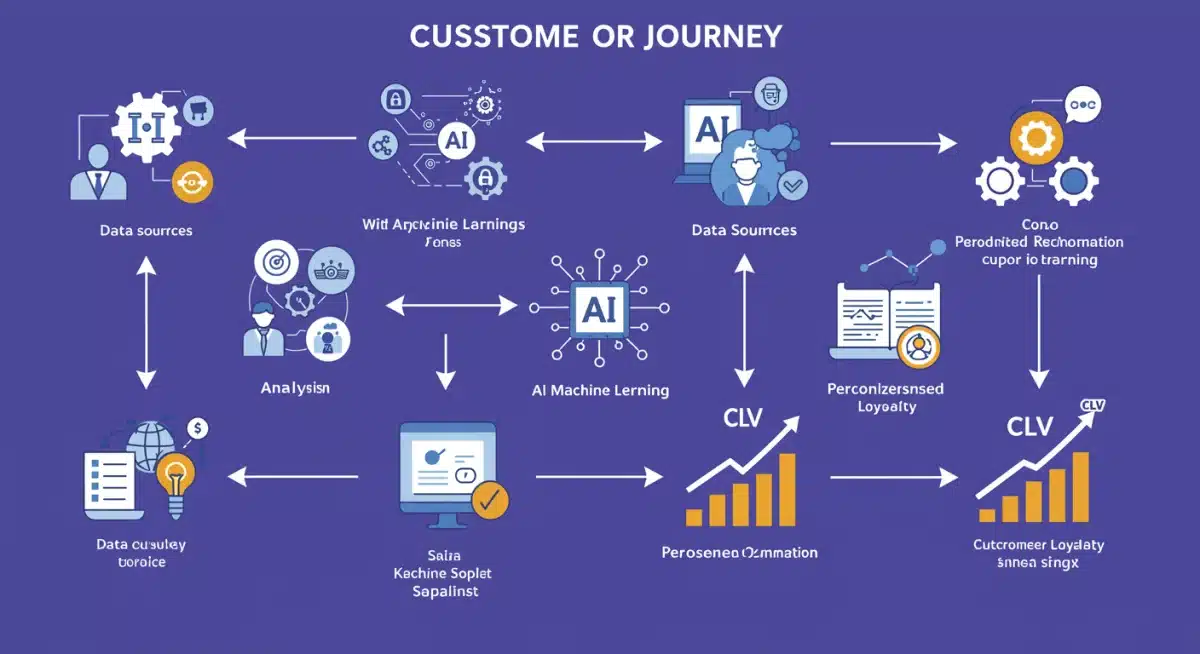
Strategic implementation: from data collection to tailored experiences
Implementing a hyper-personalization strategy that yields a 20% CLV lift requires a systematic approach, moving from meticulous data collection to the seamless delivery of tailored experiences. It’s not a one-time project but an ongoing process of refinement and adaptation. The starting point is understanding what data is available, what data is needed, and how it can be ethically and effectively gathered.
Data collection must be comprehensive, spanning all customer touchpoints. This includes online behavior (website visits, clicks, search queries), transaction history, customer service interactions, social media engagement, and even demographic information where appropriate and consented. The quality and breadth of this data directly influence the accuracy and effectiveness of personalization efforts. Once collected, raw data needs to be cleaned, structured, and integrated into a unified customer profile, often within a Customer Data Platform (CDP). This single source of truth eliminates data silos and provides a holistic view of each customer.
Building blocks of a successful hyper-personalization strategy
The journey from raw data to a personalized interaction involves several critical steps, each requiring careful planning and execution.
- Data Governance and Ethics: Establish clear policies for data collection, storage, and usage, ensuring compliance with privacy regulations like GDPR and CCPA, and building customer trust through transparency.
- Advanced Analytics and Segmentation: Employ AI and ML algorithms to analyze unified data, identifying micro-segments and predicting individual preferences, behaviors, and future needs.
- Content and Offer Orchestration: Develop a dynamic content strategy that allows for the creation and delivery of highly individualized messages, product recommendations, and offers across various channels.
- Real-time Engagement and Feedback Loops: Implement systems for real-time interaction and continuously collect feedback to refine personalization models and adapt to changing customer preferences instantly.
The final, and perhaps most crucial, step is the deployment of these tailored experiences across all customer-facing channels – website, mobile app, email, social media, and even in-store interactions. This requires robust marketing automation and integration capabilities to ensure consistency and relevance. Regular monitoring and A/B testing of personalized campaigns are essential to measure impact, identify areas for improvement, and ensure the strategy continually contributes to the desired CLV lift. This iterative process of data collection, analysis, execution, and optimization is the hallmark of a truly effective hyper-personalization strategy.
Measuring success: metrics for a 20% CLV lift
To confidently claim a 20% lift in customer lifetime value (CLV) by 2025, businesses must establish clear, measurable metrics and consistently track their progress. It’s not enough to implement hyper-personalization; proving its efficacy requires a robust measurement framework. This framework should encompass both direct CLV calculations and a suite of supporting metrics that indicate positive movement towards the overarching goal.
The primary metric, of course, is CLV itself. This can be calculated in various ways, but a common approach involves averaging customer revenue over a specific period, subtracting the costs of serving that customer, and then multiplying by the average customer lifespan. Tracking this metric before and after hyper-personalization initiatives begin provides the most direct evidence of impact. However, CLV is often a lagging indicator, meaning it reflects past performance. Therefore, a comprehensive measurement strategy also includes leading indicators that predict future CLV growth.
These leading indicators often revolve around customer engagement, satisfaction, and purchase behavior. Increased website dwell time, higher email open and click-through rates for personalized content, and improved conversion rates on personalized offers are all strong signals that hyper-personalization is resonating with customers. Additionally, a reduction in customer churn rates directly contributes to CLV by extending the customer lifespan, while an increase in average order value (AOV) or purchase frequency boosts the revenue component of CLV. Net Promoter Score (NPS) or Customer Satisfaction (CSAT) scores can also provide qualitative insights into the customer experience, indicating whether personalization efforts are truly valued.
Regular analysis of these metrics, perhaps on a quarterly or even monthly basis, allows businesses to make data-driven adjustments to their hyper-personalization strategies. This iterative process of measurement, analysis, and optimization is vital for ensuring that efforts remain aligned with the 20% CLV growth target. Without a clear and consistent measurement strategy, even the most sophisticated hyper-personalization efforts risk becoming an exercise in futility, lacking the tangible proof of their business impact.
Overcoming challenges in hyper-personalization implementation
While the promise of a 20% CLV lift through hyper-personalization is compelling, the journey to implementation is not without its hurdles. Businesses often encounter significant challenges that can impede progress if not addressed proactively. Understanding these obstacles and developing strategies to overcome them is crucial for a successful data-driven personalization initiative.
One of the most common challenges is data fragmentation. Customer data often resides in disparate systems – CRM, ERP, marketing automation, customer service platforms – creating silos that prevent a unified customer view. Integrating these systems and consolidating data into a single, accessible platform, such as a Customer Data Platform (CDP), is a foundational step. This requires significant IT investment and cross-departmental collaboration. Another major hurdle is data quality. Inaccurate, incomplete, or outdated data can lead to flawed insights and ineffective, or even detrimental, personalization efforts. Implementing robust data governance policies, data cleansing processes, and continuous data validation is essential to maintain high data quality.
Common challenges and mitigation strategies
- Privacy Concerns and Regulations: Navigate strict data privacy laws (e.g., GDPR, CCPA) by prioritizing transparency, obtaining explicit consent, and implementing privacy-by-design principles in all data collection and usage.
- Talent Gap: Address the shortage of skilled data scientists, AI/ML engineers, and personalization strategists by investing in training current employees or partnering with external experts and agencies.
- Technological Complexity: Manage the integration of multiple complex systems by adopting modular architectures, leveraging API-first approaches, and ensuring scalability of infrastructure.
- Organizational Silos: Foster a culture of data sharing and collaboration across marketing, sales, and IT departments to ensure a cohesive hyper-personalization strategy.
Beyond technical issues, organizational resistance to change and a lack of understanding of AI and ML capabilities can also hinder adoption. Educating stakeholders, demonstrating early wins, and fostering a data-driven culture are vital. Furthermore, the sheer volume and velocity of data can be overwhelming, necessitating sophisticated analytical tools and skilled personnel to extract meaningful insights. By systematically addressing these challenges, businesses can pave the way for a smoother implementation of hyper-personalization and unlock its full potential for CLV growth.
The future of hyper-personalization: AI, ethics, and sustained CLV
As we look towards 2025 and beyond, the future of hyper-personalization is poised for even greater sophistication, driven by advancements in AI, a growing emphasis on ethical data practices, and the relentless pursuit of sustained customer lifetime value (CLV). The initial goal of a 20% CLV lift by 2025 is just a stepping stone; the long-term vision involves creating truly adaptive, anticipatory, and ethically sound customer experiences.
AI will continue to be the primary engine, moving beyond predictive analytics to prescriptive recommendations. This means AI systems won’t just tell businesses what might happen, but will suggest the optimal action to take for each individual customer at any given moment. Generative AI, for instance, could dynamically create personalized content, product descriptions, or even conversational responses in real-time, making every interaction feel uniquely human-crafted. The integration of AI with emerging technologies like augmented reality (AR) and virtual reality (VR) could lead to immersive, personalized shopping or service experiences that are currently unimaginable.
However, this increased sophistication necessitates an even stronger focus on ethics and transparency. As personalization becomes more granular, the line between helpful and intrusive can blur. Customers will demand greater control over their data and clearer explanations of how it’s being used. Brands that prioritize ethical AI, transparent data practices, and provide genuine value in exchange for data will build lasting trust and loyalty. This will involve implementing explainable AI (XAI) to demystify algorithmic decisions and offering clear opt-in/opt-out mechanisms for data usage. The future of hyper-personalization is not just about technology; it’s about responsible innovation that respects individual privacy while delivering unparalleled value.
Ultimately, the continuous evolution of hyper-personalization, guided by advanced AI and strong ethical frameworks, will be the key to not just achieving, but sustaining significant CLV growth. Businesses that commit to this holistic approach will not only meet their 2025 targets but also establish themselves as leaders in customer-centric innovation, building deep, enduring relationships that drive long-term profitability and success.
| Key Aspect | Brief Description |
|---|---|
| Big Data Foundation | Collects and analyzes vast datasets from diverse sources to uncover deep customer insights. |
| Hyper-Personalization Goal | Delivers uniquely tailored experiences to individual customers using real-time data and AI. |
| CLV Impact | Aims for a 20% lift in Customer Lifetime Value by fostering loyalty, retention, and increased spending. |
| Key Technologies | Utilizes AI, ML, CDPs, and real-time analytics for effective data processing and delivery. |
Frequently asked questions about big data and hyper-personalization
While personalization segments customers into groups for targeted offers, hyper-personalization uses real-time, individual-level data, AI, and machine learning to deliver unique, context-aware experiences tailored to each customer’s specific preferences and current behavior, moving beyond broad segmentation.
Hyper-personalization enhances CLV by fostering stronger emotional connections, increasing customer retention through relevant experiences, boosting average order value (AOV) and purchase frequency, and encouraging brand advocacy, all of which lead to higher long-term revenue from each customer.
Key technologies include Customer Data Platforms (CDPs) for unified data, AI and machine learning for advanced analytics, real-time data processing capabilities, predictive analytics tools, and marketing automation platforms to deliver tailored content across various touchpoints effectively.
Major challenges include data fragmentation across systems, ensuring high data quality, addressing privacy concerns and complying with regulations, bridging the talent gap in data science, managing technological complexity, and overcoming organizational silos between departments.
Ethical data usage builds customer trust, ensures compliance with evolving privacy regulations, and prevents brand damage from intrusive practices. Transparency and control over personal data are paramount for customers, making ethical considerations vital for sustained success and CLV growth.
Conclusion
The journey towards achieving a 20% lift in customer lifetime value by 2025 through big data and hyper-personalization is a transformative one, demanding strategic vision, technological foresight, and an unwavering commitment to the customer. It moves beyond traditional marketing, embracing a future where every interaction is a testament to a brand’s understanding and dedication to individual needs. While challenges in data integration, privacy, and technical expertise exist, the rewards of deeper customer loyalty, increased engagement, and substantial revenue growth make the investment undeniably worthwhile. As AI continues to evolve and ethical data practices become standard, businesses that master the art and science of hyper-personalization will not only meet their ambitious CLV targets but also establish themselves as leaders in customer-centric innovation, building deep, enduring relationships that drive long-term profitability and success.