Topical Authority: 2025 Blueprint for Niche SERP Domination

Achieving topical authority in 2025 requires a strategic blueprint focusing on 8 pillar content clusters to dominate niche SERPs and establish undeniable industry expertise.
In the ever-evolving landscape of search engine optimization, mere keyword stuffing is a relic of the past. To truly stand out and capture significant organic traffic, businesses must pivot towards a holistic content strategy that establishes undeniable expertise. This guide delves into
Building Topical Authority: A 2025 Blueprint for Dominating Niche SERPs with 8 Pillar Content Clusters, offering a comprehensive roadmap for achieving unparalleled digital leadership.
Understanding topical authority and its 2025 significance
Topical authority, at its core, signifies that a website is recognized by search engines as a comprehensive and trustworthy source of information on a particular subject. It moves beyond individual keyword rankings to acknowledge a broader expertise across an entire topic or niche.
In 2025, with advanced AI algorithms like Google’s MUM and RankBrain, search engines are increasingly sophisticated at understanding context, intent, and the relationships between various pieces of content. This means that a site that covers a topic exhaustively and accurately will be favored over one that only offers fragmented, keyword-centric articles.
The significance of topical authority in 2025 cannot be overstated. It’s no longer enough to rank for a handful of high-volume keywords. Instead, the goal is to become the go-to resource, the definitive answer provider, for every conceivable query within your chosen niche. This not only boosts organic visibility but also builds brand trust and credibility with your audience.
Why topical authority matters more than ever
- Algorithm evolution: Search engines prioritize comprehensive, expert sources.
- User experience: Users seek complete answers, not scattered information.
- Long-term SEO gain: Authority builds sustainable, resilient rankings.
- Brand reputation: Establishes your organization as an industry leader.
Embracing topical authority means shifting from a reactive keyword strategy to a proactive, comprehensive content ecosystem. It requires deep research into your niche, understanding every facet of user intent, and meticulously planning content that addresses each sub-topic with depth and precision. This foundational understanding is the bedrock upon which our 2025 blueprint is built.
Identifying your core niche and audience for targeted impact
Before embarking on any content creation, a precise understanding of your core niche and target audience is paramount. Without this clarity, your efforts to build topical authority will be scattered and inefficient. It’s about defining the specific problem you solve or the exact information gap you fill for a particular group of people. This initial phase is less about keywords and more about deep market research and empathetic audience understanding.
Begin by asking fundamental questions: Who are you trying to reach? What are their biggest challenges, questions, and aspirations related to your field? What language do they use to describe these needs? Answering these questions helps in segmenting your audience and identifying the precise sub-niches where you can truly excel and establish authority.
Audience research techniques
- Persona development: Create detailed profiles of your ideal readers.
- Competitor analysis: Identify content gaps and opportunities in your niche.
- Forum and social listening: Understand real-time questions and discussions.
- Keyword intent analysis: Go beyond keywords to understand user motivation.
Once your niche and audience are clearly defined, you can then map out the broader topics and sub-topics that are most relevant to them. This forms the basis for your pillar content clusters, ensuring that every piece of content you create serves a specific purpose in addressing your audience’s needs and cementing your position as a trusted resource within that defined space. This targeted approach prevents content sprawl and ensures maximum impact.
Structuring pillar content: the foundational 8 clusters
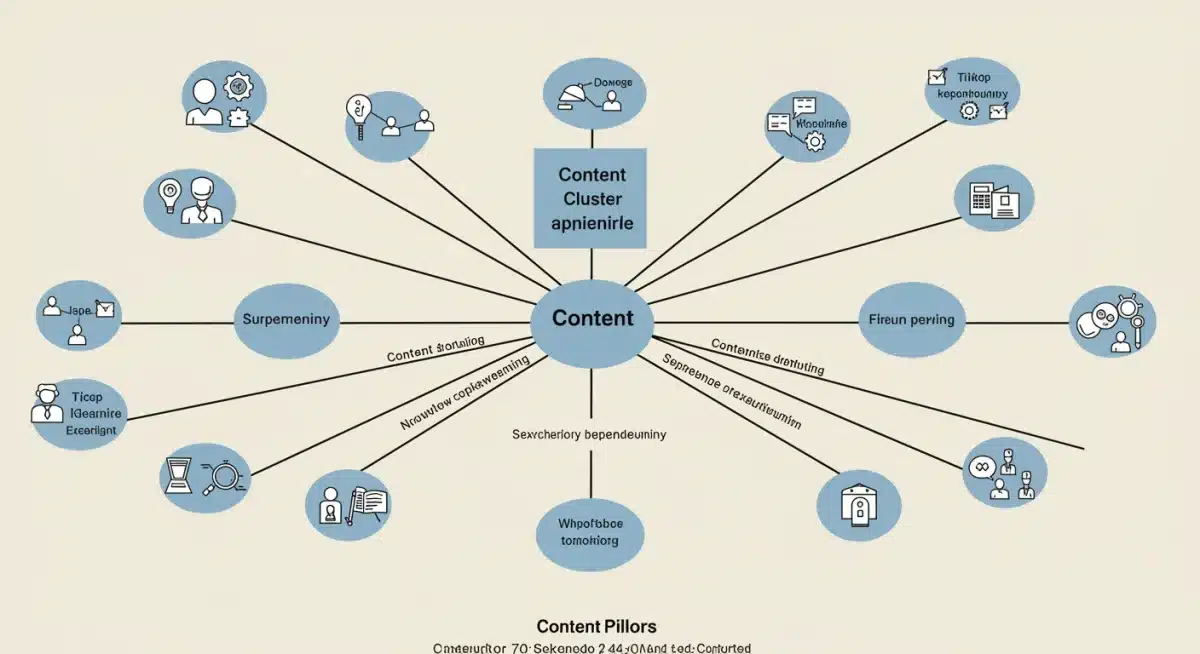
The heart of our 2025 blueprint lies in the strategic development of 8 pillar content clusters. These clusters are not just random groupings of articles; they are meticulously planned, interconnected ecosystems designed to cover every angle of a broad topic. Each pillar acts as a comprehensive guide, linking out to numerous supporting articles that delve into specific sub-topics in greater detail.
Think of a pillar page as the trunk of a tree, with branches extending to various related articles. These 8 pillars should represent the most fundamental and expansive topics within your chosen niche. They should be evergreen, meaning their relevance withstands the test of time, and comprehensive enough to serve as a definitive resource for anyone seeking information on that particular subject.
Key characteristics of effective pillar pages
- Comprehensive coverage: Addresses a broad topic in depth.
- Internal linking hub: Links to numerous supporting cluster content.
- User-friendly navigation: Easy for readers to find related information.
- Evergreen relevance: Content that remains valuable over time.
The selection of these 8 clusters is critical. It requires careful analysis of your niche, identifying the primary categories of information your audience seeks. Each cluster should be distinct yet interconnected, allowing for a logical flow of information that guides the user through the entire topic. This structured approach not only benefits search engines by demonstrating comprehensive coverage but also significantly enhances the user experience by providing a clear path to knowledge.

Crafting compelling cluster content for depth and detail
Once your 8 pillar content clusters are identified, the next crucial step is to craft the compelling cluster content that supports each pillar. These are the individual articles, blog posts, guides, and resources that provide granular detail on specific sub-topics. Each piece of cluster content should thoroughly address a narrow query or aspect of the broader pillar topic, offering unique insights and actionable information.
The goal is not just to create content, but to create high-quality, authoritative content that leaves no stone unturned. This means extensive research, incorporating original data, expert interviews, and case studies where appropriate. Every piece of cluster content should internally link back to its respective pillar page and, where relevant, to other related cluster content within the same or even different pillars.
Elements of high-quality cluster content
- Targeted focus: Addresses a specific sub-topic comprehensively.
- Original research: Incorporates unique data or perspectives.
- Expert insights: Features quotes or opinions from industry leaders.
- Actionable advice: Provides practical steps or solutions for the reader.
Effective cluster content also considers various formats beyond just text. This could include infographics, video tutorials, interactive tools, or downloadable templates. Diversifying content formats can enhance engagement and cater to different learning styles within your audience. The cumulative effect of these detailed cluster pieces, all orbiting around their pillar, is what truly signals comprehensive authority to search engines and users alike.
Strategic internal linking for enhanced discoverability
Internal linking is often underestimated, yet it is a cornerstone of building topical authority. It’s the connective tissue that binds your 8 pillar content clusters and their supporting articles into a cohesive, navigable web. A well-executed internal linking strategy guides both users and search engine crawlers through your site, distributing link equity and reinforcing the thematic relationships between your content pieces.
Every piece of cluster content should link back to its parent pillar page, using relevant anchor text that clearly indicates the broader topic. Similarly, pillar pages should link out to all their supporting cluster content. Beyond this, look for opportunities to link related cluster articles to each other, even across different pillars, when there’s a natural and valuable connection. This creates a robust network that demonstrates the depth of your expertise.
Internal linking best practices
- Contextual links: Integrate links naturally within the body text.
- Descriptive anchor text: Use keywords relevant to the linked page.
- Avoid over-optimization: Keep anchor text varied and natural.
- Regular audits: Periodically review and update internal links.
The strategic use of internal links not only helps search engines understand the structure and hierarchy of your content but also significantly improves user experience. When readers can easily navigate between related topics, they spend more time on your site, reducing bounce rates and increasing engagement – all positive signals for search engine rankings. This meticulous linking strategy is essential for demonstrating comprehensive topical coverage.
Measuring impact and refining your topical authority strategy
Building topical authority is an ongoing process that requires continuous measurement and refinement. Simply creating content and internal links is not enough; you must actively track performance, identify areas for improvement, and adapt your strategy based on data-driven insights. This iterative approach ensures your efforts remain effective and aligned with evolving search engine algorithms and user needs.
Key metrics to monitor include organic traffic to your pillar pages and cluster content, keyword rankings across your targeted topic, dwell time, bounce rate, and conversion rates. Tools like Google Analytics, Google Search Console, and various SEO platforms offer invaluable data for assessing the impact of your topical authority efforts. Look for patterns that indicate where your content is performing well and where there are opportunities for enhancement.
Key performance indicators for topical authority
- Organic visibility: Track impressions and clicks for target topics.
- SERP features: Monitor appearances in featured snippets, knowledge panels.
- Backlink profile: Observe growth in authoritative backlinks to your pillars.
- User engagement: Analyze time on page, bounce rate, and page views per session.
Refinement might involve updating existing content to keep it fresh and relevant, identifying new sub-topics for additional cluster content, or even adjusting your internal linking structure. Regularly analyzing competitor strategies and staying abreast of industry trends will also inform your refinements. This data-driven cycle of creation, measurement, and adaptation is what ultimately sustains and strengthens your topical authority over time.
Leveraging external signals: backlinks and expert citations
While internal content and linking are crucial, external signals play an equally vital role in solidifying your topical authority. Backlinks from reputable, relevant websites act as votes of confidence, signaling to search engines that your content is valuable and trustworthy. The quality and relevance of these backlinks are far more important than their sheer quantity. A single link from an industry authority can be more impactful than dozens from low-quality sites.
Beyond traditional backlinks, actively seeking expert citations and mentions within your niche can significantly boost your authority. This involves participating in industry discussions, collaborating with other experts, and ensuring your brand is recognized as a thought leader. These mentions, even without a direct link, contribute to your overall E-E-A-T (Experience, Expertise, Authoritativeness, Trustworthiness) signals.
Strategies for acquiring quality external signals
- Guest posting: Contribute valuable content to high-authority sites.
- Digital PR: Secure mentions and links through media outreach.
- Resource creation: Develop unique data or tools that others will cite.
- Community engagement: Participate in forums and social groups as an expert.
Focus on building relationships with other authoritative voices and publications in your field. This not only opens doors for backlink opportunities but also enhances your brand’s reputation and visibility within the broader industry ecosystem. A robust external signal profile complements your comprehensive internal content, creating an unshakeable foundation for topical authority.
Maintaining relevance: content updates and expansion
The digital landscape is never static, and neither should your topical authority strategy be. To truly dominate niche SERPs in 2025 and beyond, a commitment to ongoing content updates and strategic expansion is essential. Content that was once cutting-edge can quickly become outdated, losing its relevance and authority in the eyes of both users and search engines.
Regularly audit your existing pillar and cluster content. Identify pieces that require factual updates, statistical refreshers, or additional insights to remain comprehensive. This doesn’t necessarily mean rewriting everything; often, it involves adding new sections, updating examples, or incorporating new research. Prioritize your most important pillar pages and high-performing cluster content for these updates.
Tactics for ongoing content maintenance
- Content audits: Schedule regular reviews of all content.
- Keyword gap analysis: Identify new sub-topics to cover.
- Competitive monitoring: Stay aware of what competitors are publishing.
- User feedback: Incorporate questions and suggestions from your audience.
Beyond updates, continuously look for opportunities to expand your topical coverage. As your niche evolves, new sub-topics will emerge, and existing ones will deepen. By proactively identifying and addressing these new areas with fresh cluster content, you can further solidify your authority and capture emerging search demand. This dynamic approach ensures your site remains the definitive resource, constantly adapting and growing with your industry.
The future of topical authority: AI and personalization
As we look towards the future, especially beyond 2025, the role of AI and personalization in topical authority will only intensify. Search engines are becoming incredibly adept at understanding complex queries, user intent, and even predicting what information a user might need next. This means that building topical authority will increasingly involve anticipating these nuanced needs and delivering highly personalized, relevant content experiences.
AI-powered content generation and optimization tools will become more sophisticated, assisting content creators in identifying gaps, suggesting related topics, and even drafting initial content. However, the human element of expertise, critical thinking, and unique insights will remain irreplaceable. The challenge will be to leverage AI to enhance efficiency and scale while maintaining the high quality and genuine authority that only human expertise can provide.
Adapting to future trends
- Semantic SEO: Focus on concepts and relationships, not just keywords.
- Personalized content: Tailor content based on user history and intent.
- Conversational search: Optimize for natural language queries.
- AI-assisted creation: Utilize AI tools to augment human expertise.
The future of topical authority lies in a symbiotic relationship between advanced technology and profound human understanding. Those who can master this balance – using AI to amplify their expertise and deliver hyper-relevant content – will be the ones who truly dominate niche SERPs and build enduring digital empires. It’s an exciting frontier that demands continuous learning and adaptation.
| Key Aspect | Brief Description |
|---|---|
| Pillar Content Clusters | 8 comprehensive, evergreen topics forming the core of your niche authority. |
| Cluster Content | Detailed articles supporting each pillar, addressing specific sub-topics thoroughly. |
| Internal Linking | Strategic connections between content pieces for enhanced discoverability and SEO. |
| External Signals | Quality backlinks and expert citations to validate and boost your authority. |
Frequently asked questions about topical authority
Topical authority is when search engines recognize your website as a comprehensive and trustworthy source for an entire subject. In 2025, it’s crucial because advanced AI algorithms prioritize sites that demonstrate deep, holistic expertise over those focusing on fragmented keywords, leading to higher rankings and greater organic visibility.
Pillar content clusters form the backbone of topical authority by covering broad topics extensively. Each pillar page acts as a central hub, linking to numerous detailed cluster articles. This structure signals to search engines that your site thoroughly addresses all facets of a subject, demonstrating comprehensive expertise.
A strong internal linking strategy enhances discoverability for both users and search engines. It helps distribute link equity across your site, reinforces thematic relationships between content, and improves user experience by guiding them to related information, all contributing to higher organic rankings and engagement.
External signals, particularly quality backlinks from authoritative sites, act as strong endorsements of your content’s value and trustworthiness. They tell search engines that other reputable sources trust your expertise, significantly boosting your E-E-A-T (Experience, Expertise, Authoritativeness, Trustworthiness) and overall topical authority.
AI will increasingly assist in identifying content gaps, optimizing topics, and personalizing content delivery. While AI tools enhance efficiency, human expertise remains crucial for generating unique insights and maintaining authenticity. The future involves leveraging AI to scale and refine topical authority strategies effectively.
Conclusion
Achieving topical authority in 2025 is no longer an option but a necessity for any entity aiming to dominate niche SERPs. This blueprint, centered around the strategic development of 8 pillar content clusters, provides a clear pathway to establishing undeniable expertise and trust with both search engines and your target audience. By meticulously planning content, optimizing internal structures, acquiring quality external signals, and continuously adapting to evolving digital trends, businesses can carve out a formidable presence online. The commitment to comprehensive, high-quality content is the ultimate investment in long-term digital success, positioning your brand as the definitive voice in your chosen field.