Beyond GA4: Emerging Data Platforms for U.S. Businesses in 2025

U.S. businesses are increasingly seeking alternatives to Google Analytics 4, with emerging data platforms in 2025 offering advanced capabilities for unified customer insights, enhanced privacy, and real-time strategic decision-making.
The digital analytics landscape is evolving at an unprecedented pace, pushing U.S. businesses to look beyond Google Analytics 4: exploring emerging data platforms for U.S. businesses in 2025. With privacy regulations tightening and the demand for more granular, actionable insights growing, the need for robust, flexible, and future-proof data solutions is more critical than ever. This shift isn’t just about replacing a tool; it’s about embracing a new paradigm for understanding customer behavior and driving business growth.
The Evolving Landscape of Digital Analytics Post-GA4
Google Analytics 4 (GA4) marked a significant departure from its predecessor, Universal Analytics, introducing an event-based data model and a stronger focus on privacy. While GA4 offers certain advantages, many U.S. businesses find themselves seeking platforms that provide greater customization, deeper integration capabilities, and more comprehensive customer views. This pursuit is fueled by the desire to unlock truly actionable insights from their vast datasets.
The transition away from Universal Analytics highlighted the limitations of relying on a single, albeit powerful, vendor for all analytical needs. Businesses are now prioritizing platforms that offer flexibility, scalability, and the ability to integrate seamlessly with their existing tech stacks. This move ensures they can adapt quickly to market changes and maintain a competitive edge.
Understanding the Shift: Why Businesses Are Looking Beyond GA4
The reasons for exploring alternatives to GA4 are multifaceted, ranging from specific feature requirements to broader strategic goals. Businesses are seeking solutions that can address their unique challenges and empower them with more control over their data.
- Data Ownership and Control: Many platforms offer greater data ownership, allowing businesses to house their data in their own environments.
- Customization and Flexibility: The ability to tailor data models, reports, and dashboards to specific business needs is a key driver.
- Privacy Compliance: Enhanced features for managing user consent and complying with evolving privacy regulations like CCPA and upcoming state laws.
- Unified Customer View: Integrating data from various sources (CRM, ERP, marketing automation) into a single, cohesive customer profile.
Ultimately, the move beyond GA4 is about achieving a more holistic and powerful data strategy. It’s about moving from simply tracking website interactions to understanding the entire customer journey across all touchpoints, both online and offline.
Customer Data Platforms (CDPs): A Unified Approach to Customer Insights
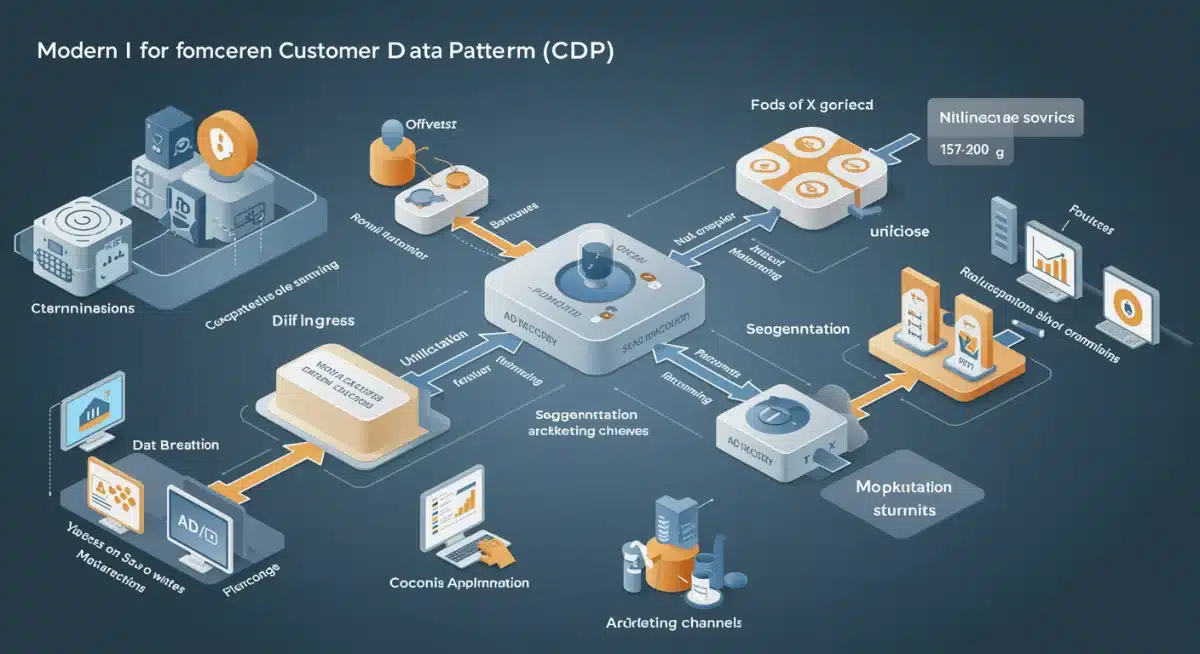
Customer Data Platforms (CDPs) are rapidly emerging as a cornerstone for businesses aiming to create a unified and persistent customer view. Unlike traditional analytics tools, CDPs are designed to ingest data from disparate sources, cleanse it, and unify it into a single customer profile, making it accessible for various marketing and analytical purposes.
The power of a CDP lies in its ability to break down data silos. By consolidating data from web analytics, CRM systems, email platforms, mobile apps, and offline interactions, businesses can gain a truly 360-degree understanding of their customers. This comprehensive view enables highly personalized marketing campaigns, improved customer service, and more accurate segmentation.
Key Features and Benefits of Modern CDPs
Modern CDPs offer a rich set of features that go beyond basic data aggregation. They provide the infrastructure for advanced analytics and activation, making them invaluable for data-driven organizations. These platforms are becoming essential for U.S. businesses navigating the complexities of modern customer engagement.
- Data Ingestion and Unification: Automatically collects and unifies data from all customer touchpoints, creating a golden record for each customer.
- Segmentation and Personalization: Enables dynamic segmentation based on real-time behavior and attributes, powering highly targeted marketing efforts.
- Journey Orchestration: Supports the design and execution of personalized customer journeys across multiple channels.
- Activation and Integration: Seamlessly integrates with marketing automation, advertising platforms, and other business systems for data activation.
For U.S. businesses, investing in a CDP means investing in a future where customer interactions are not just monitored but deeply understood and optimized. This leads to higher conversion rates, increased customer lifetime value, and a stronger brand presence.
Data Warehouses and Data Lakes: The Foundation for Advanced Analytics
Beyond specialized platforms like CDPs, the underlying infrastructure for data storage and processing is also undergoing significant evolution. Data warehouses (DW) and data lakes (DL) form the foundational layer for advanced analytics, providing scalable and flexible environments for storing and querying vast amounts of raw and structured data. For U.S. businesses, understanding these technologies is crucial for building a robust data strategy.
While data warehouses are optimized for structured data and analytical querying, data lakes are designed to store raw, unstructured, and semi-structured data at scale. The trend in 2025 is moving towards a hybrid approach, often referred to as a ‘data lakehouse,’ which combines the flexibility of data lakes with the data management capabilities of data warehouses.
Emerging Trends in Data Storage and Processing
The advancements in cloud computing have made sophisticated data warehousing and data lake solutions more accessible to businesses of all sizes. These platforms offer unparalleled scalability, performance, and cost-efficiency compared to on-premise solutions. U.S. businesses are leveraging these capabilities to perform complex analyses that were previously unfeasible.
- Cloud-Native Solutions: Platforms like Snowflake, Databricks, and Google BigQuery offer serverless and managed services, reducing operational overhead.
- Real-time Data Processing: Enhanced capabilities for ingesting and processing data in real-time, enabling immediate insights and actions.
- Advanced Security and Governance: Robust features for data encryption, access control, and compliance with data privacy regulations.
- Machine Learning Integration: Seamless integration with machine learning (ML) tools and frameworks for predictive analytics and AI-driven insights.
By establishing a strong data foundation with modern data warehouses and data lakes, U.S. businesses can empower their data scientists and analysts to extract maximum value from their data assets. This foundational strength is key to staying competitive in a data-driven economy.
Marketing Attribution Platforms: Measuring True ROI
In the complex digital landscape, understanding which marketing efforts truly drive results is paramount. Marketing attribution platforms are gaining prominence as businesses seek to move beyond last-click models and gain a more accurate understanding of their return on investment (ROI). These platforms provide sophisticated models to assign credit to various touchpoints along the customer journey.
Traditional attribution models often oversimplify the customer path, leading to misallocation of marketing budgets. Modern attribution platforms, however, leverage advanced algorithms and machine learning to analyze multi-touch interactions, providing a more granular and accurate picture of marketing effectiveness. This precision allows U.S. businesses to optimize their spending and improve campaign performance.
Beyond Last-Click: Multi-Touch Attribution Models
The shift towards multi-touch attribution reflects a more realistic understanding of how customers interact with brands. By considering every touchpoint, from initial awareness to final conversion, businesses can make more informed decisions about where to invest their marketing dollars. This is a critical area for U.S. businesses looking to maximize efficiency.
- Algorithmic Models: Utilize machine learning to dynamically assign credit based on the impact of each touchpoint.
- Path-Based Models: Analyze common customer journeys and distribute credit based on predefined rules or data-driven insights.
- Incremental Lift Measurement: Quantify the true incremental impact of marketing activities, beyond what would have happened naturally.
- Integration with Ad Platforms: Seamlessly connect with advertising platforms to optimize bids and campaigns based on comprehensive attribution data.
For U.S. businesses, adopting a sophisticated marketing attribution platform means moving from guesswork to data-driven certainty in their marketing investments. This leads to more effective campaigns, better resource allocation, and ultimately, greater profitability.
Privacy-Enhancing Technologies (PETs) and Data Clean Rooms
With increasing global focus on data privacy, Privacy-Enhancing Technologies (PETs) and data clean rooms are becoming indispensable tools for U.S. businesses. These technologies allow organizations to collaborate on data analysis and derive insights while maintaining strict privacy and security standards, ensuring compliance with regulations like CCPA and other emerging state laws.
Data clean rooms, in particular, provide a secure, neutral environment where multiple parties can combine and analyze their datasets without directly sharing raw, identifiable information. This enables rich, collaborative insights for advertising, measurement, and audience segmentation, all within a privacy-preserving framework.
Navigating Data Privacy in 2025
The regulatory landscape for data privacy is constantly evolving, making it challenging for businesses to stay compliant while still leveraging data for strategic advantage. PETs and data clean rooms offer a pathway to achieve both, fostering trust with customers and partners. U.S. businesses are increasingly adopting these solutions to navigate the complexities of data sharing and analysis responsibly.
- Homomorphic Encryption: Allows computations on encrypted data without decrypting it, preserving privacy during analysis.
- Differential Privacy: Adds noise to datasets to prevent the re-identification of individuals while still allowing for aggregate analysis.
- Secure Multi-Party Computation (MPC): Enables multiple parties to jointly compute a function over their inputs while keeping those inputs private.
- Centralized Consent Management: Tools to manage and enforce user consent preferences across all data touchpoints.
Implementing PETs and data clean rooms is not just about compliance; it’s about building a sustainable data strategy that respects user privacy and secures sensitive information. For U.S. businesses, this proactive approach is essential for long-term success and maintaining consumer trust.
The Rise of Composable Analytics Stacks
The future of data analytics for U.S. businesses lies increasingly in composable analytics stacks. This approach moves away from monolithic, all-in-one solutions towards a flexible architecture where businesses can select and integrate best-of-breed tools for each component of their data pipeline. This modularity provides unparalleled agility and customization.
A composable stack allows businesses to choose specific tools for data ingestion, storage, processing, transformation, visualization, and activation, tailoring the entire system to their exact needs. This contrasts sharply with the limitations often encountered with single-vendor platforms, including GA4, where customization might be restricted.
Building a Tailored Data Ecosystem
The composable approach empowers U.S. businesses to build a data ecosystem that is perfectly aligned with their strategic objectives and technical capabilities. It fosters innovation by allowing companies to adopt new technologies as they emerge, without being locked into a rigid framework. This flexibility is a significant advantage in the fast-paced digital world.
- Modularity and Flexibility: Ability to swap out components as needs evolve or better solutions become available.
- Vendor Agnosticism: Reduces reliance on a single vendor, mitigating risks and increasing negotiation power.
- Cost Optimization: Pay only for the specific services and features needed, avoiding unnecessary bundled costs.
- Enhanced Innovation: Freedom to integrate cutting-edge tools and technologies that offer specialized functionalities.
For U.S. businesses, embracing a composable analytics stack means gaining full control over their data infrastructure, enabling them to build highly efficient, scalable, and future-proof analytics capabilities. This strategic shift is crucial for maintaining a competitive edge in 2025 and beyond.
| Key Platform Type | Primary Benefit for U.S. Businesses |
|---|---|
| Customer Data Platforms (CDPs) | Creates a unified, 360-degree customer view for enhanced personalization. |
| Data Warehouses/Lakes | Provides scalable infrastructure for storing and querying vast, diverse datasets. |
| Marketing Attribution Platforms | Accurately measures ROI of marketing efforts beyond last-click models. |
| Composable Analytics Stacks | Offers flexibility to integrate best-of-breed tools for a tailored data pipeline. |
Frequently Asked Questions About Emerging Data Platforms
Businesses seek greater data ownership, customization, enhanced privacy compliance, and a more unified view of customer interactions that GA4 may not fully provide, driving the exploration of more specialized and flexible solutions.
A CDP unifies customer data from various sources into a single, persistent profile. It’s crucial for personalization, segmentation, and orchestrating consistent customer experiences across all touchpoints, enhancing marketing effectiveness.
Data clean rooms provide a secure environment for multiple parties to analyze combined datasets without sharing raw, identifiable information. This enables collaborative insights while strictly adhering to privacy regulations and protecting sensitive data.
A composable analytics stack is a flexible architecture where businesses select and integrate best-of-breed tools for each component of their data pipeline, offering greater customization, agility, and freedom from vendor lock-in.
Multi-touch attribution moves beyond last-click models to provide a more accurate understanding of marketing ROI. It assigns credit to all touchpoints in the customer journey, allowing for better budget allocation and campaign optimization.
Conclusion
The journey beyond Google Analytics 4: exploring emerging data platforms for U.S. businesses in 2025 is not merely a reaction to technological shifts or regulatory pressures; it is a proactive embrace of a more sophisticated, privacy-conscious, and ultimately more effective data strategy. From unifying customer insights with CDPs to building robust foundations with data warehouses, measuring true ROI with attribution platforms, ensuring privacy with PETs and clean rooms, and adopting flexible composable stacks, the options are diverse and powerful. U.S. businesses that strategically invest in these emerging platforms will be better equipped to understand their customers deeply, optimize their operations, and drive sustainable growth in an increasingly data-driven world. The future of analytics is about choice, control, and the relentless pursuit of actionable intelligence.