CCPA Updates 2025: U.S. Marketers Data Privacy Compliance

U.S. marketers must proactively adapt to the evolving data privacy landscape, as the California Consumer Privacy Act (CCPA) continues to introduce significant updates impacting how consumer data is collected, processed, and utilized.
The digital marketing landscape is constantly shifting, and staying compliant with data privacy regulations is paramount for U.S. marketers. This article explores The Latest in Data Privacy Compliance: What U.S. Marketers Need to Know About CCPA Updates for 2025, offering crucial insights into how these changes will impact your strategies and operations.
Understanding the Evolving CCPA Landscape
The California Consumer Privacy Act (CCPA) has set a precedent for data privacy in the United States, significantly influencing how businesses handle consumer information. Since its inception, the CCPA has undergone several amendments, most notably with the California Privacy Rights Act (CPRA), which expanded its scope and introduced new enforcement mechanisms. As we approach 2025, further refinements and interpretations are anticipated, making continuous vigilance essential for marketers.
These evolving regulations are not merely about avoiding penalties; they are about building and maintaining consumer trust. In an era where data breaches are common and privacy concerns are high, demonstrating a robust commitment to data protection can be a significant competitive advantage. Marketers who prioritize compliance will not only mitigate legal risks but also foster stronger, more ethical relationships with their audience.
Key Changes and Enforcement Trends
The foundation laid by the CPRA means that the California Privacy Protection Agency (CPPA) is actively enforcing these regulations. Marketers should anticipate increased scrutiny on data collection practices, data sharing with third parties, and the mechanisms provided for consumers to exercise their rights. The CPPA has shown a willingness to issue significant fines, emphasizing the need for proactive compliance rather than reactive adjustments.
- Expanded Definition of “Sensitive Personal Information”: This includes data such as racial or ethnic origin, religious or philosophical beliefs, union membership, genetic data, biometric data, health information, and information about a consumer’s sex life or sexual orientation. Marketers must handle this data with extreme care and obtain explicit consent.
- Data Minimization Principle: Businesses are increasingly expected to collect only the personal information that is necessary and proportionate to achieve the purposes for which it was collected. This challenges traditional marketing practices that often favored collecting as much data as possible.
- Purpose Limitation: Personal information collected for one purpose should not be used for a new, incompatible purpose without informing the consumer and, in some cases, obtaining new consent.
In conclusion, the CCPA landscape in 2025 will be characterized by a more mature and aggressive enforcement environment. Marketers must move beyond basic compliance and integrate privacy-by-design principles into their data strategies. This means re-evaluating existing data flows, vendor relationships, and consumer-facing privacy notices to ensure full alignment with the spirit and letter of the law.
Impact on Data Collection and Usage
The forthcoming CCPA updates 2025 will fundamentally reshape how U.S. marketers approach data collection and usage. The emphasis is increasingly on transparency, consumer control, and accountability. This means moving away from opaque data practices towards a model where consumers have a clear understanding of what data is being collected and how it will be used.
Marketers need to re-evaluate every touchpoint where consumer data is captured, from website forms to mobile app interactions. The goal is not just to comply with specific mandates but to build a system that respects consumer privacy by default. This proactive approach can lead to more engaged and loyal customers who trust your brand with their information.
Redefining Consent and Opt-Out Mechanisms
One of the most significant areas of impact is the concept of consent. The CCPA, particularly through its CPRA amendments, has moved towards a more stringent definition of explicit consent for certain types of data processing, especially concerning sensitive personal information. Marketers must ensure their consent mechanisms are clear, unambiguous, and easily revocable.
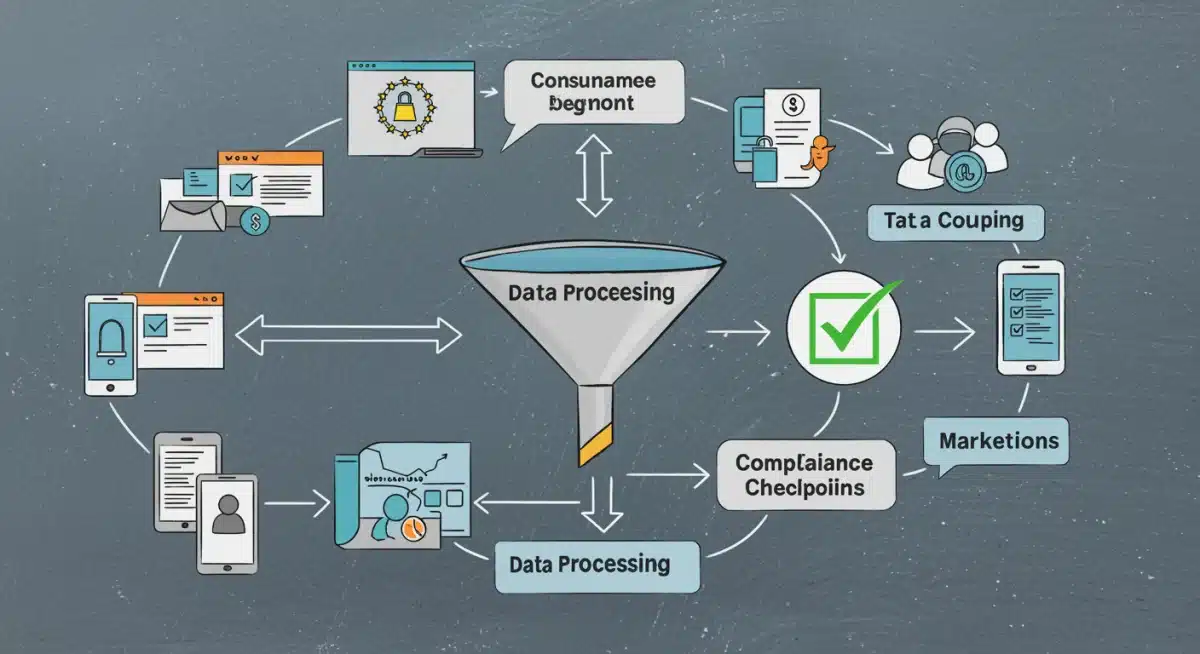
Furthermore, the right to opt-out of the sale or sharing of personal information has been strengthened. This includes the right to opt-out of cross-context behavioral advertising, which is a cornerstone of many digital marketing strategies. Businesses must provide clear and easily accessible “Do Not Sell or Share My Personal Information” links or buttons.
- Granular Consent Options: Implement consent management platforms (CMPs) that allow consumers to select specific categories of data use they consent to, rather than an all-or-nothing approach.
- Clear Opt-Out Pathways: Ensure opt-out links are prominent and functional, ideally with a global privacy control (GPC) signal recognition.
- Refreshed Privacy Policies: Regularly update privacy policies to reflect current data collection practices, data sharing agreements, and consumer rights under CCPA, making them easy to understand for the average consumer.
In essence, the future of data collection and usage for U.S. marketers lies in transparent, consent-driven practices. This shift requires not just technical adjustments but also a fundamental change in mindset, prioritizing consumer autonomy over unfettered data acquisition.
Navigating Consumer Rights and Requests
The core of the CCPA and its subsequent updates lies in empowering consumers with greater control over their personal information. For U.S. marketers, this translates into a significant responsibility to not only inform consumers of their rights but also to establish robust, efficient mechanisms for handling consumer requests. The CCPA updates 2025 will likely bring further clarifications and expectations regarding the timeliness and thoroughness of responding to these requests.
Ignoring or improperly handling consumer requests can lead to severe penalties and reputational damage. Therefore, understanding and streamlining the process for managing rights such as access, deletion, and correction is no longer optional but a critical operational imperative for any business dealing with California residents’ data.
Implementing Robust Request Fulfillment Systems
The ability to efficiently fulfill consumer requests is a benchmark of compliance. This involves not only front-end mechanisms for receiving requests but also back-end processes for verifying identities, locating data across various systems, and executing the requested action within the stipulated timeframe. Automation and integration of data systems become key enablers here.
- Right to Know: Consumers can request disclosure of the categories and specific pieces of personal information collected about them, the sources from which it was collected, the business purposes for collecting or selling it, and the categories of third parties with whom it is shared.
- Right to Delete: Consumers can request the deletion of personal information collected from them, with certain exceptions. Marketers must have a clear process to identify and remove data from all relevant databases and third-party vendors.
- Right to Correct: The CPRA introduced the right for consumers to request the correction of inaccurate personal information. This adds another layer of complexity to data management, requiring systems that can accurately modify data.
- Right to Opt-Out: As discussed, the right to opt-out of the sale or sharing of personal information, including for cross-context behavioral advertising, remains a central tenet.
Effectively managing consumer rights requires a cross-functional effort involving legal, IT, and marketing teams. Investing in specialized privacy management software can significantly streamline these processes, reducing manual errors and ensuring timely compliance. A well-executed consumer rights program not only meets legal obligations but also enhances brand trust.
Third-Party Data Sharing and Vendor Management
In the intricate ecosystem of digital marketing, third-party data sharing is almost unavoidable. However, the CCPA updates 2025 place a much stronger emphasis on the responsibilities of businesses when sharing data with vendors, service providers, and other third parties. U.S. marketers must exercise extreme diligence in vetting their partners and ensuring that all data-sharing agreements are robust and compliant.
The concept of “sharing” data under CCPA is broader than just “selling” and includes disclosing personal information for cross-context behavioral advertising. This means even if no monetary exchange occurs, data shared for targeting purposes can fall under the sharing definition, triggering opt-out rights and requiring specific contractual clauses.
Strengthening Vendor Contracts and Due Diligence
Marketers need to review all existing contracts with third-party vendors, including ad tech platforms, analytics providers, and CRM systems, to ensure they contain adequate CCPA-compliant clauses. New contracts should explicitly define the roles of each party (e.g., business, service provider, contractor) and outline responsibilities regarding data protection, consumer rights, and security.
- Service Provider/Contractor Agreements: Ensure contracts with service providers and contractors explicitly state that they are prohibited from selling or sharing personal information, retaining, using, or disclosing personal information for any purpose other than for the business purpose specified in the contract.
- Data Processing Addendums (DPAs): Implement comprehensive DPAs that clearly outline data handling procedures, security measures, and incident response protocols.
- Regular Audits: Conduct periodic audits of third-party vendors to verify their compliance with contractual obligations and CCPA requirements. This proactive approach helps identify and mitigate risks before they escalate.
Ultimately, the responsibility for consumer data protection rests with the primary business collecting the data. Therefore, a robust vendor management program, coupled with strong contractual agreements, is indispensable for U.S. marketers navigating the complexities of third-party data sharing under the evolving CCPA framework.
Data Security and Breach Notification Requirements
Beyond compliance with consumer rights, data security remains a critical pillar of the CCPA. The CCPA updates 2025 will continue to reinforce the expectation that businesses implement reasonable security measures to protect personal information from unauthorized access, use, disclosure, alteration, or destruction. A data breach can lead to significant financial penalties, class-action lawsuits, and severe reputational damage.
U.S. marketers, often at the forefront of data collection, must work closely with their IT and security teams to ensure that all marketing-related data systems and processes adhere to the highest standards of cybersecurity. Proactive security measures are far more effective and less costly than reactive responses to a breach.
Implementing Robust Security Protocols
A comprehensive data security strategy involves multiple layers of protection, from technical safeguards to employee training and incident response planning. The CCPA specifies that businesses must implement “reasonable security procedures and practices appropriate to the nature of the information.” While it doesn’t prescribe specific technologies, it implies a standard of care that evolves with technological advancements and threat landscapes.
- Encryption: Encrypt personal information both in transit and at rest, especially for sensitive data.
- Access Controls: Implement strict access controls, ensuring that only authorized personnel have access to personal data, based on the principle of least privilege.
- Regular Security Audits: Conduct frequent security assessments, penetration testing, and vulnerability scans to identify and address weaknesses in systems and processes.
- Employee Training: Provide ongoing training for all employees, especially those handling personal data, on data privacy best practices, security protocols, and phishing awareness.
In the event of a data breach, timely and accurate notification is mandatory under CCPA, particularly if unencrypted and unredacted personal information is compromised. Marketers must be part of an organization-wide incident response plan that ensures rapid detection, containment, and notification, mitigating potential harm and legal exposure.
Preparing Your Marketing Strategy for 2025
As the CCPA updates 2025 draw near, U.S. marketers have a unique opportunity to not just comply but to innovate. The privacy-first approach is rapidly becoming the industry standard, and those who embrace it wholeheartedly will be better positioned for long-term success. This involves a strategic re-evaluation of marketing practices, moving towards more ethical and transparent engagement with consumers.
The shift towards stricter data privacy regulations doesn’t signal the end of effective marketing; rather, it encourages a pivot towards more creative, value-driven, and trust-based strategies. Marketers can leverage this moment to differentiate their brands and build deeper connections with their audience.
Embracing Privacy-Enhancing Technologies and Ethical Marketing
The future of marketing under CCPA will increasingly rely on privacy-enhancing technologies (PETs) and a renewed focus on ethical marketing principles. This includes exploring alternatives to third-party cookies, such as first-party data strategies, contextual advertising, and privacy-preserving analytics.
- First-Party Data Focus: Prioritize the collection and utilization of first-party data, obtained directly from consumers with their explicit consent. This data is more reliable and less regulated than third-party data.
- Contextual Advertising: Explore advertising models that rely on the content of a webpage rather than individual user profiles, offering a privacy-friendly alternative to behavioral targeting.
- Privacy-Preserving Analytics: Invest in analytics tools that offer insights without compromising individual privacy, such as aggregated data analysis or differential privacy techniques.
- Transparency as a Brand Value: Position your brand as a leader in data privacy, clearly communicating your data practices and commitment to consumer rights. This builds trust and strengthens brand loyalty.
Ultimately, preparing your marketing strategy for 2025 means embedding privacy into the very fabric of your operations. It’s about designing campaigns that are effective, compliant, and respectful of consumer autonomy, ensuring that your brand thrives in an increasingly privacy-conscious world.
| Key Aspect | Description for Marketers |
|---|---|
| Consumer Rights | Expanded rights to know, delete, correct, and opt-out require robust fulfillment systems. |
| Data Sharing | Stricter rules on sharing with third parties, demanding stronger vendor contracts. |
| Consent Frameworks | Explicit consent needed for sensitive data and clearer opt-out mechanisms for behavioral advertising. |
| Security Measures | Mandatory reasonable security procedures and practices to prevent data breaches. |
Frequently Asked Questions About CCPA Updates for 2025
The primary changes for 2025 focus on enhanced enforcement by the CPPA, broadened definitions of sensitive personal information, stricter consent requirements for data usage, and a stronger emphasis on data minimization and purpose limitation principles for U.S. marketers.
CCPA updates significantly impact third-party data sharing by requiring more robust vendor contracts, explicit definitions of service provider roles, and clear opt-out mechanisms for consumers regarding data shared for cross-context behavioral advertising. Marketers must conduct thorough due diligence on all partners.
The 2025 updates strengthen existing rights to know, delete, and opt-out, while also emphasizing the right to correct inaccurate personal information. Marketers need streamlined systems to efficiently handle these requests and ensure timely compliance, upholding consumer autonomy.
To comply with CCPA data security, marketers must implement reasonable security measures, including encryption, strict access controls, and regular security audits. Developing a comprehensive incident response plan and providing ongoing employee training are also crucial for protecting personal data and preventing breaches.
Marketers can adapt by prioritizing first-party data, exploring contextual advertising, and utilizing privacy-preserving analytics. Embracing transparency as a core brand value and investing in privacy-enhancing technologies will foster consumer trust and loyalty, turning compliance into a competitive advantage.
Conclusion
The landscape of data privacy in the United States, particularly under the evolving CCPA, demands continuous attention and proactive adaptation from marketers. The CCPA updates 2025 underscore a clear trend towards greater consumer control, enhanced transparency, and stringent accountability for businesses handling personal information. For U.S. marketers, this isn’t merely a regulatory hurdle but an opportunity to redefine brand trust and ethical engagement. By prioritizing robust compliance measures, strengthening data security, meticulously managing third-party relationships, and embracing privacy-by-design principles, businesses can not only mitigate risks but also build stronger, more sustainable relationships with their audience. The future of marketing is deeply intertwined with a commitment to privacy, making informed and proactive compliance an indispensable component of success.