Internal Linking Strategy 2025: Boost Rankings 5%

Implementing a strategic internal linking strategy in 2025 is paramount for SEO, enabling efficient link equity distribution and a projected 5% improvement in keyword rankings by enhancing content discoverability and authority.
In the dynamic realm of search engine optimization, a well-executed internal linking strategy remains one of the most potent yet often underutilized tools. For 2025, understanding and leveraging this power is not just beneficial, but essential for distributing link equity effectively and achieving a measurable 5% improvement in your keyword rankings. This article delves into how a thoughtful approach to internal links can transform your SEO performance.
Understanding internal linking fundamentals in 2025
Internal linking forms the backbone of your website’s architecture, guiding both users and search engine crawlers through your content. In 2025, the principles remain steadfast, but the nuances of implementation have evolved with algorithm updates and user behavior. A strong internal link profile helps search engines understand the hierarchy and context of your pages, signaling which content is most important and how different topics relate to each other. This foundational understanding is critical before diving into advanced tactics.
Effective internal linking isn’t just about connecting pages; it’s about creating a logical flow that enhances user experience and strengthens your site’s overall authority. By directing visitors to relevant content, you increase engagement, reduce bounce rates, and encourage deeper exploration of your offerings. From an SEO perspective, this translates into improved crawlability and indexability, giving your pages a better chance to rank for targeted keywords.
The undeniable impact on SEO and user experience
- Improved Crawlability: Internal links help search engine bots discover and index new and updated content more efficiently.
- Enhanced User Experience: Relevant links provide users with additional valuable information, keeping them on your site longer.
- Defined Site Architecture: A clear internal link structure helps search engines understand the relationships between your pages.
- Increased Page Authority: Distributes ‘link juice’ from high-authority pages to other important content, boosting their ranking potential.
The core concept here is about creating a web of interconnectedness that benefits every aspect of your site. Each link acts as a vote of confidence, telling search engines that the linked page is important and relevant to the anchor text used. This strategic distribution of authority is what ultimately underpins improved keyword rankings and sustained organic traffic.
In conclusion, grasping the fundamental role of internal links in both SEO and user experience is the first step towards a successful 2025 strategy. It’s about more than just adding links; it’s about intelligent placement and thoughtful connection that elevates your entire website.
Strategic distribution of link equity for ranking improvements
Link equity, often referred to as ‘link juice,’ is the value passed from one page to another through hyperlinks. A sophisticated internal linking strategy focuses on channeling this equity from your most authoritative pages to those you want to rank higher. This isn’t a random process; it requires careful analysis of your existing content, identifying power pages, and strategically placing links to boost the visibility of target keywords.
For 2025, understanding which pages hold the most authority within your domain is paramount. Tools like Ahrefs, Moz, or Semrush can help identify these ‘power pages’ based on external backlinks and organic traffic. Once identified, these pages become critical hubs for distributing equity to less authoritative but equally important content. This targeted approach ensures that your most valuable assets are continually reinforced.
Identifying power pages and their role in equity distribution
- Analyze Backlink Profiles: Determine which pages have the most external backlinks, indicating high external authority.
- Review Organic Traffic: Pages with significant organic traffic often possess strong internal authority as well.
- Assess Content Quality: High-quality, evergreen content naturally attracts more links and user engagement.
The art of distributing link equity lies in creating a natural, contextual flow. Avoid forced or irrelevant links. Instead, integrate links seamlessly within your content, ensuring they add value to the reader’s journey. This not only benefits SEO but also enhances the overall user experience, a crucial factor in Google’s ranking algorithms.
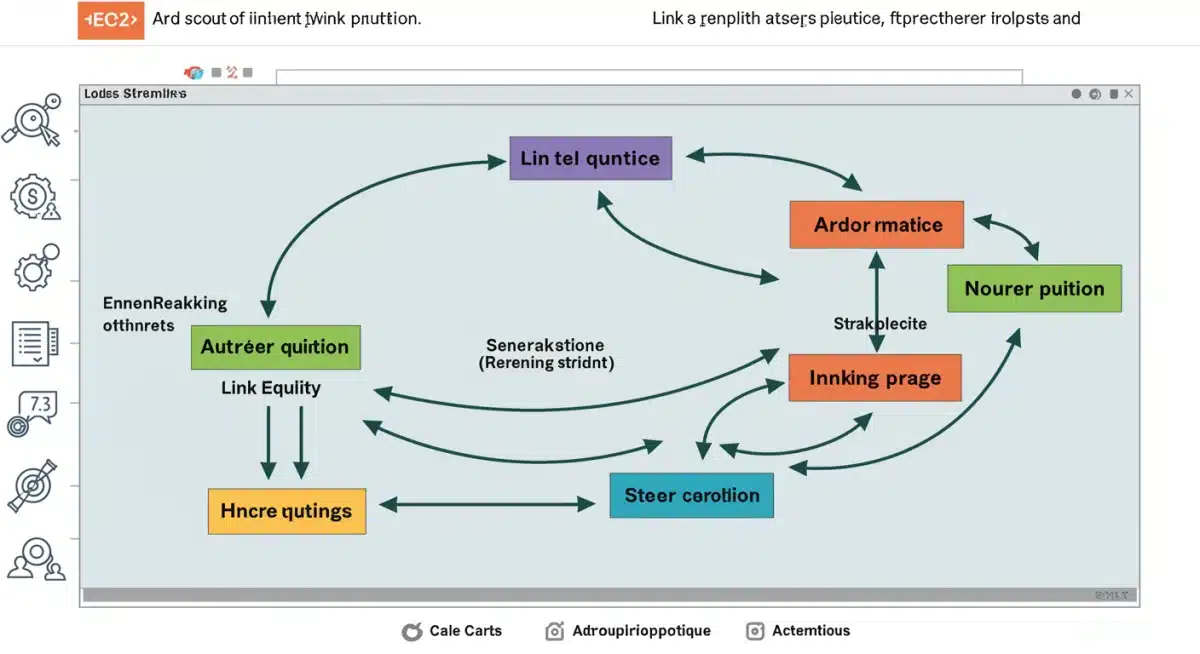
Ultimately, strategic link equity distribution is about intelligently leveraging your website’s existing strengths to uplift its weaker areas. By consciously directing authority from strong pages to those that need a boost, you create a more balanced and robust site, directly contributing to improved keyword rankings.
Advanced internal linking techniques for 2025
Moving beyond the basics, 2025 demands a more sophisticated approach to internal linking. This involves not just placing links, but optimizing their placement, anchor text, and overall structure to maximize their impact. Think about creating content hubs, utilizing contextual links, and regularly auditing your internal link profile for opportunities and issues.
One powerful technique is the ‘content hub and spoke’ model. Here, a central pillar page covers a broad topic, linking out to several ‘spoke’ pages that delve into specific sub-topics. These spoke pages, in turn, link back to the pillar page, reinforcing its authority and creating a tightly knit cluster of related content. This structure clearly signals to search engines the depth and breadth of your expertise on a given subject.
Implementing content hubs and contextual linking
- Pillar Pages: Create comprehensive guides on broad topics.
- Cluster Content: Develop detailed articles on sub-topics related to your pillar pages.
- Bidirectional Linking: Ensure spoke pages link back to their respective pillar pages.
- Contextual Relevance: Place links naturally within the text where they provide additional value.
Another advanced consideration is the use of varied anchor text. While exact-match anchor text can be powerful, overusing it can appear manipulative. Strive for a mix of exact-match, partial-match, branded, and generic anchor texts to maintain a natural and diverse profile. This signals to search engines that your links are organic and genuinely helpful.
In summary, advanced internal linking in 2025 is about building intelligent, interconnected content structures that benefit both users and search engines. By adopting techniques like content hubs and thoughtful anchor text usage, you can significantly amplify your SEO efforts.
Auditing and optimizing your existing internal link structure
Even the best internal linking strategy requires continuous monitoring and optimization. A regular audit of your existing link structure can uncover broken links, orphaned pages, and missed opportunities to strengthen your site’s authority. This proactive approach ensures that your link equity flows efficiently and that no valuable content is overlooked by search engines.
Start by identifying orphaned pages – content that receives no internal links, making it difficult for crawlers to discover. These pages are essentially invisible to search engines and represent a significant missed opportunity. Integrating them into your internal link structure can quickly boost their visibility and ranking potential. Similarly, broken internal links create a poor user experience and waste crawl budget, so identifying and fixing them is crucial.
Key steps for an effective internal link audit
- Identify Orphaned Pages: Use tools like Screaming Frog or Google Search Console to find pages without internal links.
- Locate Broken Links: Regularly check for internal broken links and fix them promptly.
- Analyze Anchor Text: Ensure anchor text is diverse, relevant, and not over-optimized.
- Review Link Depth: Aim for important pages to be accessible within 2-3 clicks from the homepage.
Beyond fixing issues, an audit also helps you identify opportunities for improvement. Are there high-traffic pages that could link to important but underperforming content? Are there relevant keywords that could be better supported by internal links? Continuously asking these questions allows for ongoing refinement of your strategy.
To conclude, regular auditing and optimization are non-negotiable for maintaining a healthy and effective internal link structure. By proactively addressing weaknesses and capitalizing on strengths, you ensure your website remains a well-oiled machine for SEO success.
Measuring the impact: tracking keyword rankings and traffic
The ultimate goal of any SEO strategy, including internal linking, is to achieve measurable results. For 2025, it’s not enough to simply implement changes; you must rigorously track their impact on keyword rankings, organic traffic, and other key performance indicators. This data-driven approach allows you to refine your strategy, prove ROI, and continually optimize for better outcomes.
Start by establishing baseline metrics before implementing significant internal linking changes. Track the current rankings of your target keywords and the organic traffic to the pages you’re optimizing. This initial data provides a benchmark against which you can measure your progress. Without a clear baseline, it’s impossible to accurately assess the effectiveness of your efforts.
Essential metrics for monitoring internal linking performance
- Keyword Rankings: Monitor the position of your target keywords in search results.
- Organic Traffic: Track changes in traffic to pages affected by internal linking.
- Page Authority/Domain Rating: Observe improvements in internal metrics that signal increased authority.
- Bounce Rate and Time on Page: Changes in these metrics can indicate improved user engagement due to better navigation.
Utilize tools like Google Analytics, Google Search Console, and third-party SEO platforms to gather and analyze your data. Look for trends and correlations between your internal linking adjustments and changes in your metrics. For example, a sudden increase in rankings for a specific keyword after adding new internal links to that page is a strong indicator of success.
In conclusion, effective measurement is the cornerstone of any successful internal linking strategy. By meticulously tracking keyword rankings and traffic, you gain invaluable insights into what works and where further optimization is needed, ultimately driving your target 5% improvement.
Future-proofing your internal linking strategy for long-term success
The SEO landscape is constantly evolving, and what works today might need adjustments tomorrow. Future-proofing your internal linking strategy means building a flexible, adaptable framework that can withstand algorithm updates and changing user behaviors. This involves focusing on evergreen principles, staying informed, and integrating new technologies as they emerge.
Prioritize creating high-quality, relevant content that naturally lends itself to internal linking. Content that is genuinely valuable will always attract attention and provide opportunities for meaningful connections. Avoid chasing fleeting trends and instead invest in foundational content that will remain relevant for years to come, forming the stable core of your internal link architecture.
Key considerations for a resilient internal linking strategy
- Content Quality: Focus on creating evergreen, high-value content that naturally attracts links.
- Semantic SEO: Build topical authority by linking semantically related content.
- User Intent: Align internal links with user search intent to enhance relevance.
- Schema Markup: Explore how structured data can further define content relationships.
Staying abreast of Google’s guidelines and algorithmic changes is also crucial. While the core principles of internal linking are stable, how search engines interpret and value links can shift. Subscribing to industry news, attending webinars, and participating in SEO communities will keep you informed and agile.
Ultimately, a future-proof internal linking strategy is one that is built on solid, user-centric principles, continuously optimized, and adaptable to change. By focusing on these elements, you ensure your website’s authority and rankings remain strong for the long haul.
| Key Point | Brief Description |
|---|---|
| Link Equity Distribution | Channel authority from strong pages to boost weaker ones, improving overall site ranking. |
| Content Hubs | Organize content around pillar pages and related clusters for enhanced topical authority. |
| Regular Audits | Continuously check for broken links, orphaned pages, and optimization opportunities. |
| Performance Tracking | Monitor keyword rankings and traffic to measure impact and refine strategy. |
Frequently asked questions about internal linking
Link equity, or ‘link juice,’ is the value or authority passed from one web page to another through hyperlinks. It’s crucial because it helps search engines understand the importance of your pages, significantly influencing their ability to rank higher in search results.
Regular internal link audits are recommended at least quarterly, or more frequently for larger, dynamic websites. This ensures you catch broken links, identify orphaned content, and uncover new opportunities to strengthen your site’s structure and authority effectively.
Yes, a well-executed internal linking strategy can absolutely lead to a 5% or more improvement in keyword rankings. By efficiently distributing link equity and enhancing content discoverability, it signals to search engines the importance and relevance of your pages.
Content hubs are clusters of related content centered around a main ‘pillar page.’ They use internal links to connect the pillar page to several ‘spoke’ pages, creating a strong topical authority and improving search engine understanding of your expertise.
Anchor text is the clickable text in a hyperlink. It plays a vital role by providing context about the linked page to both users and search engines. Using varied, relevant anchor text helps in targeted keyword ranking and avoids appearing manipulative.
Conclusion
The year 2025 underscores the enduring significance of a meticulous internal linking strategy in the realm of SEO. It is far more than a technical detail; it is a strategic imperative that directly influences how search engines perceive and rank your content. By thoughtfully distributing link equity, implementing advanced techniques like content hubs, and consistently auditing your site, you can achieve tangible improvements in keyword rankings and overall organic visibility. Embracing these principles will not only enhance user experience but also solidify your website’s authority, ensuring sustained growth and a competitive edge in the digital landscape.