Top 3 Programmatic Advertising Strategies for U.S. Markets in 2025

The 3 most effective programmatic advertising strategies for U.S. markets in 2025 will leverage advanced data analytics, AI-powered optimization, and seamless omnichannel integration to deliver hyper-targeted and efficient campaigns.
As we accelerate towards 2025, the landscape of digital advertising continues its rapid evolution, particularly within the dynamic U.S. market. Understanding the 3 most effective programmatic advertising strategies for U.S. markets in 2025 isn’t just an advantage; it’s a necessity for brands aiming to capture attention and drive conversions. This article will delve into the core tactics that will define success, offering insider knowledge and critical analysis to help you navigate the complexities of modern ad tech.
The rise of first-party data activation and clean rooms
The privacy-first era is reshaping how advertisers approach targeting and measurement. As third-party cookies diminish, the strategic activation of first-party data within secure environments, often referred to as ‘clean rooms,’ becomes paramount. This shift allows brands to maintain granular audience insights while respecting user privacy, a critical balance for sustained growth in the U.S. market.
Clean rooms, provided by platforms like Google, Amazon, and Snowflake, enable advertisers to securely match their first-party data with publisher data without exposing raw Personally Identifiable Information (PII). This collaborative approach fosters a new level of data-driven precision.
Leveraging first-party data for enhanced targeting
First-party data, collected directly from customer interactions, offers unparalleled accuracy. Utilizing this data within programmatic platforms allows for the creation of highly specific audience segments, moving beyond broad demographics to behavioral and intent-based targeting.
- CRM integration: Connecting customer relationship management systems directly to programmatic platforms for real-time audience activation.
- Website and app analytics: Analyzing user behavior on owned properties to identify high-value segments and personalize ad experiences.
- Subscription data: Using subscriber information to tailor offers and content, increasing relevance and engagement.
The role of data clean rooms in privacy-centric advertising
Data clean rooms are secure, neutral environments where multiple parties can bring their anonymized data sets together for analysis, without either party seeing the other’s raw data. This technology is crucial for maintaining privacy compliance while still enabling sophisticated audience insights and activation.
By facilitating secure data collaboration, clean rooms address the growing concerns around data privacy and regulatory compliance, particularly with evolving laws in various U.S. states. They allow for advanced attribution and measurement capabilities that were previously reliant on third-party identifiers, ensuring campaign effectiveness in a cookieless world.
The strategic use of first-party data, fortified by the privacy guarantees of data clean rooms, will be a cornerstone of effective programmatic advertising in the U.S. market by 2025. This strategy not only enhances targeting accuracy but also builds trust with consumers, a valuable asset in today’s digital economy.
AI-powered optimization and predictive analytics
Artificial intelligence (AI) is no longer a futuristic concept in programmatic advertising; it’s a present-day imperative. In 2025, AI-powered optimization and predictive analytics will move beyond basic bid management to encompass creative generation, audience forecasting, and real-time campaign adjustments, pushing the boundaries of efficiency and effectiveness.
These advanced capabilities allow advertisers to anticipate market shifts, identify emerging trends, and automatically fine-tune campaigns for optimal performance, often surpassing human capabilities in speed and scale.
Advanced AI for real-time campaign adjustments
AI algorithms can process vast amounts of data in real-time, identifying patterns and making instantaneous adjustments to bids, placements, and creative elements. This dynamic optimization ensures that campaigns are always performing at their peak, minimizing waste and maximizing ROI.
- Dynamic creative optimization (DCO): AI automatically selects and customizes ad creatives based on individual user profiles and real-time context.
- Algorithmic bidding: AI-driven bidding strategies that learn and adapt to market conditions, optimizing for specific KPIs like conversions or viewability.
- Fraud detection: Sophisticated AI models can identify and mitigate ad fraud in real-time, protecting ad spend and maintaining campaign integrity.
Predictive analytics for future-proofing campaigns
Predictive analytics leverages historical data and machine learning to forecast future outcomes. For programmatic advertising, this means anticipating audience behavior, predicting campaign performance, and identifying optimal investment opportunities before they fully materialize.
By understanding potential future scenarios, advertisers can proactively adjust their strategies, allocate budgets more effectively, and prepare for upcoming seasonal trends or market shifts. This foresight provides a significant competitive edge, allowing for more strategic and less reactive campaign management.
The integration of AI-powered optimization and predictive analytics will transform programmatic advertising into a highly intelligent and adaptive system. This strategy ensures that campaigns are not only efficient but also future-proof, capable of navigating the ever-changing digital landscape of the U.S. market.
Omnichannel programmatic activation and CTV dominance
The modern consumer journey is rarely linear, spanning multiple devices and platforms. In 2025, truly effective programmatic advertising will embrace an omnichannel approach, seamlessly connecting ad experiences across all touchpoints. A significant driver of this will be the continued dominance and evolution of Connected TV (CTV).
Integrating CTV into a broader programmatic strategy allows brands to reach audiences on the big screen with the precision and measurability traditionally associated with digital advertising, creating a cohesive and impactful brand narrative.
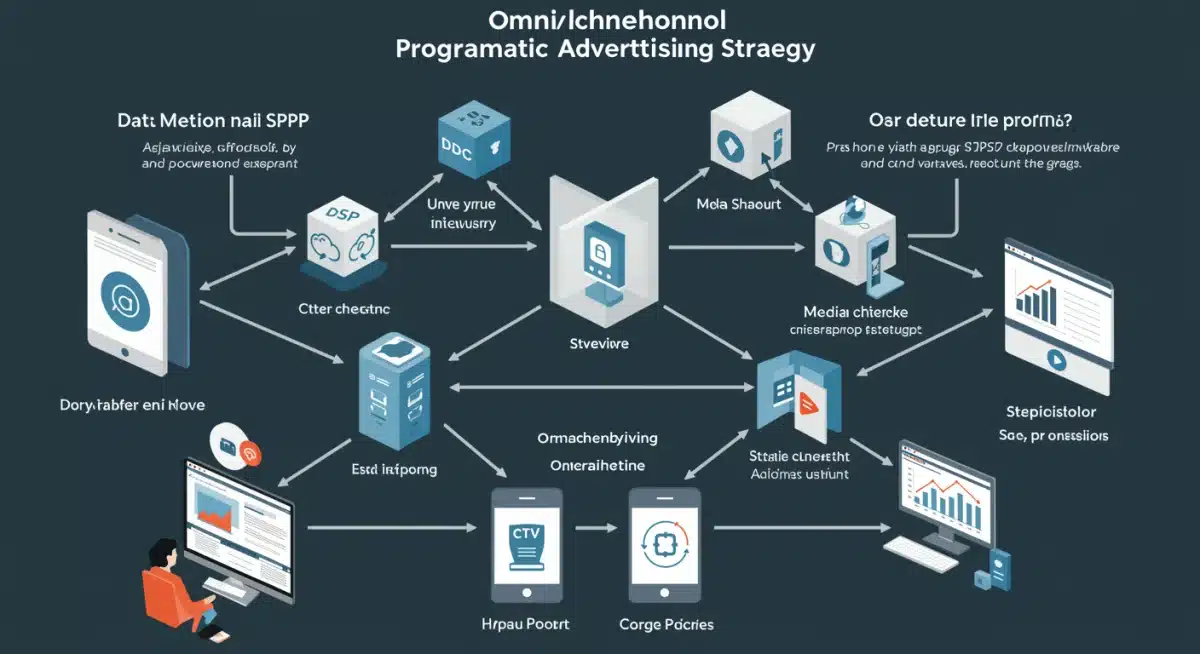
Seamless customer journeys across all touchpoints
Omnichannel programmatic activation involves coordinating ad delivery and messaging across various channels, including desktop, mobile, social media, audio, and out-of-home (OOH). The goal is to create a unified and consistent brand experience, regardless of where the consumer interacts with content.
This holistic approach ensures that each ad impression builds upon previous interactions, moving the consumer further down the conversion funnel. It requires robust data integration and a centralized platform for managing campaigns across diverse media types.
The pivotal role of Connected TV (CTV) in 2025
CTV has emerged as a powerhouse in the programmatic ecosystem. Its ability to combine the immersive experience of television with the targeting capabilities of digital is unparalleled. By 2025, CTV will be a non-negotiable component of any successful programmatic strategy in the U.S.
- Audience reach: Accessing a growing audience that is cutting the cord and consuming content via streaming services.
- Advanced targeting: Leveraging first-party data and third-party segments to deliver highly relevant ads to specific households.
- Measurable outcomes: Providing detailed impression, completion, and conversion metrics that traditional TV advertising lacks.
The convergence of omnichannel programmatic activation with the surging popularity of CTV will unlock new opportunities for brands to engage with their target audiences in highly personalized and impactful ways. This integrated strategy is essential for achieving a competitive edge in the U.S. market.
Enhanced privacy compliance and consumer trust
As the digital advertising landscape evolves, so too do consumer expectations and regulatory requirements regarding data privacy. In 2025, maintaining enhanced privacy compliance will not merely be a legal obligation but a strategic differentiator in programmatic advertising. Building and sustaining consumer trust through transparent data practices will be paramount for brands operating in the U.S. market.
Advertisers must proactively adapt to a world with stricter data governance, moving towards privacy-enhancing technologies and consent-driven data collection methods. This focus ensures not only compliance but also fosters a more positive brand image.
Navigating the evolving regulatory landscape
The U.S. is witnessing a patchwork of state-level privacy laws, such as CCPA, CPRA, and similar legislation in Virginia, Colorado, and Utah. Advertisers must implement robust systems to comply with these diverse regulations, which often have different requirements for data collection, usage, and consumer rights.
- Consent management platforms (CMPs): Implementing effective CMPs to capture, manage, and honor user consent preferences across all digital properties.
- Data mapping and inventory: Understanding where consumer data is stored, how it’s used, and who has access to it within the programmatic supply chain.
- Regular audits: Conducting frequent assessments of data practices to ensure ongoing compliance and identify potential vulnerabilities.
Building brand loyalty through transparent data practices
Beyond legal compliance, transparency in data practices is crucial for building and maintaining consumer trust. Brands that communicate clearly about their data usage and offer easily accessible privacy controls are more likely to foster loyalty and positive sentiment.
This involves simplifying privacy policies, providing clear opt-out mechanisms, and demonstrating a genuine commitment to protecting user data. In an environment where consumers are increasingly aware of their digital rights, trust becomes a valuable currency that can influence purchasing decisions and brand perception.
Prioritizing enhanced privacy compliance and actively working to build consumer trust will be a non-negotiable aspect of successful programmatic advertising in the U.S. by 2025. This strategy moves beyond mere adherence to regulations, positioning brands as responsible stewards of consumer data.
The integration of retail media networks
Retail media networks (RMNs) are rapidly emerging as a powerful force within the programmatic advertising ecosystem. By 2025, their integration will be a key strategy for brands seeking to leverage vast troves of first-party purchase data and reach consumers closer to the point of sale. This trend is particularly impactful in the U.S., where major retailers are investing heavily in their advertising platforms.
RMNs offer a unique opportunity to target shoppers based on their actual purchase history, both online and in-store, providing an invaluable layer of intent-driven targeting for programmatic campaigns.
Unlocking intent data from retail platforms
The primary advantage of RMNs lies in their rich first-party data, derived from transactional histories. This data provides deep insights into consumer preferences, brand loyalties, and purchasing patterns, which can be activated programmatically.
- Product-level targeting: Reaching consumers who have previously purchased specific products or categories, or those who have viewed them.
- Basket analysis: Identifying complementary products and cross-selling opportunities based on typical shopping cart contents.
- Loyalty program integration: Leveraging data from loyalty programs to offer personalized promotions and reinforce customer retention.
Expanding reach beyond retailer-owned properties
While RMNs primarily offer advertising placements on their own e-commerce sites and apps, many are expanding their programmatic capabilities to allow brands to activate their first-party data for off-site advertising. This means brands can use retail data to target audiences across the open web, social media, and even CTV.
This expansion transforms RMNs from closed ecosystems into powerful data providers that can fuel broader programmatic strategies. The ability to connect purchase intent data with general consumer behavior across various channels makes for a highly potent combination, especially in competitive U.S. markets.
The effective integration of retail media networks into programmatic advertising strategies will become a critical differentiator in 2025. Leveraging their unique first-party data for both on-site and off-site targeting will enable brands to achieve unprecedented levels of personalization and drive measurable sales growth.
Sustainability and ethical considerations in ad tech
Beyond performance metrics and technological advancements, the programmatic advertising industry in 2025 will face increasing scrutiny regarding its environmental footprint and ethical implications. Brands and platforms operating in the U.S. market will need to prioritize sustainability and ethical considerations, not just as a matter of corporate social responsibility, but as a growing expectation from consumers and regulators alike.
The energy consumption of ad tech infrastructure and the potential for algorithmic bias are issues that demand proactive solutions. Addressing these concerns will contribute to a more responsible and resilient advertising ecosystem.
Addressing the environmental impact of ad tech
The vast infrastructure required for programmatic advertising – data centers, servers, and network transmissions – consumes significant amounts of energy. As environmental awareness grows, brands will be expected to partner with ad tech vendors committed to reducing their carbon footprint.
- Green ad delivery: Opting for platforms that prioritize energy-efficient data centers and optimize ad delivery to reduce unnecessary impressions.
- Supply chain transparency: Demanding greater visibility into the energy consumption of various partners within the programmatic supply chain.
- Sustainable creative production: Encouraging the creation of lighter, more efficient ad formats that require less bandwidth and processing power.
Ethical AI and algorithmic bias mitigation
The increasing reliance on AI in programmatic advertising raises concerns about algorithmic bias, where historical data can inadvertently perpetuate or amplify societal biases. Ensuring ethical AI development and deployment is crucial to prevent discriminatory targeting or unfair ad distribution.
Advertisers must work with ad tech partners who are committed to auditing their algorithms for bias, promoting diversity in data sets, and implementing safeguards to ensure equitable ad delivery. This includes adhering to fair housing, employment, and credit advertising laws.
Embracing sustainability and ethical considerations will become an integral part of programmatic advertising strategies in 2025. Brands that demonstrate a commitment to these values will not only mitigate risks but also enhance their reputation and appeal to an increasingly conscious consumer base in the U.S. market.
| Key Strategy | Brief Description |
|---|---|
| First-Party Data & Clean Rooms | Utilizing owned customer data securely for precise targeting amidst privacy shifts. |
| AI Optimization & Predictive Analytics | AI-driven real-time adjustments and future forecasting for maximum campaign efficiency. |
| Omnichannel & CTV Dominance | Seamless ad experiences across devices, with Connected TV as a key growth channel. |
| Retail Media Networks Integration | Leveraging retailer’s first-party purchase data for highly targeted programmatic campaigns. |
Frequently asked questions about programmatic advertising in 2025
The biggest challenge will be adapting to a cookieless future and navigating the complex, evolving landscape of data privacy regulations across various U.S. states. Advertisers must master first-party data activation and secure data clean rooms to maintain effective targeting.
AI will revolutionize programmatic ad buying by enabling real-time optimization of bids, creative elements, and placements. It will also power predictive analytics for audience forecasting and proactive campaign adjustments, leading to unprecedented efficiency and ROI.
CTV is crucial because it combines the immersive experience of television with digital’s precise targeting and measurement capabilities. It reaches a growing audience of cord-cutters, offering advanced audience segments and measurable outcomes that traditional TV cannot.
Data clean rooms are secure, neutral environments allowing multiple parties to analyze aggregated data without sharing raw PII. They are essential for privacy-compliant data collaboration, enabling sophisticated targeting and measurement in a privacy-first world.
Brands can build consumer trust through transparent data practices, clear communication about data usage, and easily accessible privacy controls. Adhering to ethical AI principles and partnering with sustainable ad tech vendors also reinforces a positive brand image.
Conclusion
The programmatic advertising landscape in the U.S. is poised for significant transformation by 2025. Success will hinge on a proactive embrace of innovative strategies that prioritize data privacy, leverage advanced AI, and unify experiences across diverse channels, especially CTV. Brands that master first-party data activation within secure clean rooms, harness AI for dynamic optimization and predictive insights, and effectively integrate omnichannel approaches will not only navigate the evolving market but will also set new benchmarks for performance. Moreover, a commitment to ethical considerations and sustainability will deepen consumer trust, solidifying long-term brand loyalty in an increasingly complex digital ecosystem. The future of programmatic advertising is intelligent, integrated, and inherently privacy-conscious.