CTV Ad Spending to Surge 40% by 2025: Analysis & Updates

Connected TV (CTV) advertising is projected to experience a substantial 40% increase in spend by late 2025, driven by evolving viewer habits and advanced targeting capabilities.
The landscape of media consumption is rapidly shifting, and with it, the strategies advertisers employ to reach their target audiences. Nowhere is this more evident than in the realm of Connected TV (CTV) advertising, which is on the cusp of an unprecedented expansion. Industry analysts and market reports consistently point towards a significant upswing, with projections indicating a remarkable CTV advertising forecast of a 40% spend increase by late 2025. This isn’t merely a trend; it represents a fundamental recalibration of advertising budgets and a testament to CTV’s growing efficacy.
Understanding the CTV Advertising Phenomenon
Connected TV (CTV) refers to any television that can be connected to the internet and access content beyond traditional broadcast or cable, encompassing smart TVs, gaming consoles, and streaming devices. The rise of CTV advertising marks a pivotal moment in the advertising industry, offering advertisers a potent blend of television’s broad reach with digital’s precision targeting and measurement capabilities. This convergence is reshaping how brands engage with consumers, moving away from the broad strokes of linear television towards more personalized and data-driven approaches.
The allure of CTV lies in its ability to offer a premium, full-screen viewing experience, similar to traditional TV, but with the added benefits of digital advertising technology. This includes advanced audience segmentation, real-time bidding, and comprehensive attribution models. As more households cut the cord and shift to streaming services, advertisers are following suit, recognizing the immense potential to connect with engaged viewers in a measurable way. This transition is not just about where people watch content, but how advertisers can optimize their spend for maximum impact.
Key Drivers of CTV Growth
- Audience Migration: A mass exodus from traditional linear TV to streaming platforms.
- Enhanced Targeting: The ability to reach specific demographics and psychographics with unparalleled accuracy.
- Improved Measurement: Digital-like metrics provide clearer ROI and campaign optimization.
- Premium Content: High-quality, engaging content across diverse streaming services attracts viewers and advertisers alike.
In essence, CTV advertising is bridging the gap between the emotional impact of television commercials and the analytical rigor of digital campaigns. This hybrid model is proving irresistible to marketers seeking both brand awareness and performance outcomes, laying a strong foundation for the projected spend increase.
Recent Updates and Market Dynamics
The CTV advertising landscape is dynamic, with constant innovations and shifts influencing its trajectory. Recent updates highlight a maturing ecosystem, characterized by increased platform interoperability, enhanced data privacy measures, and the emergence of new ad formats. Programmatic CTV, in particular, is gaining significant traction, allowing for automated, data-driven ad placements that optimize reach and frequency across diverse streaming environments.
One notable development is the growing emphasis on first-party data integration. As third-party cookies face obsolescence, advertisers are leveraging their own customer data to inform CTV campaigns, leading to more relevant and effective ad experiences. Furthermore, the expansion of shoppable TV ads and interactive formats indicates a move towards more engaging and direct-response-oriented CTV advertising, blurring the lines between content consumption and commerce.
Technological Advancements Fueling Expansion
- Programmatic Evolution: More sophisticated algorithms and AI-driven optimization for ad placement.
- Data Privacy Solutions: Development of privacy-centric targeting methods and measurement frameworks.
- Interactive Ad Formats: Innovations like shoppable ads and personalized calls-to-action.
- Cross-Platform Integration: Improved capabilities for managing campaigns across multiple CTV devices and publishers.
These technological advancements, coupled with a growing understanding of viewer behavior on CTV platforms, are providing advertisers with a robust toolkit to maximize their investment. The continuous evolution of ad tech in this space ensures that CTV remains at the forefront of digital advertising innovation, justifying the anticipated surge in spending.
Comparison: CTV vs. Traditional Linear TV Advertising
While traditional linear TV advertising has long been the gold standard for mass reach and brand building, CTV advertising offers distinct advantages that are increasingly appealing to modern marketers. The most significant differentiator lies in targeting precision. Linear TV buys typically rely on broad demographic data and viewership patterns, often leading to wasted impressions. CTV, conversely, leverages digital data – including viewing habits, demographics, interests, and even purchase intent – to deliver highly relevant ads to specific households or individuals.
Measurement and attribution also present a stark contrast. Linear TV measurement often involves panel-based data and extrapolated reach, making it challenging to link ad exposure directly to business outcomes. CTV, being a digital medium, provides granular analytics on impressions, completed views, engagement rates, and even conversions, offering a clearer picture of campaign performance and ROI. This digital-first approach to measurement allows for real-time optimization and more efficient budget allocation.
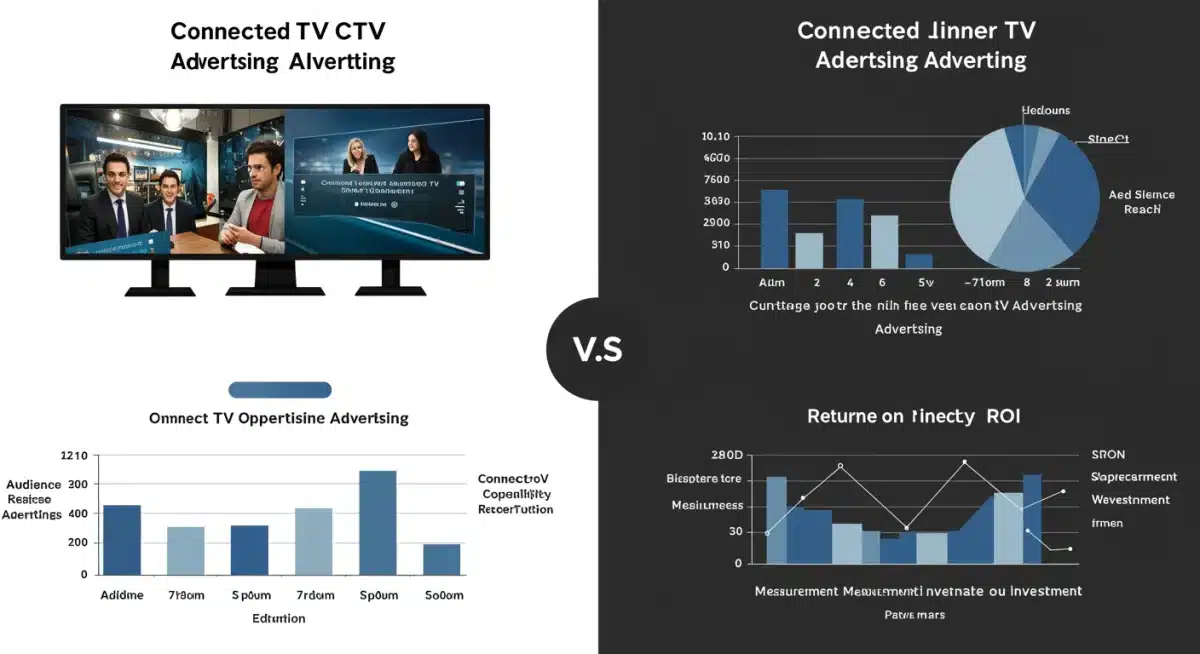
Furthermore, the flexibility of CTV ad buying stands in contrast to the often rigid and long-term commitments of linear TV. Advertisers can execute programmatic buys, adjust campaigns mid-flight, and experiment with different creative strategies more easily on CTV. This agility is crucial in today’s fast-paced market, allowing brands to respond quickly to market changes and optimize their messaging for immediate impact. The shift towards CTV is not merely a replacement but an evolution, offering a more intelligent and adaptable advertising solution.
Analyzing the Predicted 40% Spend Increase
The projection of a 40% increase in CTV ad spend by late 2025 is not an arbitrary figure; it’s a reflection of several converging factors. Firstly, the ongoing shift in consumer viewing habits is undeniable. With the proliferation of streaming services and the increasing affordability of smart TVs, more households are primarily consuming content via CTV. Advertisers naturally follow eyeballs, and the sheer volume of engaged CTV viewers makes it an indispensable channel.
Secondly, the performance metrics associated with CTV advertising are increasingly compelling. Brands are seeing higher completion rates for video ads, better engagement, and stronger attribution data compared to other digital video formats. This demonstrable effectiveness provides a strong incentive for increasing investment. As marketers become more sophisticated in their use of data and programmatic tools within the CTV ecosystem, the efficiency and ROI of their campaigns continue to improve, justifying larger budgets.
Finally, the maturation of the CTV advertising infrastructure plays a critical role. Improved supply-side platforms (SSPs), demand-side platforms (DSPs), and measurement solutions are making it easier for advertisers to plan, execute, and evaluate CTV campaigns at scale. This infrastructure development reduces friction and increases confidence among advertisers, paving the way for substantial growth. The 40% surge represents a strategic re-prioritization of ad dollars towards a channel that delivers both reach and measurable results.
Challenges and Opportunities in the CTV Landscape
Despite the promising growth trajectory, the CTV advertising landscape is not without its challenges. Fragmentation across numerous streaming services and devices can make audience reach and frequency capping complex. Measurement standardization also remains an ongoing challenge, with various platforms offering different metrics and reporting capabilities. Ad fraud, though less prevalent than in other digital video, is another concern that requires continuous vigilance and technological solutions.
Navigating the Complexities
- Audience Fragmentation: Developing strategies to reach audiences across a diverse range of streaming platforms.
- Measurement Discrepancies: Working towards unified measurement standards and cross-platform attribution models.
- Ad Fraud Prevention: Implementing robust verification tools and partnering with trusted platforms.
- Creative Optimization: Adapting ad creatives for the unique viewing context of CTV to maximize engagement.
However, these challenges also present significant opportunities for innovation. The demand for unified measurement solutions is driving new partnerships and technological advancements that will ultimately benefit the entire ecosystem. The need for sophisticated fraud detection creates opportunities for ad tech providers to develop cutting-edge security measures. Furthermore, the push for more engaging and interactive ad formats encourages creative experimentation, leading to richer and more impactful advertising experiences for consumers. Overcoming these hurdles will further solidify CTV’s position as a dominant advertising channel.
Strategies for Maximizing CTV Ad Performance
To fully capitalize on the projected growth in CTV advertising, marketers must adopt strategic approaches that leverage the unique capabilities of the channel. A key strategy involves sophisticated audience segmentation. Moving beyond basic demographics, advertisers should utilize first-party data, CRM data, and third-party data to create highly granular audience segments. This allows for hyper-targeted campaigns that resonate deeply with specific viewer groups, improving relevance and reducing wasted impressions.
Creative optimization is another critical component. CTV ads are consumed in a lean-back, immersive environment, similar to traditional TV. Therefore, creatives should be high-quality, engaging, and tell a compelling story. Experimenting with different ad lengths, calls-to-action, and interactive elements can significantly boost performance. A/B testing various creative versions and continually refining them based on performance data is essential for maximizing impact.
Furthermore, integrating CTV campaigns with other digital channels creates a powerful omnichannel strategy. By using CTV for brand awareness and upper-funnel initiatives, and then retargeting those exposed audiences on social media or search platforms, advertisers can guide consumers through the entire sales funnel. Robust measurement and attribution models that track the customer journey across multiple touchpoints are crucial for understanding the true impact of CTV on overall marketing objectives.
Best Practices for Effective CTV Campaigns
- Advanced Audience Segmentation: Utilize rich data to create precise target groups.
- High-Quality Creative: Produce engaging, story-driven video ads optimized for the big screen.
- Cross-Channel Integration: Harmonize CTV with other digital channels for a unified customer journey.
- Continuous Measurement & Optimization: Leverage real-time data to refine targeting, bidding, and creative.
By focusing on these strategic pillars, advertisers can not only participate in the CTV growth but also lead the way in demonstrating its full potential as a highly effective and measurable advertising medium. The future of advertising is undeniably connected, and those who master CTV will be well-positioned for success.
| Key Point | Brief Description |
|---|---|
| Projected Growth | CTV ad spend is forecast to increase by 40% by late 2025, reflecting significant market confidence. |
| Key Drivers | Audience migration, advanced targeting, and superior measurement capabilities are fueling CTV expansion. |
| CTV vs. Linear TV | CTV offers precise targeting, granular measurement, and greater flexibility compared to traditional linear TV. |
| Maximizing Performance | Sophisticated audience segmentation, creative optimization, and cross-channel integration are crucial. |
Frequently Asked Questions About CTV Advertising
The projected increase is driven by a combination of factors, including the continued shift of viewers from traditional TV to streaming platforms, the enhanced targeting capabilities of CTV, and the superior measurement and attribution models it offers compared to linear TV.
CTV advertising leverages digital data for precise audience targeting and provides granular, real-time performance metrics. Traditional linear TV relies on broader demographic targeting and panel-based measurement, offering less flexibility and detailed attribution.
Key challenges include audience fragmentation across numerous streaming services, inconsistencies in measurement and reporting standards, and the persistent need to combat ad fraud. Overcoming these requires robust technology and strategic planning.
To maximize performance, advertisers should focus on advanced audience segmentation, creating high-quality and engaging ad creatives, integrating CTV campaigns with other digital channels, and continuously optimizing based on real-time performance data and analytics.
While CTV is rapidly growing and capturing a larger share of ad budgets, it’s more likely to complement rather than entirely replace linear TV in the near future. Linear TV still offers broad reach for certain demographics, but CTV provides the precision and measurability modern advertisers demand.
Conclusion
The trajectory of Connected TV advertising is undeniably upward, with a predicted 40% spend increase by late 2025 signaling a significant shift in the advertising ecosystem. This growth is not merely a reflection of evolving consumer habits but also a testament to CTV’s inherent advantages: precise targeting, superior measurement, and unparalleled flexibility. While challenges such as fragmentation and measurement standardization persist, the opportunities for innovation and strategic execution are immense. Advertisers who embrace CTV’s unique capabilities, focusing on data-driven strategies and compelling creative, will be best positioned to harness its full potential, driving both brand awareness and measurable business outcomes in the years to come.